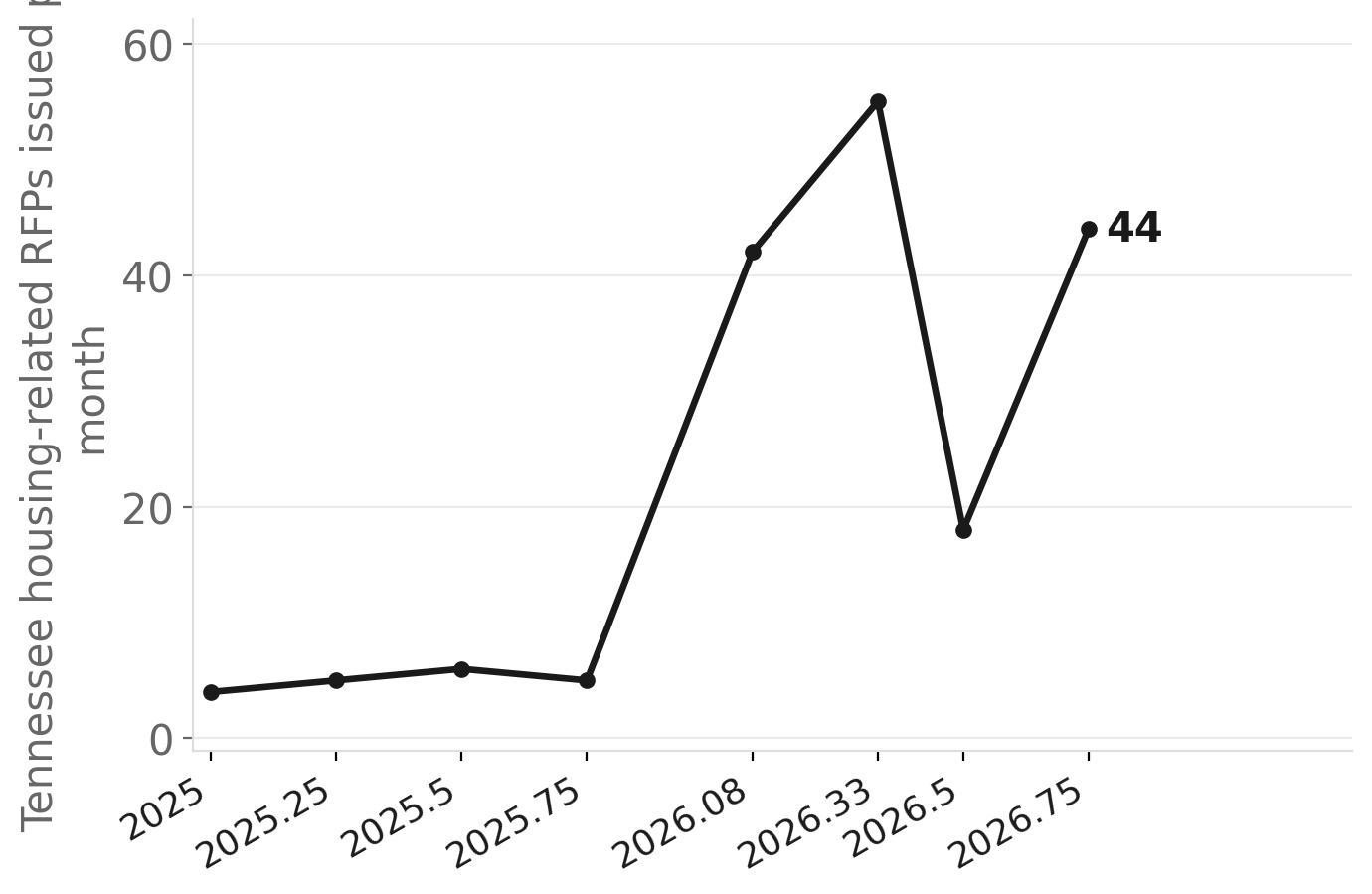
Tennessee housing agencies issued roughly 44 procurement notices in the last 30 days, against a trailing 12-month average of about 18 per month. That 147 percent surge is not a Nashville story. It is coming disproportionately from places like Lewisburg, Fayetteville, and South Pittsburg, small housing authorities that rarely make the state housing policy conversation and are now scrambling to spend money they have waited years to receive.
What makes October's spike qualitatively different from earlier 2026 peaks is who is doing the issuing. Housing authorities account for 11 of the 43 verifiable October RFPs, and cities and towns for another 15, the highest combined share of bona fide housing-sector issuers of any month this year. That composition signals something real: this is not procurement noise from industrial "pump housings" or fire stations inflating the count. The agencies writing these notices are the ones whose entire institutional reason for existence is putting roofs over people's heads.
The proximate cause is a collision of deadlines. Five distinct state and federal funding instruments are releasing dollars in the same procurement window, and each has its own clock.
Source: NationGraph.
The most visible is the $20 million Community Workforce Housing Innovation Pilot Program (HB 2509/SB 2410), a state loan fund signed into law in 2026 and administered by the Tennessee Housing Development Agency. It targets areas where the gap between median income and home sale prices is widest and reserves half of assisted units for essential services workers. Separately, the Essential Governmental Employee Housing Act (HB 1796) authorizes Williamson County, Franklin, and Brentwood to partner with private developers on housing for government employees, a narrow but telling sign that even Tennessee's wealthiest suburban jurisdictions are feeling the supply squeeze. A third 2026 measure, HB 753, lets cities and counties adopt local ordinances reducing property tax assessments on Low-Income Housing Tax Credit developments, lowering the operating cost burden on LIHTC projects that THDA has already been financing: THDA awarded more than $25 million in federal 9% credits in 2025, a pipeline expected to generate $250 million in equity over a decade.
Those three state-level tools sit alongside two federal streams that are also actively open. THDA's HOME Investment Partnerships Program, federal block grant money that THDA distributes competitively to local grantees, has a 2026 NOFA currently open, with individual awards running $1 million to $1.5 million per cycle. The agency's Tennessee Housing Trust Fund Competitive Grants program, funded not by direct appropriation but by profits from THDA's own mortgage products, is also active: THDA awarded a $600,000 Trust Fund grant to the Southeastern Housing Foundation in September 2026 for Knoxville rehabilitation, a signal that disbursements are flowing and triggering downstream procurement. On top of all that, HUD Capital Fund grants are running at scale across the state, Chattanooga Housing Authority alone carries $121 million in active federal housing grants, with Tennessee's Economic and Community Development office holding another $114 million.
None of these five instruments is the same program doing the same thing. The state loan fund builds workforce supply at middle incomes. The Trust Fund targets nonprofit rehabilitation at the low end. HOME moves federal dollars through THDA to local homeownership and rental projects. The Capital Fund goes directly to housing authorities for public housing infrastructure. And HB 753 is a tax policy change, not a spending vehicle at all. They are not a coordinated initiative; they are five separate tools that happen to be releasing obligations in the same fall window, and local agencies are trying to respond to all of them at once.
The agencies doing the most issuing are not the big-city authorities. Jackson Housing Authority has put out four RFPs this month. Lewisburg and Bristol Community Development have each issued three. Franklin, Murfreesboro, Fayetteville, and South Pittsburg Housing Authorities are all active. These are organizations built for lighter procurement loads, and Enterprise Community Partners has noted that post-pandemic population growth has pushed home prices beyond median incomes across Tennessee metros, adding structural urgency to what might otherwise have been a manageable administrative adjustment.
For residents in those communities, the near-term question is capacity: whether small housing authorities can turn these procurement notices into signed contracts, completed designs, and eventually built units before grant cycles close and unspent funds revert. The state's 95-county patchwork of housing authorities and regional development districts was not designed for simultaneous statewide activation.
The next signal to watch is THDA's HOME application deadline this fall and whether the Community Workforce Housing Innovation Pilot Program loan fund releases its first commitments before the end of the calendar year. If small agencies miss those windows, the 2026 legislative session's ambitions could show up as a procurement spike that didn't convert into housing.