Ten Colorado institutions issued 14 stormwater-related RFPs in the past 30 days, roughly double the monthly baseline of five or six, and seven of those institutions had not issued a stormwater RFP in more than a year. The procurement surge is concentrated around a single regulatory clock: CDPHE's once-a-decade MS4 general permit renewal, which completed a six-meeting stakeholder engagement cycle in May 2026 and is now approaching draft publication for public comment. Towns that cannot demonstrate they know what is in their stormwater systems, and how those systems perform, cannot certify compliance under new permit terms.
The urgency is not hypothetical. Denver's individual MS4 permit expired March 31, 2026. Aurora and Lakewood have been operating on administrative extensions since 2014, meaning Colorado's second- and third-largest cities have been running on a twelve-year-old regulatory framework. All three now face the new permit cycle without current approvals in hand.
The RFPs being issued now are the paper trail of a state trying to get current before new terms lock in. Denver solicited engineering services for green infrastructure stormwater inlets. The City of Thornton posted an on-call civil and pipeline engineering contract. CSU-Fort Collins moved on a stormwater pump station procurement. CDPHE itself entered the market with a Clean Watershed Needs Survey RFP, designed to collect capital infrastructure data that feeds EPA's national database and, ultimately, shapes how Clean Water State Revolving Fund allocations flow back to Colorado communities. When the regulator issues a procurement to count what the state owns and owes, it signals how seriously the agency is treating the compliance gap.
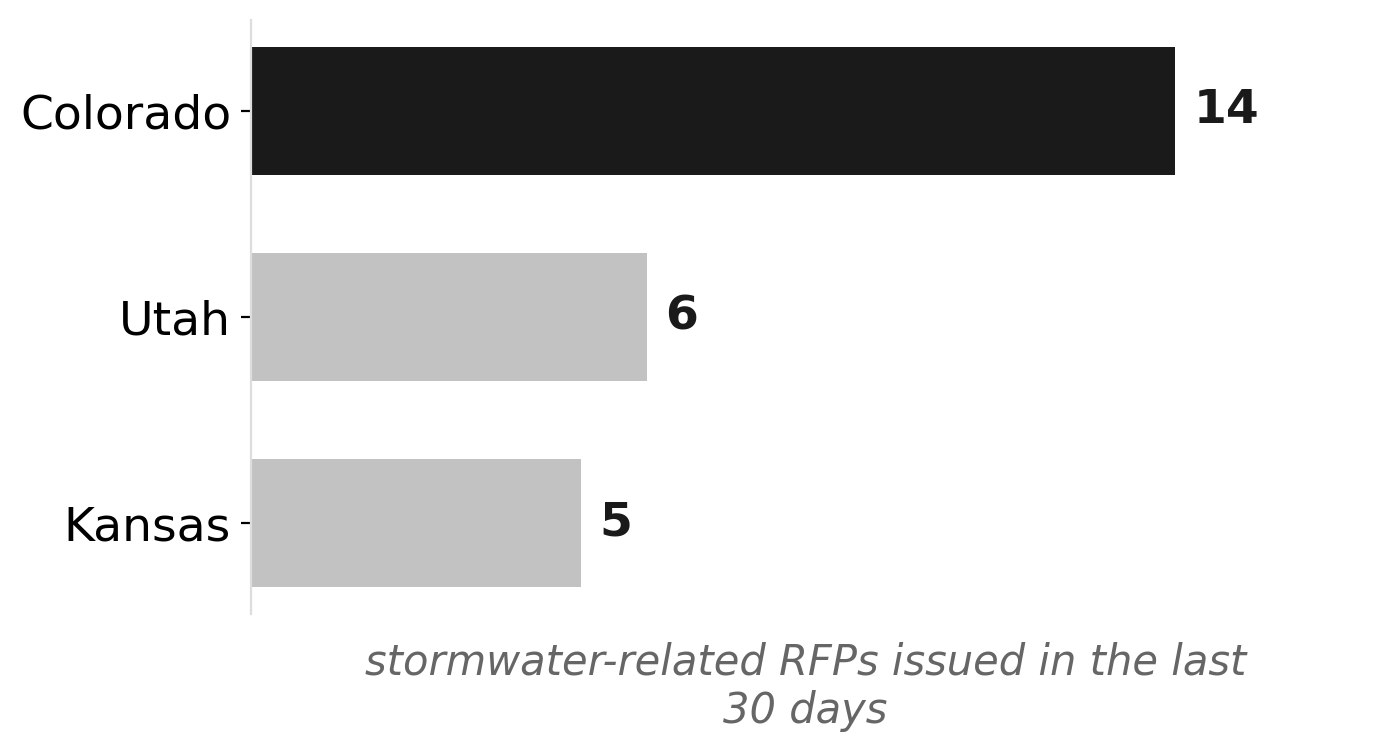
Source: NationGraph.
Colorado's activity is not matched elsewhere in the region. Utah and Kansas, the next closest states, logged six and five stormwater RFPs respectively in the same window. Colorado's fourteen suggest something specific to the state's regulatory calendar, not a general uptick in infrastructure spending.
A second, parallel driver is operating alongside the permit renewal, and the two should not be conflated. More than $24 million in USDA Emergency Watershed Protection Program grants has flowed to Colorado communities since late 2024, concentrated in fire-affected rural counties including Rio Blanco, Ridgway, Pagosa Springs, and Archuleta. These grants fund emergency stabilization of watersheds damaged by wildfire, and they carry their own procurement requirements. The Town of Grand Lake's RFP for Little Columbine Creek restoration and the Town of Frederick's Godding Hollow floodplain study are consistent with communities working through post-disaster recovery money, not MS4 compliance pressure. Both towns are issuing stormwater RFPs, but for fundamentally different reasons than Denver or Thornton.
The distinction matters for anyone reading the procurement calendar as a signal. The urban and institutional RFPs, Denver's inlet engineering, Thornton's on-call pipeline contract, CSU's pump station, are driven by regulatory deadline. The rural creek and floodplain studies are driven by disaster recovery funding with its own expenditure timelines. Colorado's stormwater procurement moment is unusually concentrated because both forces arrived in the same window.
Colorado's layered permitting structure amplifies the pressure. CDPHE administers a statewide MS4 general permit, a separate Cherry Creek Basin MS4 permit, a non-standard MS4 permit covering universities and military installations, and individual large-city permits for Denver, Aurora, Lakewood, and Colorado Springs. Renewal pressure is running across multiple permit tracks simultaneously, which is why the procurement surge spans a university, a state environmental agency, mountain towns, and Front Range cities in the same thirty-day window.
For residents, the near-term consequence is engineering contracts, not finished infrastructure. The RFPs being issued now will produce assessments, models, and management plans, the documentation that municipalities need to certify compliance before new permit terms are finalized. Construction spending, if triggered, comes later. The more immediate question is whether cities operating on expired or decade-old permits can move through procurement, assessment, and plan approval quickly enough to be in good standing when CDPHE's draft permit opens for public comment.
The May 2026 stakeholder engagement cycle closed. The draft permit is the next formal milestone. Towns that have not started their assessments are already behind the timeline that ends there.