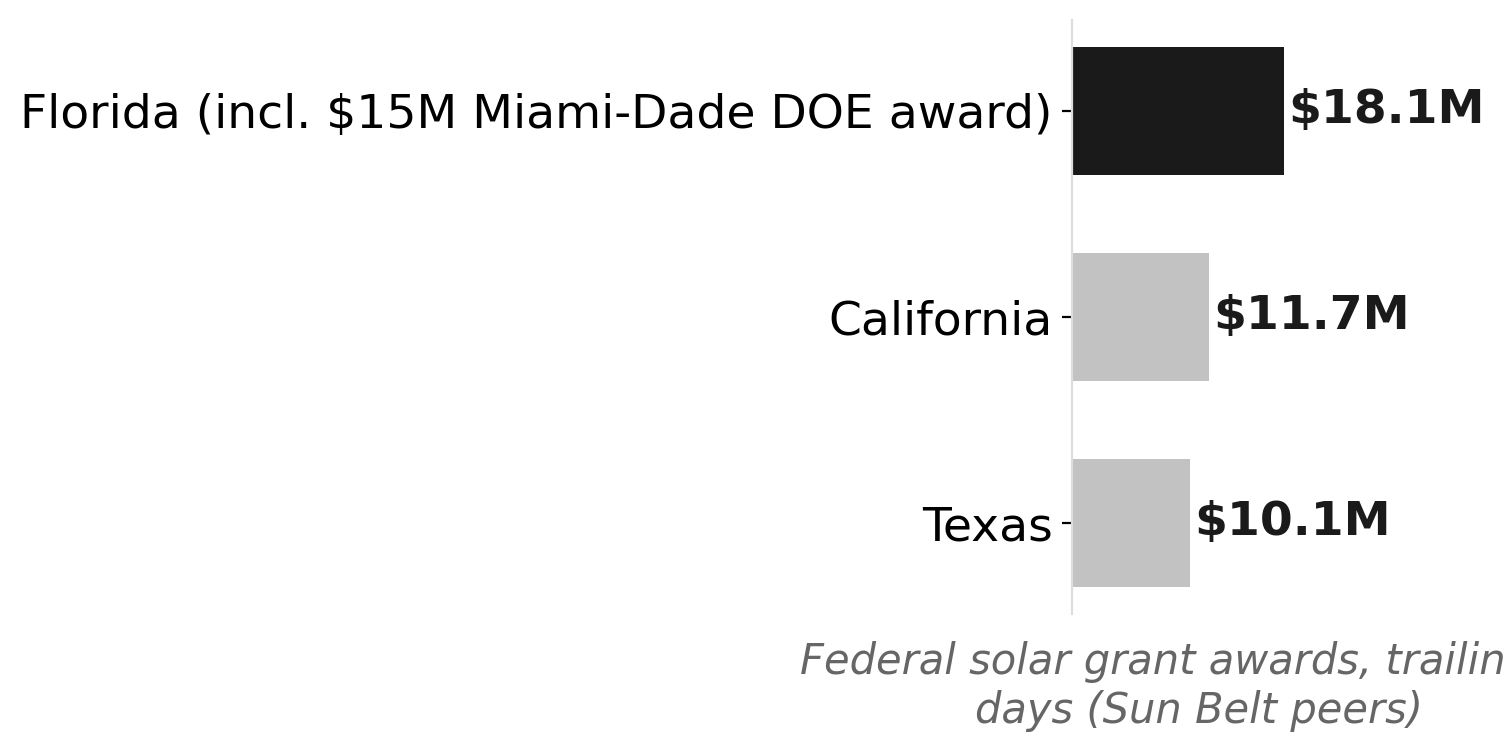
Florida received $18.1 million in new federal solar grants in the trailing 90 days, up 79% from $10.1 million in the same window a year ago, and almost all of it arrived in a single wire transfer that the state government in Tallahassee had no legal mechanism to intercept.
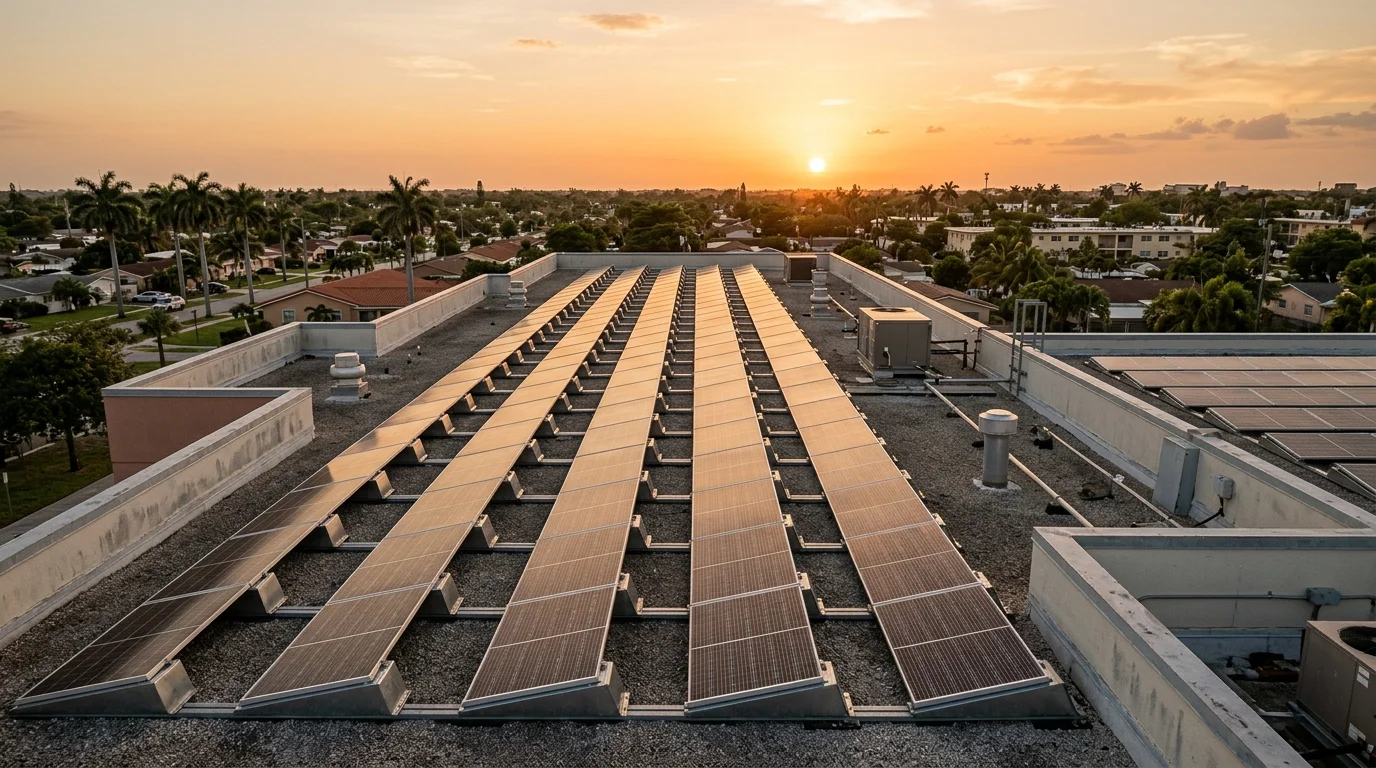
The number doing the work is a $15 million cooperative agreement from the U.S. Department of Energy to Miami-Dade County Public Schools, which entered its active period on October 1, 2026. It is the largest federal solar-school award in Florida's history, and it funds rooftop solar installation and energy-efficiency retrofits across 74 buildings on 10 Title I campuses, serving roughly 7,460 students. Three of those campuses double as designated emergency shelters.
The source is the DOE's Renew America's Schools Program, authorized under Section 40541 of the Bipartisan Infrastructure Law. The program's architecture is the key detail: money flows directly from DOE's Office of State and Community Energy Programs to local educational agencies. State energy offices are not intermediaries. State governors are not signatories. The cooperative agreement is between the federal government and a school board.
Source: NationGraph.
That structure matters acutely in Florida. Governor Ron DeSantis directed state agencies in 2024 to return IRA-allocated HEAR and HOMES rebate funds and declined to apply for the IRA's Solar for All program. Those programs are administered through state governments, so Florida's posture effectively locked residents out of them. The Renew America's Schools Program operates under entirely different statutory authority, BIL, not the IRA, and was specifically engineered to lower barriers by removing state intermediaries from the funding chain. The DeSantis administration's IRA posture carries no legal weight over a BIL cooperative agreement signed between DOE and a school district.
The distinction is not a technicality. It is the whole story. Two federal clean-energy funding regimes are running simultaneously in Florida: one that requires state acceptance and has been declined, and one that requires only a qualifying local applicant and cannot be declined on the state's behalf. Miami-Dade, with more than 350,000 students and one of the largest Title I footprints of any district in the country, is built to absorb the second kind.
M-DCPS is the only Florida school district among the 16 national selectees for Round 2 of the Renew America's Schools program, and it carries the largest building scope of any selectee nationwide. According to the DOE's program announcement, the agency has now invested $372.5 million total in public school districts across the country, covering roughly 410 facilities in 36 states. The $190 million Round 2 cohort includes districts from states across the political spectrum; the common denominator is a qualifying application, not a cooperative governor.
The solar activity in Miami-Dade is not limited to the schools award. In April 2026, Miami-Dade County signed an energy-savings contract with Ameresco for rooftop solar and LED retrofits at county courthouse facilities, a separate, locally initiated project that required no federal grant at all. The two efforts are legally distinct but collectively signal that local government in South Florida is moving on solar at a pace the state has not matched.
The remaining roughly $3 million in Florida's 90-day solar grant intake comes from NSF awards to the University of Florida for solar-materials research, steady baseline funding that predates the current surge and is unrelated to the schools program.
On the Sun Belt comparison, Florida's 90-day solar grant total now leads California ($11.7 million) and Texas ($10.1 million) among peer states for this window, entirely because of the M-DCPS award. That ranking will not hold once the cooperative agreement stops generating new obligations, but it illustrates how a single large direct-to-LEA award can shift a state's federal funding posture independent of anything happening in its capital.
For residents and school administrators watching this space, the next signal to track is implementation: the M-DCPS cooperative agreement runs through March 31, 2028, meaning solar installations across those 74 buildings must be completed and verified within roughly 18 months. DOE's prize-to-cooperative-agreement structure includes performance milestones, and the district's ability to execute at scale, across 10 campuses simultaneously, in a dense urban district, will influence how DOE structures future rounds and which districts it considers credible applicants. A third round of Renew America's Schools has not been announced, but the program's $500 million BIL authorization has not been fully obligated.