Ohio's universities pulled in $12.36 million in newly started federal artificial intelligence grants between July and September 2026, more than double the $5.54 million they received in the same window a year ago. That 123% jump is not a one-time spike. It is the latest installment in a compounding relay: those dollars are landing on top of $155.8 million in AI grants already running across 101 active awards in the state, and another major federal solicitation closes in November.
Two distinct federal programs are driving the surge, and they are doing different things through different agencies. The first is NIH's Bridge to Artificial Intelligence program, known as Bridge2AI, a Common Fund initiative that committed $130 million over four years to building AI-ready biomedical and behavioral datasets. Bridge2AI was approved for its second stage in January 2026, shifting its mission from creating datasets to deploying them as clinical-grade tools. Cleveland Clinic and Case Western Reserve University are established nodes in that network, and the payoff showed up this quarter: a $4.83 million HHS/Trans-NIH award to the Cleveland Clinic Lerner College of Medicine at Case Western, running through September 2027, is the single largest new AI grant Ohio received in the period.
The second stream runs through the National Science Foundation, which has explicitly named artificial intelligence its clearest funding priority for 2026. NSF's contribution this quarter was broader but smaller per grant: 16 awards totaling $5.5 million, spread across Ohio State, Case Western, and smaller institutions including Cleveland State, Cincinnati, Kent State, and Kenyon College. Ohio State alone collected five separate NSF and DOE awards totaling roughly $2.8 million, spanning computer science, geosciences, engineering, and a $600,000 Department of Energy Office of Science grant.
Source: NationGraph.
These two streams fund different actors doing different work. Bridge2AI money flows into medical centers and targets clinical data infrastructure. NSF's grants flow into engineering schools and computer science departments and target foundational computational research. Treating them as a single federal AI program would miss the structural reason Ohio is performing well: the state has institutions anchored in both pipelines simultaneously.
Ohio State's position in the NSF pipeline is particularly concentrated. The university serves as lead institution for three separate NSF National AI Research Institutes: ICICLE, focused on cyberinfrastructure; AI-EDGE, focused on distributed edge networks; and Imageomics, focused on biological image analysis. As Ohio State has noted, hosting two NSF AI institutes simultaneously is unusual for a single campus, and the ICICLE and AI-EDGE awards, each up to $20 million over five years, are generating ongoing disbursements that inflate the baseline even before new FY2026 cohorts arrive.
The result is a geographic bifurcation that gives Ohio a wider thematic footprint than most peer states. Cleveland runs the biomedical AI work through the Clinic and Case Western. Columbus runs the systems, network, and infrastructure AI work through Ohio State. These are not the same research community or the same federal funding channel, and that diversification insulates Ohio from a policy shift that might favor one agency over the other.
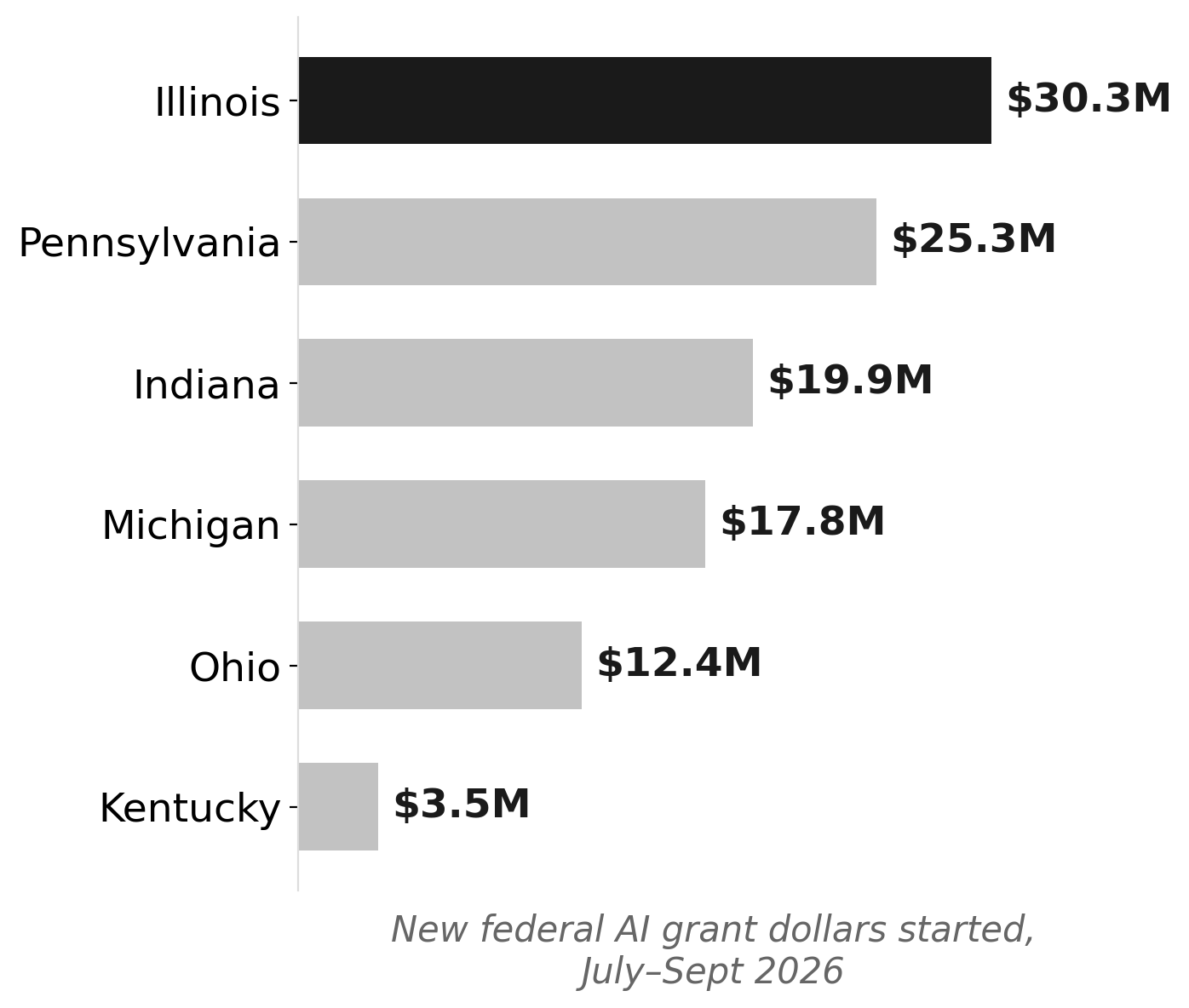
In the Midwest comparison, Ohio's position is solid but not dominant. Illinois led the same 90-day window at $30.3 million across 40 grants, followed by Pennsylvania at $25.3 million and Indiana at $19.9 million. Ohio's $12.4 million placed it fourth among the six states tracked, ahead of Michigan ($17.8 million) and comfortably ahead of Kentucky ($3.5 million). The gap between Ohio and Illinois is large enough to suggest that Ohio's surge reflects growth from a lower base, not a saturation dynamic where every major grant has already been captured.
The next inflection point comes November 4, 2026. That is the deadline for State and Territory Coordination Hub proposals under NSF's TechAccess: AI-Ready America program (NSF 26-513), a new initiative designed to build statewide AI workforce and adoption infrastructure. Ohio's research universities are eligible, and the existing grant infrastructure gives them credible institutional standing for a competitive proposal. If Ohio lands a TechAccess hub award, it would mark the third distinct federal AI program routing dollars through the state, shifting the portfolio from research-only toward workforce and industry adoption.
For residents and policymakers, the practical question is whether the research concentration in Cleveland and Columbus eventually translates into applied capacity elsewhere in the state. That connection is not guaranteed by the grants themselves, which fund university laboratories and research personnel rather than employer training programs or regional technology deployment. TechAccess, if Ohio competes for and wins it, is the first program in the current wave explicitly designed to make that translation.