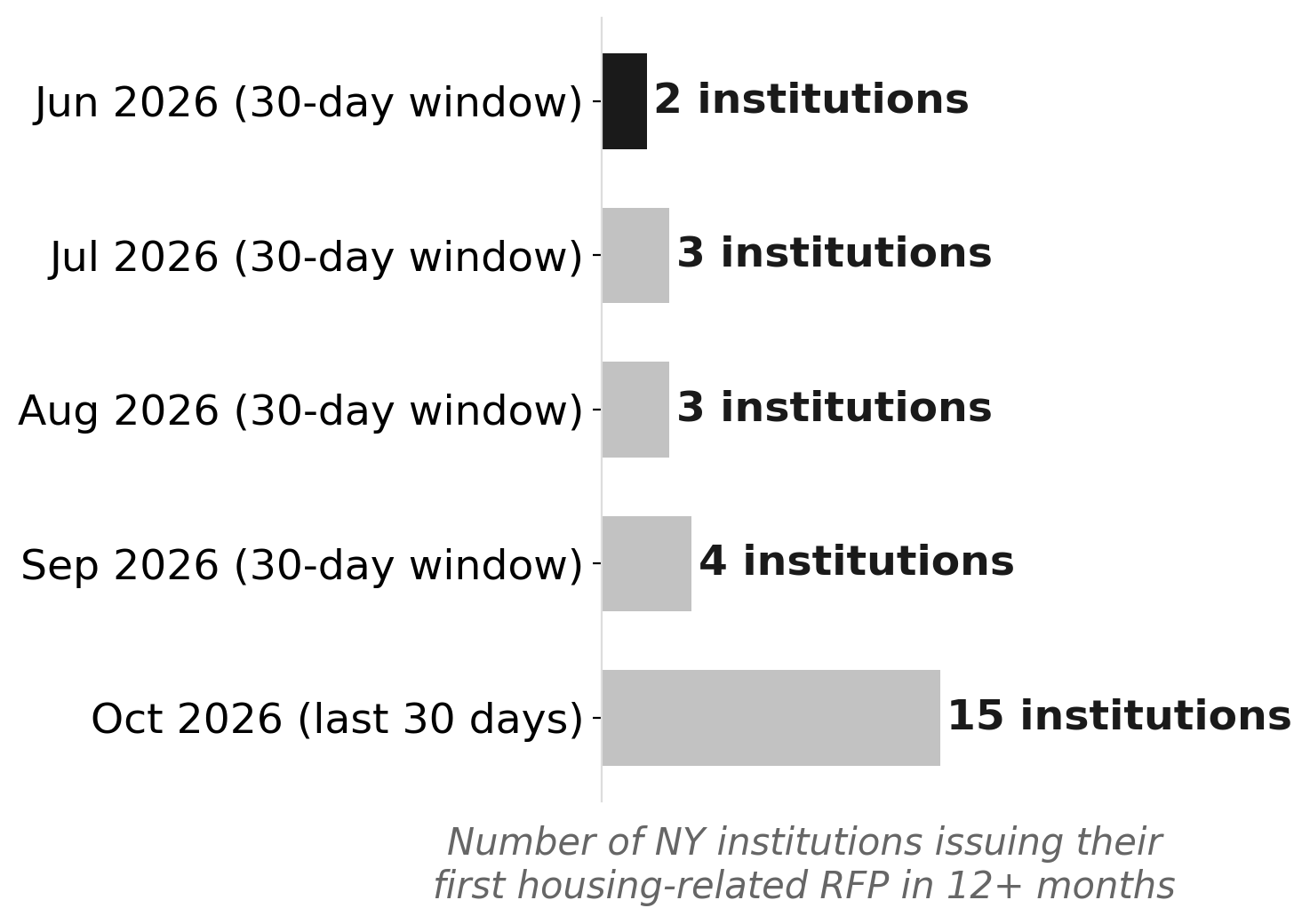
Fifteen New York institutions issued their first housing-related RFP in over a year during the last 30 days, a burst of procurement activity spanning at least 20 counties from Erie to Suffolk. The most telling signal is not a development in Buffalo or a rezoning in the suburbs. It is Warren County, a small Adirondack-gateway county, spending public money to procure a GIS-based permitting system it has explicitly titled "GIS-Based Permitting System for Pro-Housing Communities." When a county names its IT infrastructure after a state certification program, the compliance apparatus has reached the procurement desk.
The driver is Governor Hochul's Pro-Housing Communities Program, created by Executive Order 30 in July 2023 and steadily hardened by two state budgets since. The FY26 budget raised the certification requirement to cover up to $750M in state discretionary funding, up from $650M in FY25. Programs locked behind the certification gate now include the $100M Pro-Housing Supply Fund (infrastructure grants up to $10M per municipality, funded through a state appropriation), the Downtown Revitalization Initiative, and NY Forward. Municipalities that are not certified, or that cannot demonstrate active housing activity, cannot compete. The FY26 stakes made procrastination expensive.
Two concurrent funding windows have compressed that pressure into a single month. Governor Hochul announced $62M in community housing funding on August 10, 2026, open to local governments statewide. HCR separately opened a $270M LIHTC multifamily round with a September 2026 application deadline. Those are not the same program: the $62M community housing round flows directly to municipalities; the $270M is a federal tax credit allocation administered by HCR that targets developers but requires localities to have shovel-ready sites and supportive zoning. Together, they pulled municipalities and developers toward the same procurement moment at the same time.
Source: NationGraph.
The resulting wave is substantively varied, which is the point. Middletown, in Orange County, issued multiple single-family CDBG rehabilitation RFPs, drawing on federal Community Development Block Grant funds that HUD administers separately from the state certification stack and that do not require Pro-Housing certification. CDBG is the fiscal floor that keeps local housing offices operational enough to compete for state programs in the first place. Schuylerville issued a similar CDBG Housing Rehabilitation Program RFP. Buffalo issued redevelopment solicitations for the 725 Humboldt site, a former school targeted for affordable housing, and a Bailey Avenue parcel. Geneva, in Ontario County, issued a City-Owned Property Redevelopment and Housing Readiness Study, a direct positioning document for grant competition. East Hampton issued an affordable housing project RFP.
These are not examples of the same program generating the same activity. They represent a layered stack of policy mechanisms landing simultaneously. The Pro-Housing certification requirement forces municipalities to issue procurement and readiness studies; CDBG funds the rehabilitation work that keeps local offices active; and the LIHTC round creates the developer-side demand that municipalities must position themselves to attract. Warren County's GIS system is procurement for the certification layer. Geneva's readiness study is procurement for the competitive grant layer. Middletown's rehabilitation RFPs are procurement for the federal entitlement layer. The 30-day window caught all three kinds at once.
The program's built-in asymmetry is doing real work here. Downstate municipalities must demonstrate 1% annual housing stock growth to maintain certification; upstate municipalities need only 0.33%. That differential means the same deadline is activating two very different types of jurisdictions: affluent suburban towns protecting their eligibility for Downtown Revitalization grants, and legacy industrial cities protecting their access to public housing replacement funding. Buffalo's broader housing momentum illustrates the latter, with the $600M Marine Drive public housing redevelopment breaking ground in spring 2026, backed by $208M in HCR LIHTC financing and tax-exempt bonds. More than 350 municipalities are now Pro-Housing certified statewide, and annual renewal requires submission of permitting data by March 31 each year, a recurring enforcement mechanism that Warren County's GIS procurement is directly designed to survive.
At the metro level, New York City is running a parallel track. The city has moved to open city-owned land to nonprofits and minority developers, a distinct mechanism from the Pro-Housing certification stack but one that reflects the same state-level pressure to show housing activity across jurisdictions.
The next signal to watch is the September 2026 LIHTC application deadline. If the municipalities that issued RFPs this month have shovel-ready sites and certified zoning infrastructure by that date, the procurement wave will have served its purpose. If they do not, the fall funding windows will close and the clock resets to March 31, 2027, when the next certification renewal cycle begins.