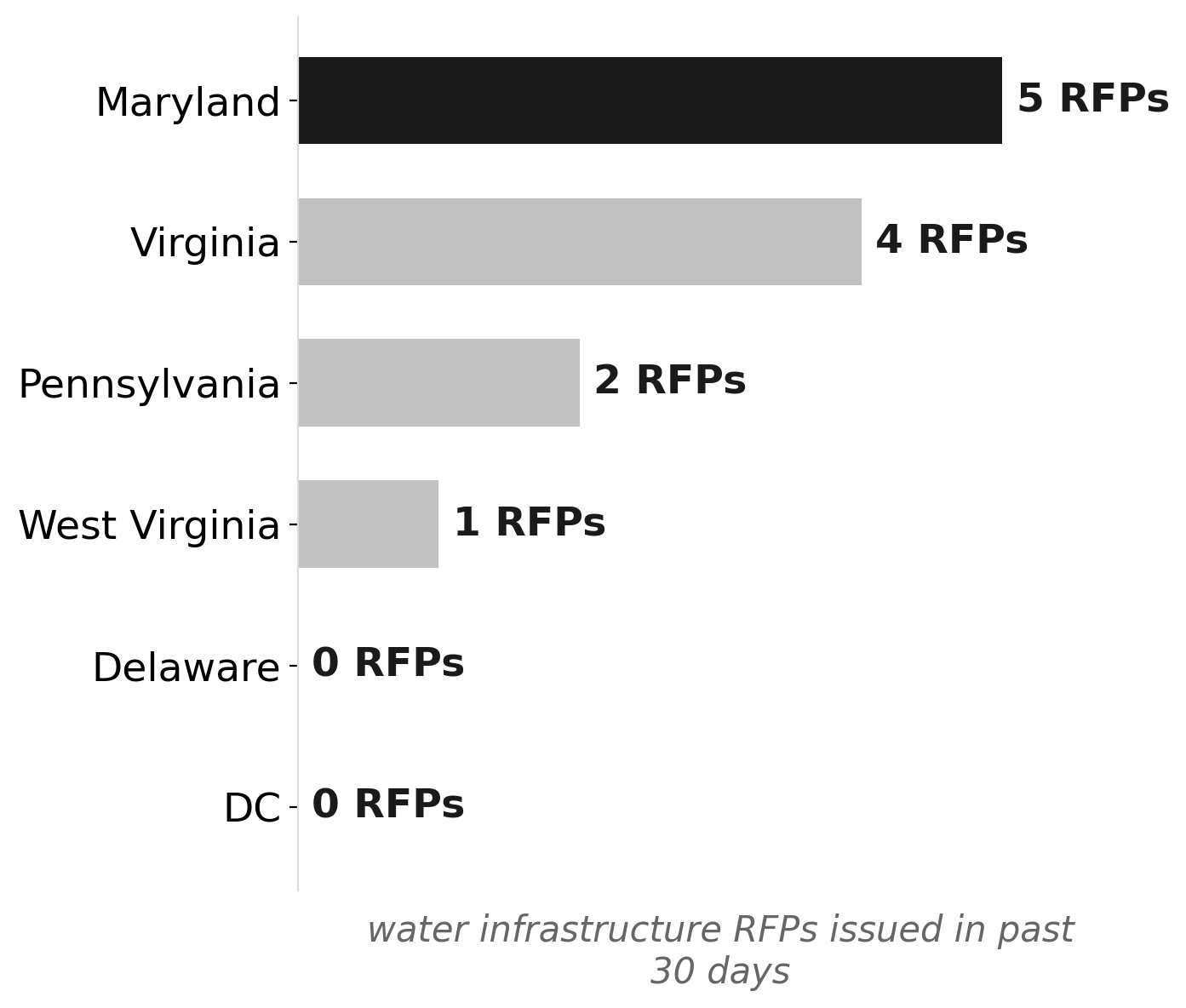
Maryland municipalities issued five water infrastructure RFPs in the past 30 days, against a trailing 12-month average of roughly 1.9 per month, a 2.6x surge that puts the state ahead of every mid-Atlantic peer, including Virginia (4), Pennsylvania (2), West Virginia (1), and Delaware and D.C. (0 each). The acceleration is not random. Two independent deadlines are converging on the same procurement offices at the same time, and the gap between them is measured in weeks.
The first deadline is federal. The Infrastructure Investment and Jobs Act's water infrastructure authorization expires September 30, 2026, and Congress has not introduced reauthorization legislation. That five-year, $50 billion commitment funded lead service line replacement, PFAS remediation, and wastewater upgrades across the country. In Maryland, the EPA routed those dollars through the Maryland Water Infrastructure Financing Administration as capitalization grants, $108.5 million for the Clean Water State Revolving Fund, $101.4 million for the Drinking Water SRF, and $9.9 million in Water Infrastructure Improvements for the Nation Act emerging-contaminants grants, all obligated between July 2025 and this fall. MWIFA then issues low-interest loans and loan forgiveness to local governments from that pool. The next application window doesn't open until December 2026, according to Maryland's own SRF program page, meaning this fall is effectively the last active procurement window under IIJA-era capitalizations. Communities that haven't obligated their projects by then risk forfeiting access to the most generous federal water financing in a generation.
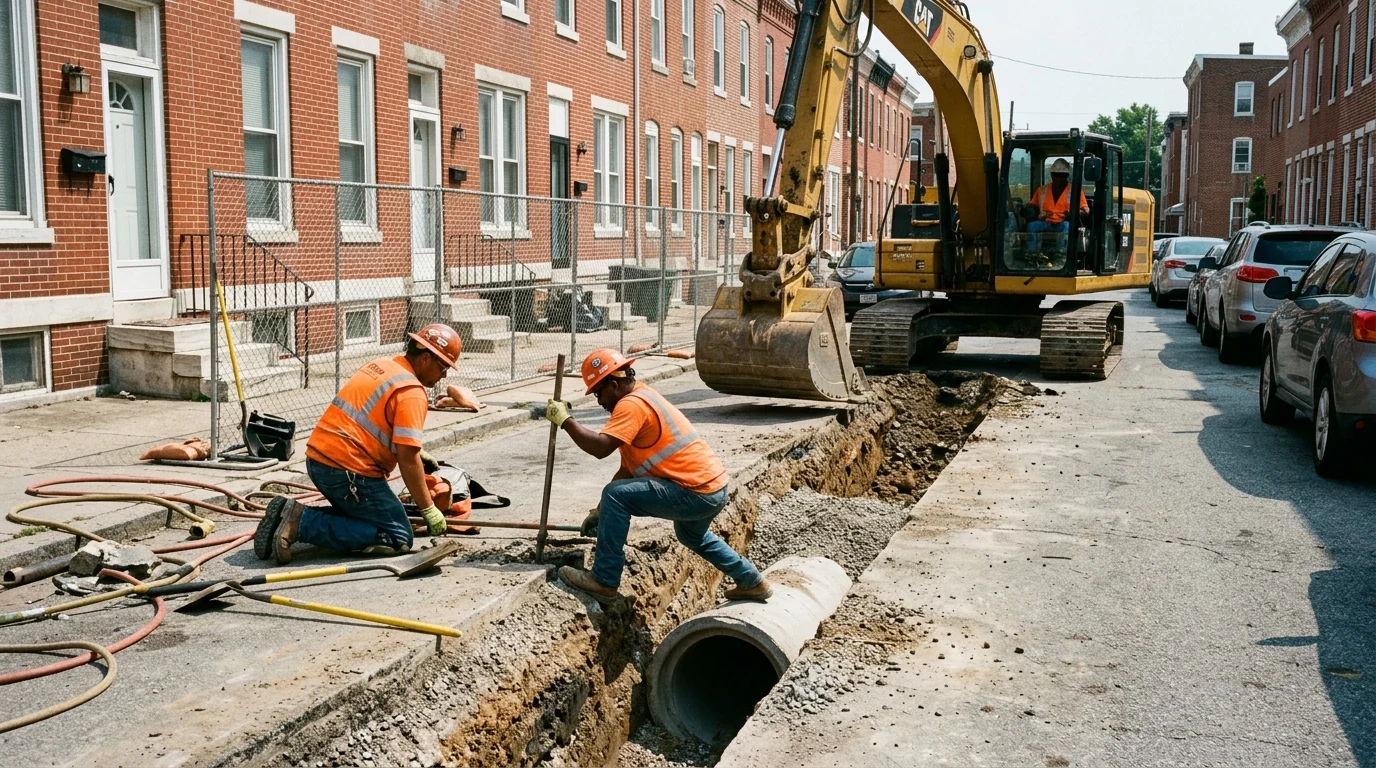
The second deadline belongs to a federal judge, not Congress. Baltimore City's Modified Consent Decree, entered in 2002 and amended in 2017, requires the city to work through a phased program of sanitary sewer rehabilitation. That obligation does not pause for budget cycles, election years, or funding cliffs. Two of the five Maryland RFPs issued in the past 30 days come directly from Baltimore's Department of Public Works: "Urgent Need Water Infrastructure Rehabilitation Phase II-FY27" and "Phase III-FY27." The word "urgent" is not marketing language, it reflects a legally mandated procurement queue that runs whether or not federal money is available. Blue Water Baltimore has publicly warned that without accelerated delivery, the Phase II consent decree work could extend to 2046.
Source: NationGraph.
The practical result is that Baltimore's DPW, the state's largest single water infrastructure procurer, is simultaneously running a court-ordered rehabilitation schedule and trying to obligate projects before a congressional authorization lapses. Those two pressures are legally distinct, the consent decree is a court order, not a funding source; SRF financing is what actually pays for the work, but they land on the same engineers, the same procurement staff, and the same contracting pipeline at the same time.
The rest of the RFP surge reflects the same IIJA-driven urgency playing out at smaller scale. Easton Utilities is bidding out water and wastewater design for Shore Medical Center. The town of Willards is procuring advanced metering infrastructure. Both are the kind of capital projects that communities have been positioning to fund through MWIFA's SRF cycle. The active EPA water grant portfolio in Maryland currently sits at $308 million obligated with only $25.8 million disbursed, a ratio that confirms the money is committed and projects are in early execution, exactly the stage when RFPs would be expected to spike.
The urgency extends beyond Maryland's borders. The IIJA directed $15 billion specifically for lead service line replacement and $4 billion for PFAS and emerging contaminant remediation nationally. Baltimore City separately received a $6.95 million Drinking Water SRF loan with $3.68 million in principal forgiveness to fund lead service line inventory and replacement covering more than 9,600 lines, a program that itself sunsets with the IIJA. The ASCE's 2026 Maryland fact sheet estimates the state's total drinking water infrastructure need at $36 billion; total IIJA distributions to Maryland across all programs reached $14.6 billion, leaving a gap that will require either successor federal legislation or a reordering of state capital priorities.
For residents, the immediate consequence is more visible construction activity, more sewer rehabilitation work in Baltimore neighborhoods, more water main projects in smaller jurisdictions, with the bulk of the federally funded pipeline expected to move into active execution through 2027 and beyond, even if no new authorizations pass. The longer-term question is what happens after September 30. Communities that miss the IIJA window will face higher borrowing costs and smaller loan-forgiveness provisions in any successor program, if one materializes.
The signal to watch is whether Congress moves a water infrastructure reauthorization before the fall recess. If it does not, the current procurement sprint in Maryland and across the mid-Atlantic will represent the final draw on a funding era that opened in November 2021. The December 2026 MWIFA application reopening will be the first test of what the post-IIJA financing landscape actually looks like.