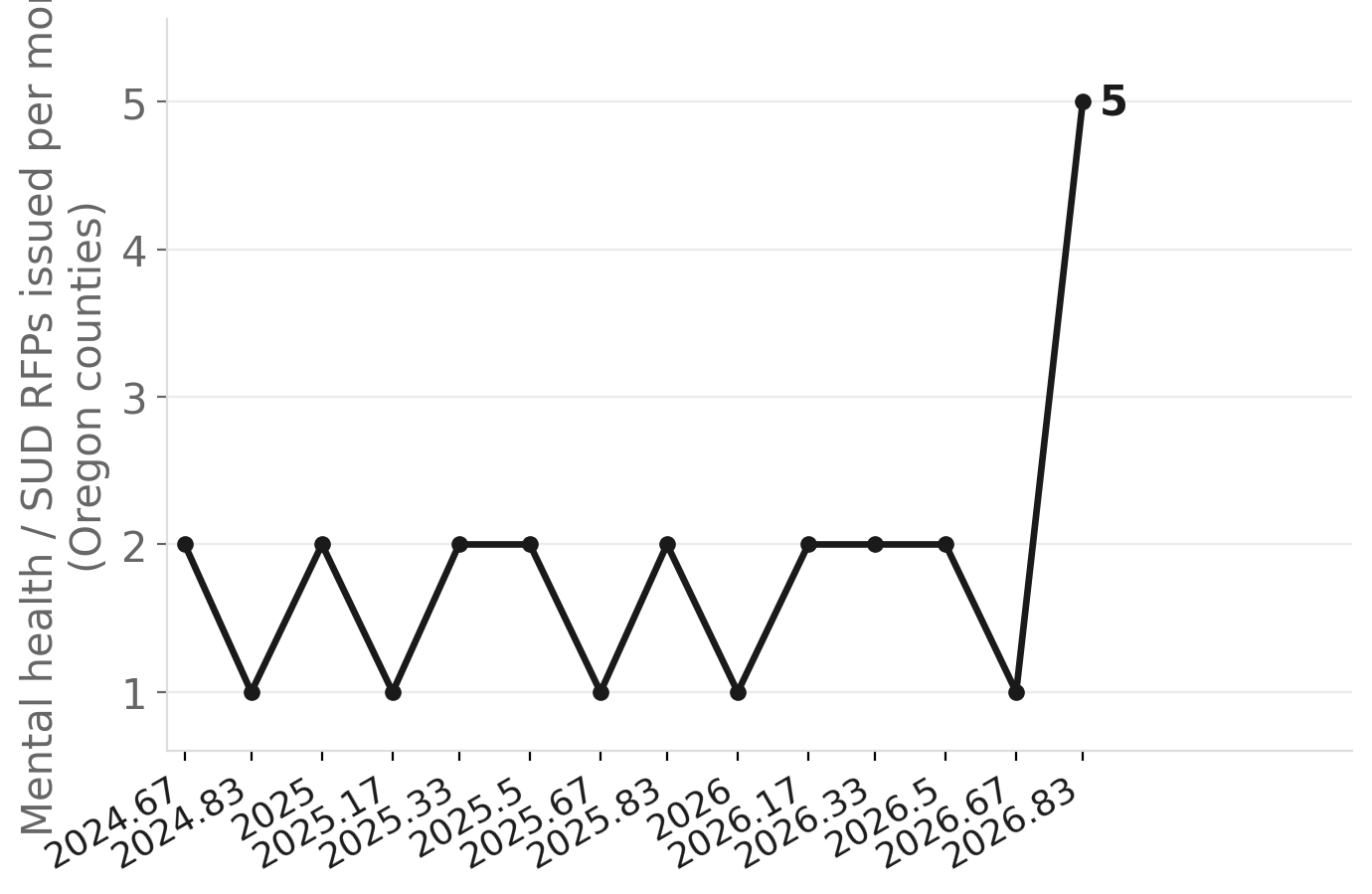
Oregon counties issued five mental health and substance use disorder solicitations in the last 30 days, nearly three times the normalized monthly average of about 1.75, and the spike has almost nothing to do with a new crisis. It is the delayed billing statement from a policy enacted two years ago.
When Governor Tina Kotek signed HB 4002 in March 2024, the law recriminalized drug possession effective September 1, 2024, and created the Behavioral Health Deflection Grant Program, funded at more than $110 million through companion bill HB 5204. Counties were required to assemble four-way partnerships, law enforcement, district attorneys, community mental health programs, and existing Behavioral Health Resource Network providers, and stand up deflection infrastructure so that people apprehended for drug possession misdemeanors could be routed to treatment rather than prosecution. Twenty-seven counties applied for deflection grants. Most programs went live between September 2024 and January 2025. The planning phase is over. The contracting phase is now.
The October 2026 RFP cluster shows what operational contracting actually looks like at this stage. Multnomah County's Mental Health and Addiction Services Division issued three separate solicitations for alcohol and drug withdrawal management services between October 6 and 9, a concentrated burst from the county that has run Oregon's highest-volume deflection program since September 1, 2024, and that expanded sobering referral access to additional first responders in June 2025. Lane County, partnering with the City of Springfield, sought medical, dental, and mental health services for adults in custody on September 26, directly mapping onto HB 4002's jail-based medication program requirements. Washington County posted an RFP for co-occurring substance use and mental health disorder support groups on September 30, with local funding flagged, reflecting the county-level cost-share reality that many deflection programs now face as startup grant dollars tighten.
Source: NationGraph.
These are not announcements of new programs. They are counties trying to put licensed, contracted providers behind commitments they made on paper in 2024.
The reason the gap between commitment and contract is so wide is structural. HB 4002 preserved Oregon's Measure 110 Behavioral Health Resource Networks, the cannabis-tax-funded county networks that provide open-access substance use services regardless of legal status, but added an entirely separate deflection layer on top of them. The two systems are operationally linked: counties must coordinate with a BHRN provider to receive deflection grants. But they fund different functions and serve different populations at the point of contact. BHRNs are community walk-in infrastructure. Deflection programs are law-enforcement-triggered pathways. Building a new pathway through an existing network requires contracts that did not exist before the law created the need for them.
The Oregon Health Authority is also managing a substantial federal grant backdrop that counties are now trying to translate into actual services. The agency holds a $197 million Rural Health Transformation grant from HHS, active through 2030, along with a $15.5 million SAMHSA community mental health block grant running through 2027, and a newly awarded $3.6 million cooperative agreement to scale 988 crisis line capacity, awarded in September 2026. Federal money sets the floor; county RFPs determine who delivers the services.
The Multnomah County Board's 2026 resolution calling for continuous improvement of its deflection program, available in the Board's public record, is a signal of what comes after the launch phase: counties that built programs quickly, under political pressure, are now auditing whether the provider relationships they have are the right ones. New solicitations follow.
For residents in these counties, the practical change is that the deflection pathway, the mechanism that determines whether someone picked up on a drug possession charge goes to jail, gets a citation, or gets routed to a withdrawal management bed, is only as functional as the contracts behind it. A deflection program without a contracted withdrawal management provider is a referral to a wait list. The RFP surge is counties closing that gap.
The next signal to watch is whether Washington County's locally funded support group contract, and others like it, reflects a quiet shift: counties absorbing costs that were supposed to be covered by state deflection grants as the initial HB 5204 allocations run out. The Oregon Criminal Justice Commission administers the BHD grant program, and the pace of re-appropriation in the 2025 legislative session will determine how many counties can sustain their programs past the startup window and how many will be writing RFPs with smaller funding lines behind them.