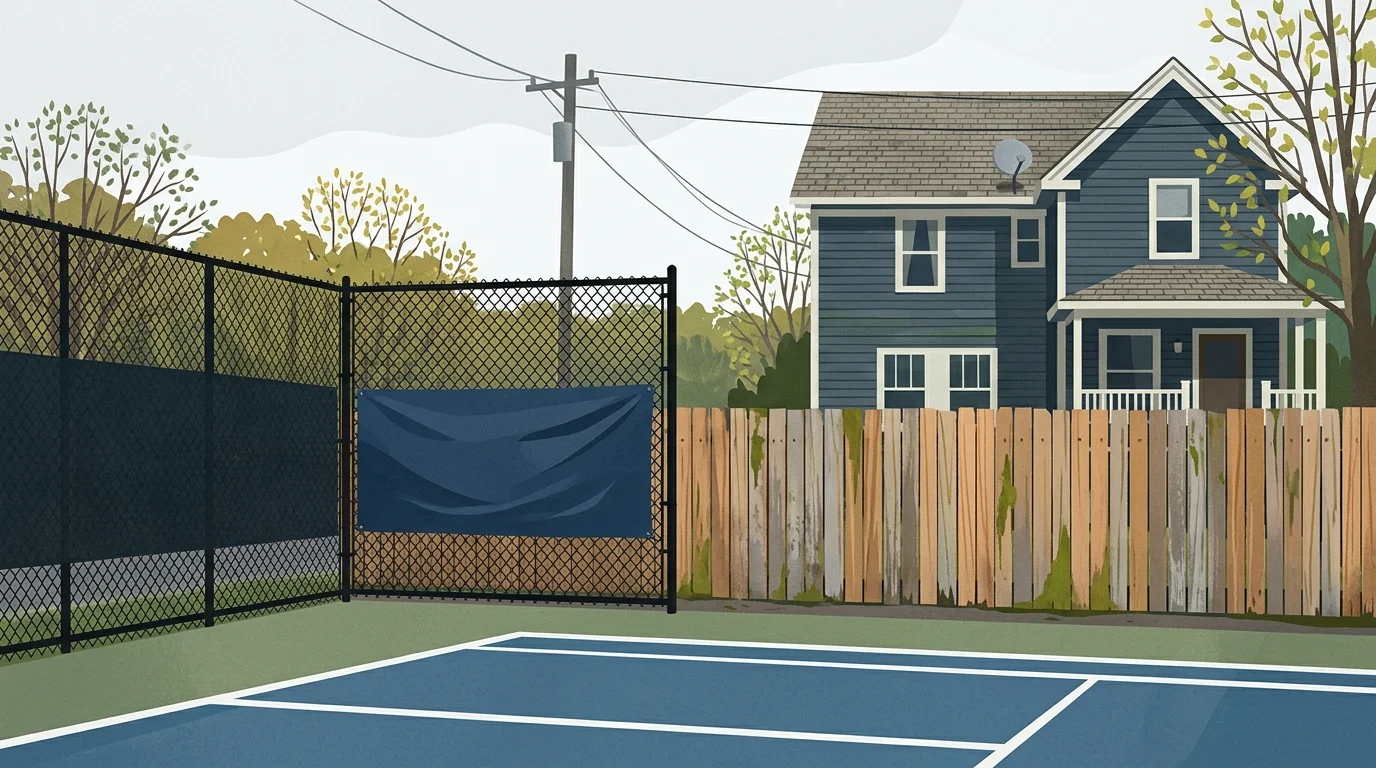
Lewiston spent public money building pickleball courts at North Temple in 2023. This spring, the city issued RFP 2026-026, due June 9, to procure sound barrier mats for the same complex. The city is not an outlier. Across Maine, at least seven municipalities, including Gorham, Standish, Wayne, Belfast, Wells, Scarborough, and Lewiston, have issued first-time pickleball-related procurement documents since July 2025. Several of them are already watching older courts cycle into a second, more expensive phase: remediation.
The driver is noise. Pickleball's polymer ball and solid paddle produce a sharp, high-frequency crack that carries differently than the thud of a tennis ball. Courts built inside existing park layouts, often close to residential property lines and sized for tennis, were not acoustically designed for the sport's sound profile. Maine's older, compact park footprints gave planners little buffer. When the courts went up fast, during the national boom that pushed U.S. participation from 8.9 million players in 2020 to 48.3 million by 2025, the acoustic math rarely got done first.
Kittery's situation is the sharpest illustration. After a neighbor, a trauma nurse working night shifts, threatened to sue the town over sleep deprivation caused by courts at Emory Field, town staff worked through multiple rounds of sound barrier installations. None satisfied the complaint. By late 2024, the Kittery Town Council was weighing closure of its outdoor courts rather than continue spending on fixes that were not solving the problem. The courts sit in exactly the kind of tight residential context that makes acoustic mitigation difficult: there is simply not enough distance between the baseline and the nearest bedroom window.
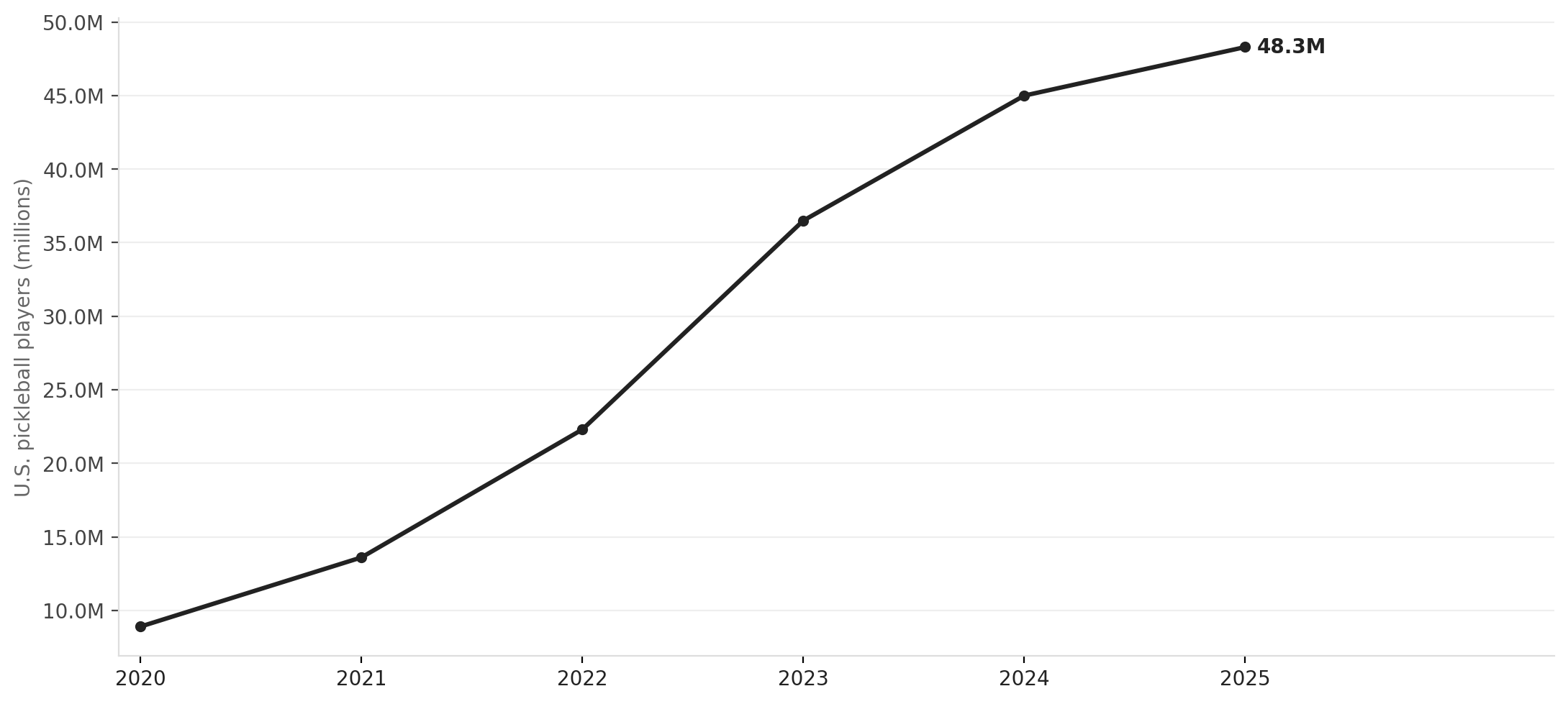
Source: NationGraph.
Belfast, which appeared as a first-time RFP issuer in July 2025, is already tracking toward the same trajectory. A Bangor Daily News report from June 2, 2026 documented neighbors at Belfast City Park describing the noise as ruining their lives. The language mirrors what Kittery residents said two years earlier, before that town ran out of acoustic options.
Wells offers a different variant of the same pattern. Its recent RFP calls for demolishing four existing tennis courts and reconstructing two tennis courts alongside six pickleball courts, a conversion that concentrates more play activity on a footprint designed for a quieter sport. York County's roughly 12,000-person town has more green space than Kittery or Lewiston, but the tennis-to-pickleball conversion model trades one set of acoustic assumptions for another.
Nationally, municipalities that built early are now writing the regulations that Maine towns mostly skipped. Many jurisdictions now require new courts to be sited 150 to 500 feet from residences and mandate acoustic barriers as a condition of permitting, according to a 2026 review of local noise ordinances. Maine Public Radio covered the acoustic engineering challenge as early as 2023, when the court-building wave was accelerating. The guidance existed. The procurement records suggest it did not always reach the planning table before shovels went in.
Maine's demographic profile sharpens the political difficulty. The state has the second-oldest median population in the country. Pickleball's early adopter base skews older and includes a substantial share of the same senior residents who vote in municipal elections and show up to parks board meetings. That creates real pressure on town councils to preserve courts even when neighbors are organizing against them. Closing courts, as Kittery may do, is politically painful. Retrofitting them is expensive and, in tight spaces, often insufficient.
Private capital is drawing a quiet conclusion from all of this. The Picklr indoor franchise opened its first Maine location in a former Shaw's supermarket in Westbrook, converting the space into 19 courts including three tournament-size. Indoor facilities sidestep the acoustic problem entirely: there are no residential neighbors, hours are controlled, and surface treatments can be specified from the start. Maine now has 171 pickleball locations with 624 courts statewide, according to Pickleheads, with Portland leading at 74 courts across 12 locations. The share of those courts that are indoors, and insulated from the complaint cycle, is likely to grow.
For parks directors across the state, the Lewiston procurement is a preview. Building a court and budgeting to quiet it are not the same line item, and most capital plans written between 2022 and 2024 did not include the second one. The question now is whether the towns still in the construction phase, Gorham, Standish, Scarborough, learn from the ones already in remediation, or whether Maine's pickleball buildout simply has one more expensive phase left to run.