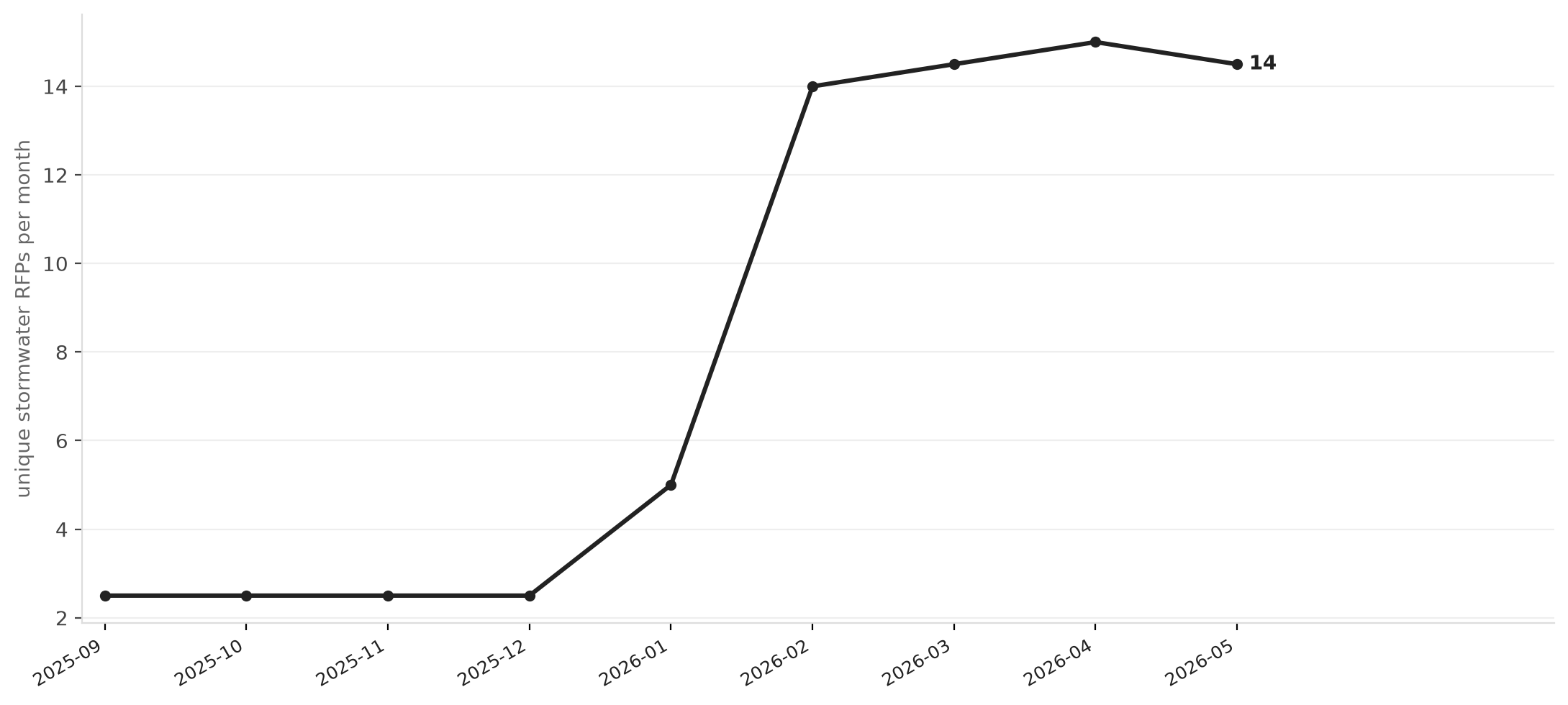
From February through May 2026, Wisconsin municipalities issued stormwater management bids at roughly two to three times their fall baseline rate, a surge that cuts across eight counties and reflects something unusual in public infrastructure finance: the money, the compliance deadline, and the political momentum arrived at the same moment.
The catalyst was January 8, 2026, when Governor Tony Evers announced $484 million in Clean Water Fund Program (CWFP) allocations for stormwater and wastewater infrastructure statewide. The package included $438 million in subsidized loans and $46 million in principal forgiveness, backed by $42.9 million in base EPA Clean Water SRF capitalization grants and $66.6 million in Bipartisan Infrastructure Law supplemental funding. Within weeks, procurement activity in Wisconsin's municipal stormwater sector accelerated sharply, reaching 13 to 16 unique bids per month compared to 1 to 4 per month in the preceding September-through-December window.
The geography of that activity tells a story about where compliance pressure is highest. Dane County anchors the surge: Fitchburg, McFarland, Monona, Sun Prairie, and the Madison Metropolitan Sewer District all issued bids in the February-May window. Waukesha County added procurements from the City of Waukesha and New Berlin. Oak Creek in Milwaukee County, Elkhorn, East Troy, and Delavan in Walworth County, and Brown County municipalities rounded out a list that also touched Winnebago, La Crosse, and Ashland counties. This is not a Milwaukee-suburban story or a Dane County story. It is statewide.
Source: NationGraph.
The funding announcement alone does not fully explain the timing. A second pressure point arrived a year earlier, on January 16, 2025, when the Wisconsin DNR launched a new Wisconsin-specific MS4 BMP Menu that tightened compliance guidance for more than 200 permitted municipalities. Under Wisconsin's municipal separate storm sewer system (MS4) permit structure, those municipalities face annual compliance reports due each March 31. The new menu raised the documentation bar at exactly the moment federal dollars became more accessible, compressing the incentive to defer capital investment. Towns that had been holding off now faced a harder question: wait and risk a compliance gap, or move.
The fiscal arithmetic underneath this is stark. Wisconsin's 2026 SRF project priority list contains more than a thousand projects with nearly $4.5 billion in requested funds. The CWFP is allocating $484 million. Demand exceeds supply by roughly nine to one. The Wisconsin Wastewater Operators' Association has flagged this mismatch directly, noting that continued high demand for CWFP assistance may strain the DNR's SFY 2026 loan capacity. For municipal finance officers, that constraint is its own deadline: a project with a complete bid package and a ready contractor is a stronger candidate for a subsidized loan than one still in planning. Getting the RFP into the street is, in part, a queue-management strategy.
Wisconsin's stormwater context adds another layer. The state sits at the intersection of Great Lakes stewardship obligations and longstanding PFAS contamination of surface waters. Its flat, agriculturally drained landscape means runoff quality feeds directly into impaired-waters listings that trigger federal scrutiny. Several Dane County municipalities, including Fitchburg and Sun Prairie, have been operating stormwater utilities and vegetation management programs for years, they are not starting from zero. They are scaling. That makes the Madison-area cluster less a sign of crisis than of an experienced cohort accelerating investment while the loan terms are favorable.
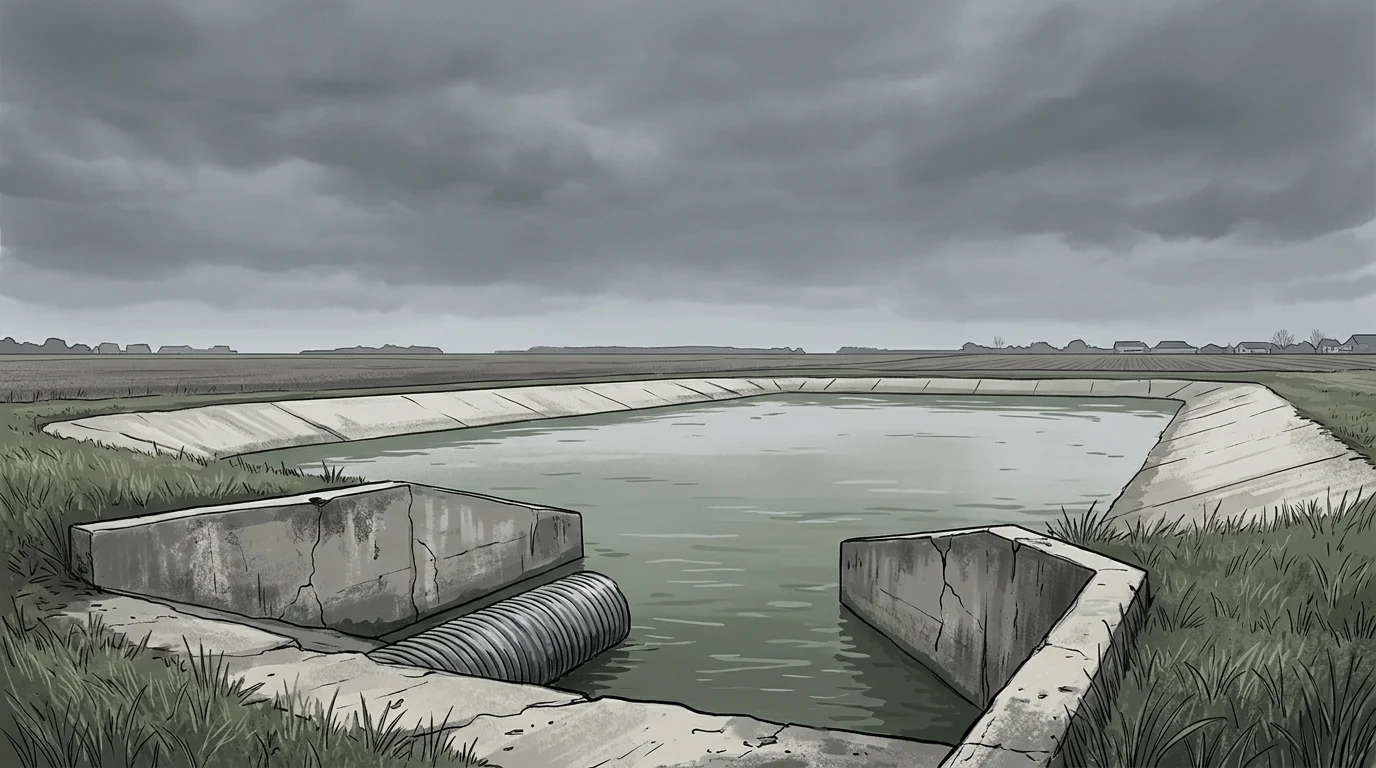
For residents across Wisconsin, the practical consequence is a near-term wave of construction: upgraded detention ponds, green infrastructure retrofits, pipe replacements, and bioswale projects. The CWFP has distributed more than $6.5 billion to Wisconsin municipalities since 1991, and the current round continues a decades-long pattern of the program serving as the state's primary bridge between federal water policy and local pipe-and-pond reality.
The next signal to watch is the DNR's SFY 2026 loan capacity announcement. If demand continues to outpace available capital, municipalities that delayed procurement into the summer or fall could find themselves pushed to the 2027 priority list, forfeiting the principal forgiveness terms available now. March 31, 2027, the next MS4 annual reporting deadline, will reveal how many of this spring's bids translated into permitted, funded projects, and how many communities are still waiting in the queue.