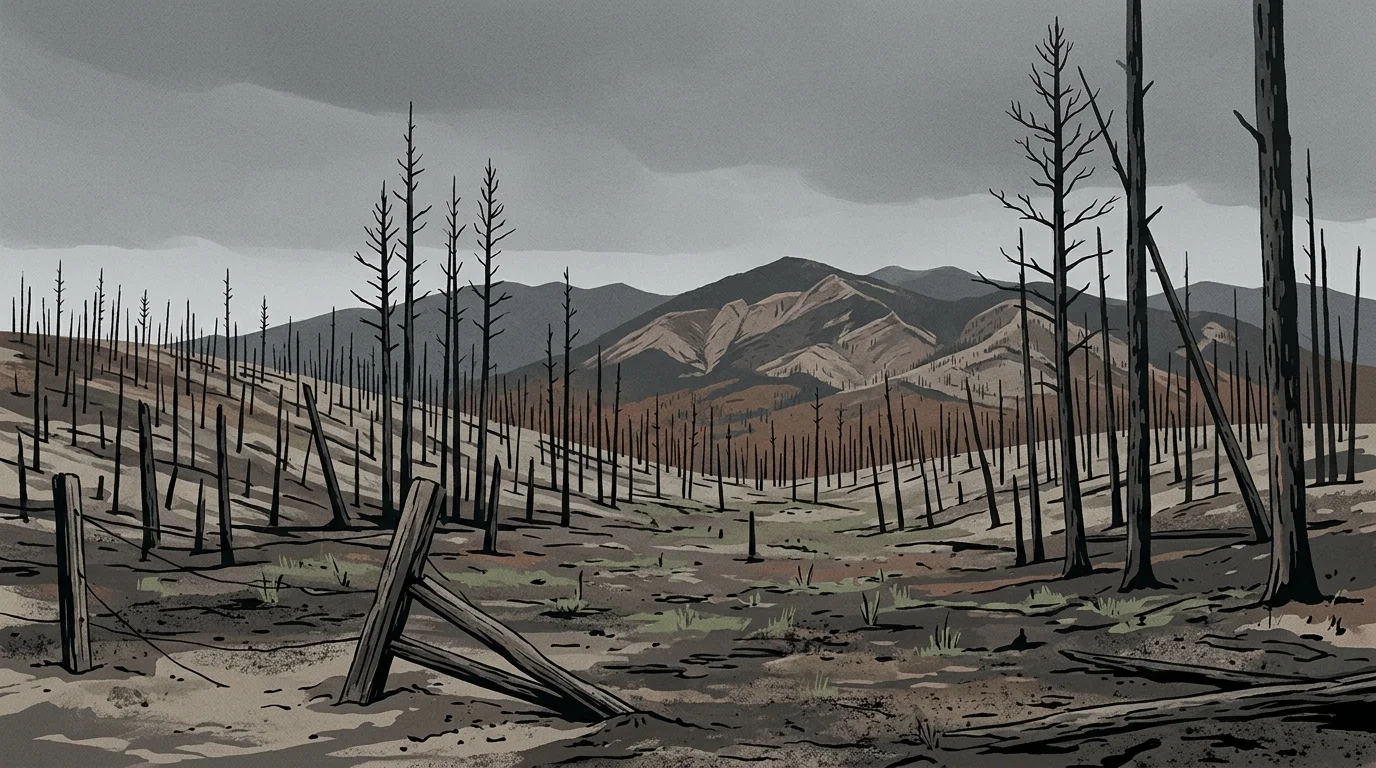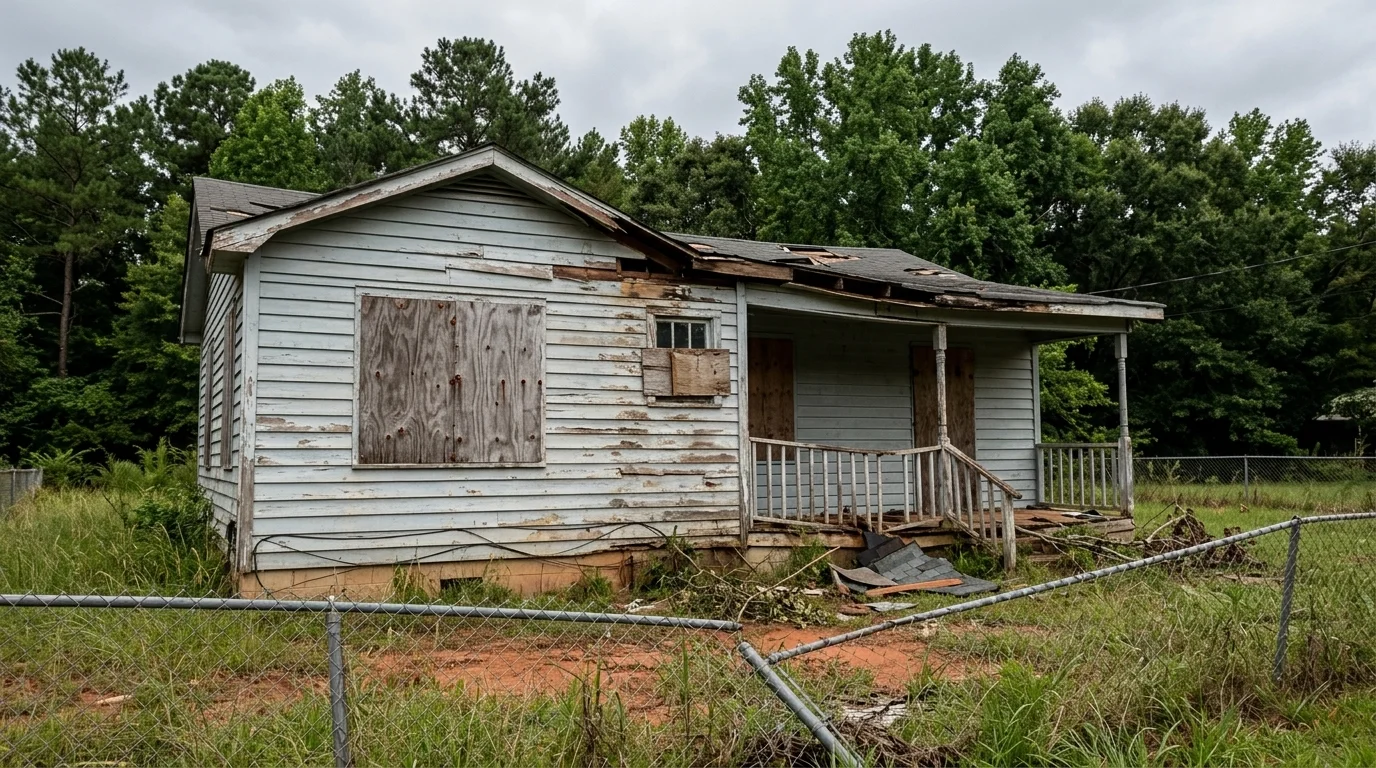
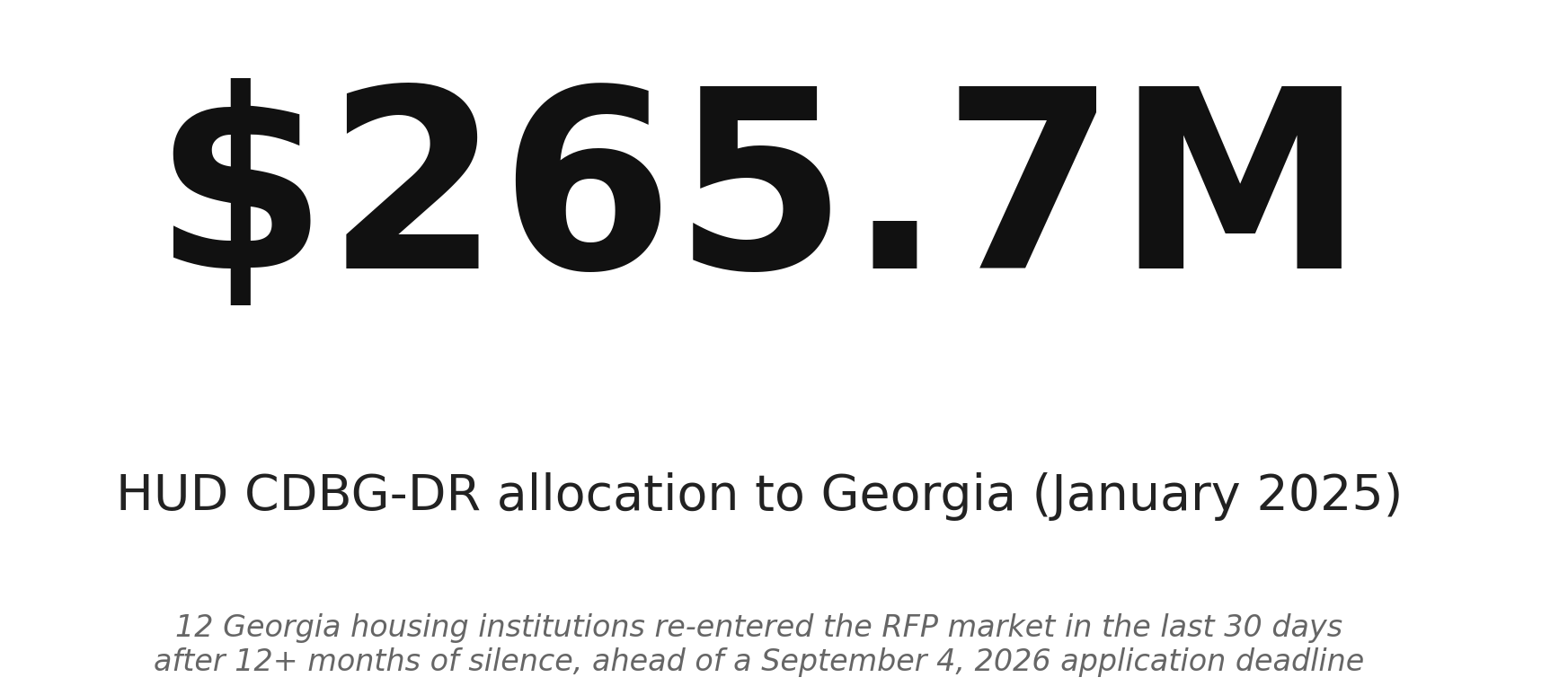
Twelve Georgia housing authorities and county governments issued housing-related RFPs in the past 30 days after going at least a year without a single procurement, the largest such reactivation in recent memory. The force behind it is a hard deadline: HUD's $265,726,000 CDBG-DR allocation to Georgia, tied to Hurricanes Idalia and Helene and Tropical Storm Debby, carries a public infrastructure application deadline of September 4, 2026. Institutions that don't move now lose access to the largest housing recovery windfall the state has seen in years.
The money arrived in January 2025, administered by the Georgia Department of Community Affairs, which simultaneously runs homeowner rehabilitation, affordable housing tax credit cycles, and the newly opened Homeowner Rehabilitation and Reconstruction Program portal. That concentration of responsibility at a single agency, under a single clock, is what makes this moment structurally different from earlier housing pushes. DCA issued its CDBG-DR Notice of Funding Opportunity on January 26, 2026, explicitly tying disaster-recovery dollars to the 2026 Housing Tax Credit cycle. Two forcing mechanisms are now running at once.
New housing grants to Georgia peaked at $296 million across 324 awards in Q1 2026, the highest recent quarter on record. Procurement activity is lagging that funding wave by roughly three to six months, which explains why the RFPs are arriving now rather than last spring. The institutions going quiet for over a year and then suddenly issuing bids are not malfunctioning; they were waiting, as procurement offices typically do, for grant agreements to be executed and capital to be confirmed. The September cliff is what ended the waiting.
Source: NationGraph.
The most consequential single procurement is Macon-Bibb County's RFQ for a modular housing developer, with responses due August 6, 2026. Macon-Bibb is one of only three Georgia cities, alongside Atlanta and Savannah, to establish a dedicated Affordable Housing Fund. That fund, seeded with roughly $12 million in ARPA dollars, is now making its most ambitious move: commissioning modular construction at scale rather than rehabilitating individual units. The county's Affordable Housing Fund has been building toward this capacity since its launch, but the modular RFQ represents a meaningful shift in ambition and method. Atlanta Housing Authority, meanwhile, issued an RFQ covering architect and engineering services across its entire capital improvement portfolio, signaling that the state's largest housing authority is moving from planning to active construction phase. Smaller authorities, including Newnan and Barnesville, are running more modest procurements: door-and-window replacements, interior renovations, the kind of deferred maintenance that accumulates during years of inaction and becomes urgent the moment money is confirmed.
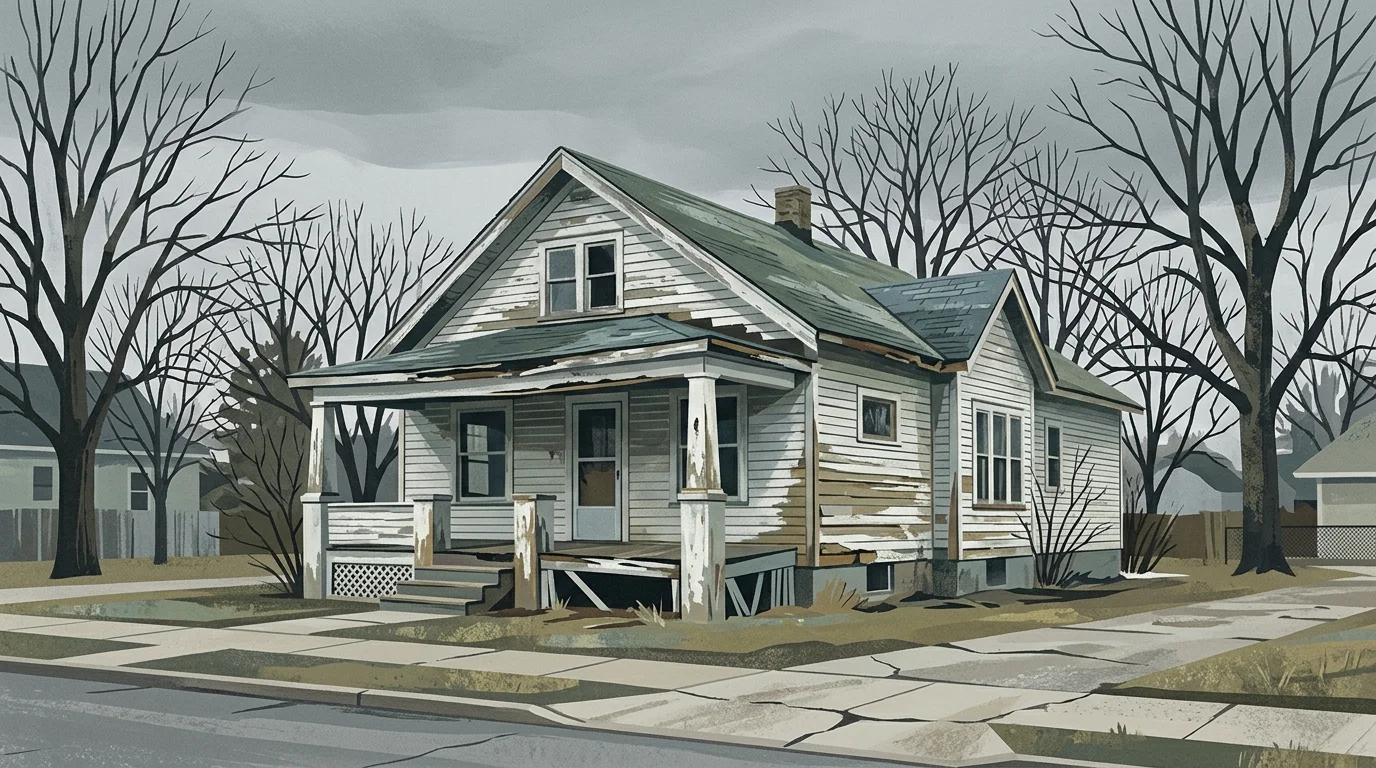
The demand-side context makes the pace of these procurements matter more than it would in an ordinary recovery cycle. Georgia lost 7.5 percent of its housing inventory between 2023 and 2024, one of the steepest single-year declines in the country, a figure Senator Warnock cited in floor remarks pressing for federal housing legislation. The storms that generated the CDBG-DR allocation hit a state that was already housing-stressed before a single hurricane made landfall. Reconstruction and affordability are not separate problems here; they are the same problem with two funding streams attached.
The Georgia General Assembly added state-level pressure during its 2026 session, which ended in April. The FY2026 amended budget included significant one-time funding for unsheltered homelessness and a $28 million increase to the OneGeorgia Authority's Rural Workforce Housing Initiative, according to Enterprise Community Partners' legislative wrap. Rural counties hit by Helene, many of which have no dedicated housing staff, are now the likeliest bottleneck. They need to move procurement paperwork at a pace they have rarely been asked to sustain.
For residents in storm-affected counties, the practical signal to watch is whether their local housing authority or county government appears on a bidder list in the next sixty days. An RFP is not a finished unit, but it is the step without which no unit gets built. Authorities that miss the September 4 infrastructure deadline do not simply defer the work; they forfeit the federal share and are left with whatever local or state dollars remain, which are considerably thinner.
The next visible checkpoint will be whether DCA's application portal closes with a full slate of submissions or with unspent allocation still on the table. If rural and small-city authorities fail to convert their newly issued RFPs into executed contracts before the deadline, the reactivation now underway will have arrived too late to matter.