Tennessee's transportation agency obligated 13 individual federal EV charging grants in the second quarter of 2026 alone, more than any prior quarter in the program's history for the state, and 21 total since January. For most of the previous four years, TDOT averaged fewer than two such awards per quarter. The acceleration is not a policy shift. It is a race against a deadline.
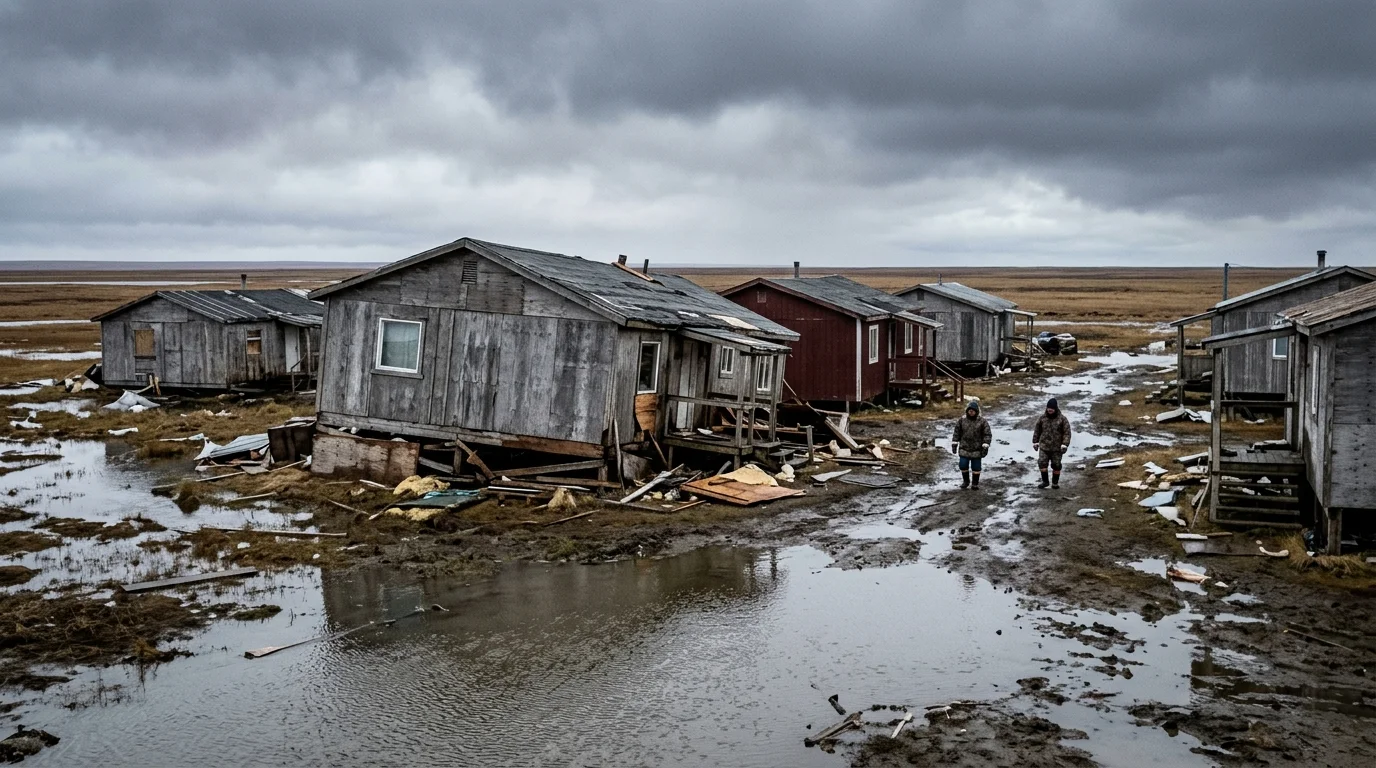
The backstory runs through federal court. The Trump administration froze all state NEVI plans on February 6, 2025, one day after the presidential transition, halting TDOT's already-announced Round 1 awardees before contracts could be executed. Fourteen months later, U.S. District Judge Tana Lin ruled that the Department of Transportation had acted "outside the law" in withholding the funds, ordering FHWA to restore access to unobligated state balances. TDOT had spent the intervening period getting its FY2026 TEVI Plan approved by FHWA in September 2025, explicitly covering all unobligated FY2022 through FY2026 balances. When the court order landed in January, TDOT had a plan ready and a clock running.
The urgency is compounded by what Congress did next. The FY2026 spending bill rescinded roughly $503 million nationally from the NEVI program, and Tennessee is among the states bearing the highest burden from that cut, owing to the size of its unobligated FY2022 balances, the direct result of the pause that prevented its first contracts from executing. Tennessee's five-year NEVI allocation is $88 million. How much of that survives the rescission window depends heavily on how much the state can obligate before the cutoff bites.
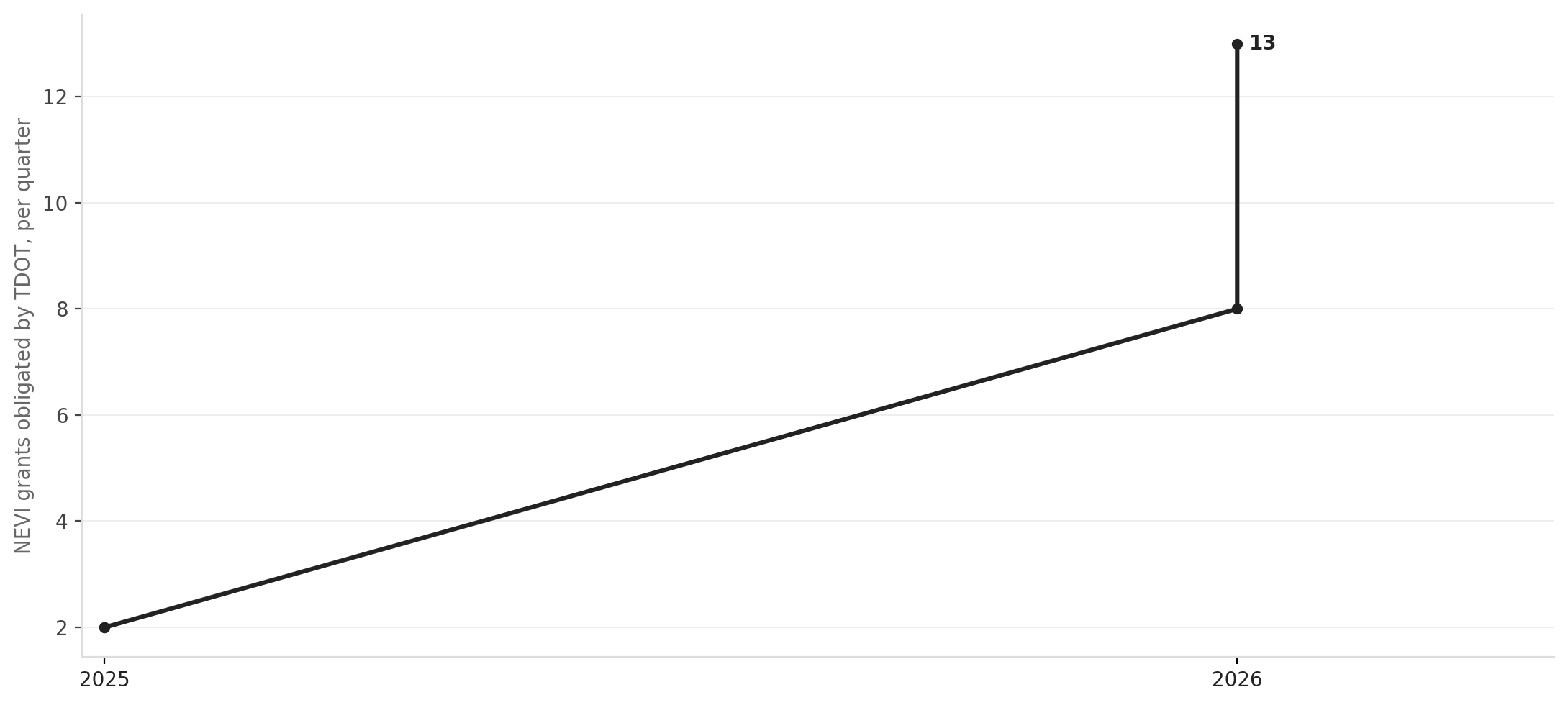
Source: NationGraph.
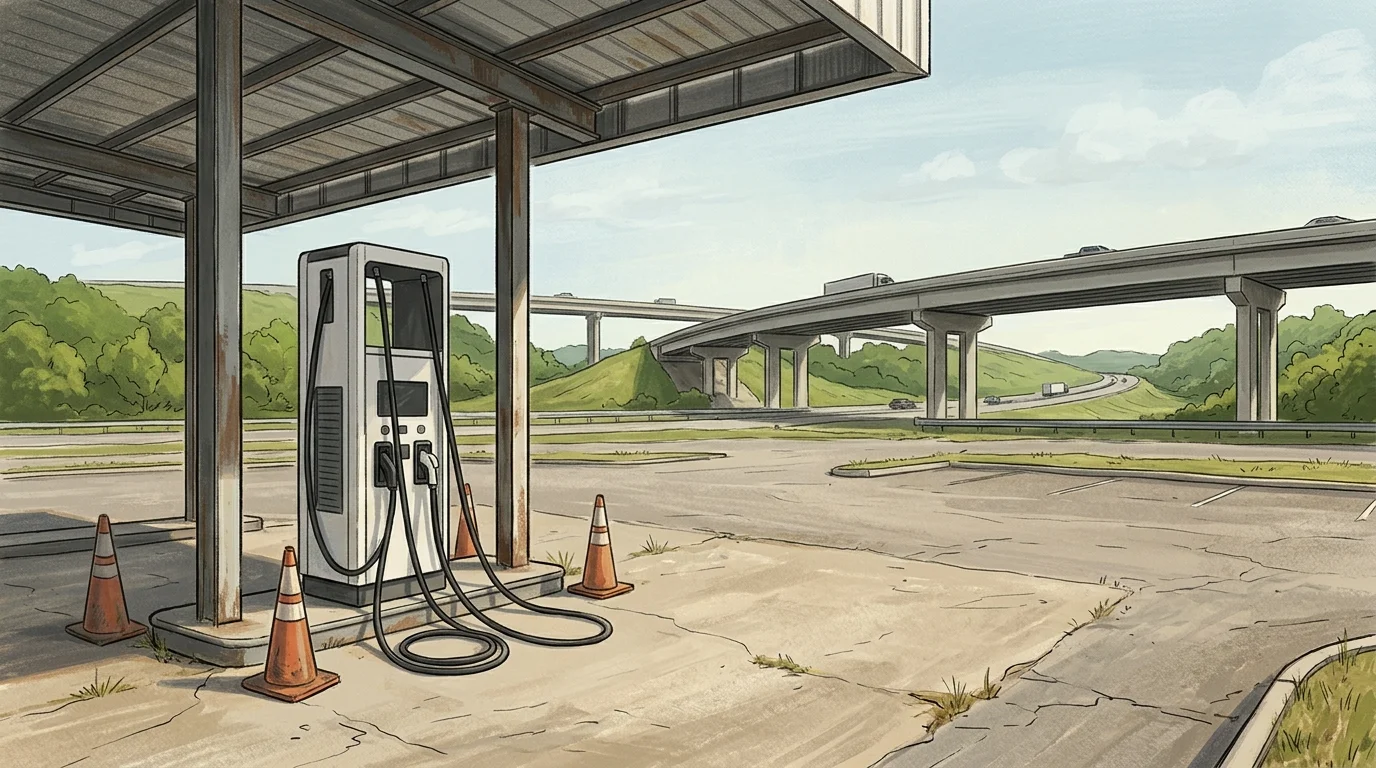
The grants TDOT is now issuing are small and deliberate. Individual site awards range from roughly $17,000 to $48,000, covering corridor locations along I-40, I-75, I-81, I-26, and SR-15. The recipient sites are not showrooms or civic centers. They are Shell stations, Valero locations, Marathon stops, and Waffle House exits, the kinds of highway anchor points where a driver running low on charge between Nashville and Knoxville would actually need to stop. The active NEVI portfolio now carries $1.4 million in obligated grants across 23 awards, all with performance periods running through 2028 to 2031.
That $1.4 million figure makes clear how much ground remains. Tennessee's $14 million in total active EV grant dollars places it well behind Virginia at $424 million, North Carolina at $168 million, and even Arkansas at $131 million. The gap is a structural artifact of the freeze, not a reflection of the state's EV economy. Tennessee hosts Volkswagen's Chattanooga assembly plant and Ford's BlueOval City in Stanton, two of the largest EV manufacturing investments in the country. The state builds the vehicles. It has struggled to build the infrastructure to charge them.
TDEC's May 2026 EV roadmap sharpens that tension. The agency raised its statewide registration target to 750,000 light-duty EVs by 2035, up sharply from the prior benchmark of 200,000 by 2028, while acknowledging that only about 68,600 plug-in vehicles were registered in Tennessee at the end of 2025. Reaching that 2035 target requires roughly eleven times the current fleet, and the charging infrastructure to support it depends substantially on whether the corridor grants now being obligated in rapid succession actually get built.
For a driver in Tennessee, the practical implication is that more fast-charging options along the state's major interstates are in the pipeline, though most sites are still under development and won't be operational for one to three years. The awards currently on the books are site-level commitments, not ribbons-cutting. What actually gets built depends on contractors delivering, permitting clearing, and the remaining NEVI dollars surviving whatever further federal budget action follows the FY2026 rescission.
The next signal to watch is whether TDOT can convert its current pace of obligations into executed contracts before any additional rescission language advances in Congress. The court ruling forced the funding window open. Whether that window stays open long enough for Tennessee to close its infrastructure gap with peer states is still an open question.