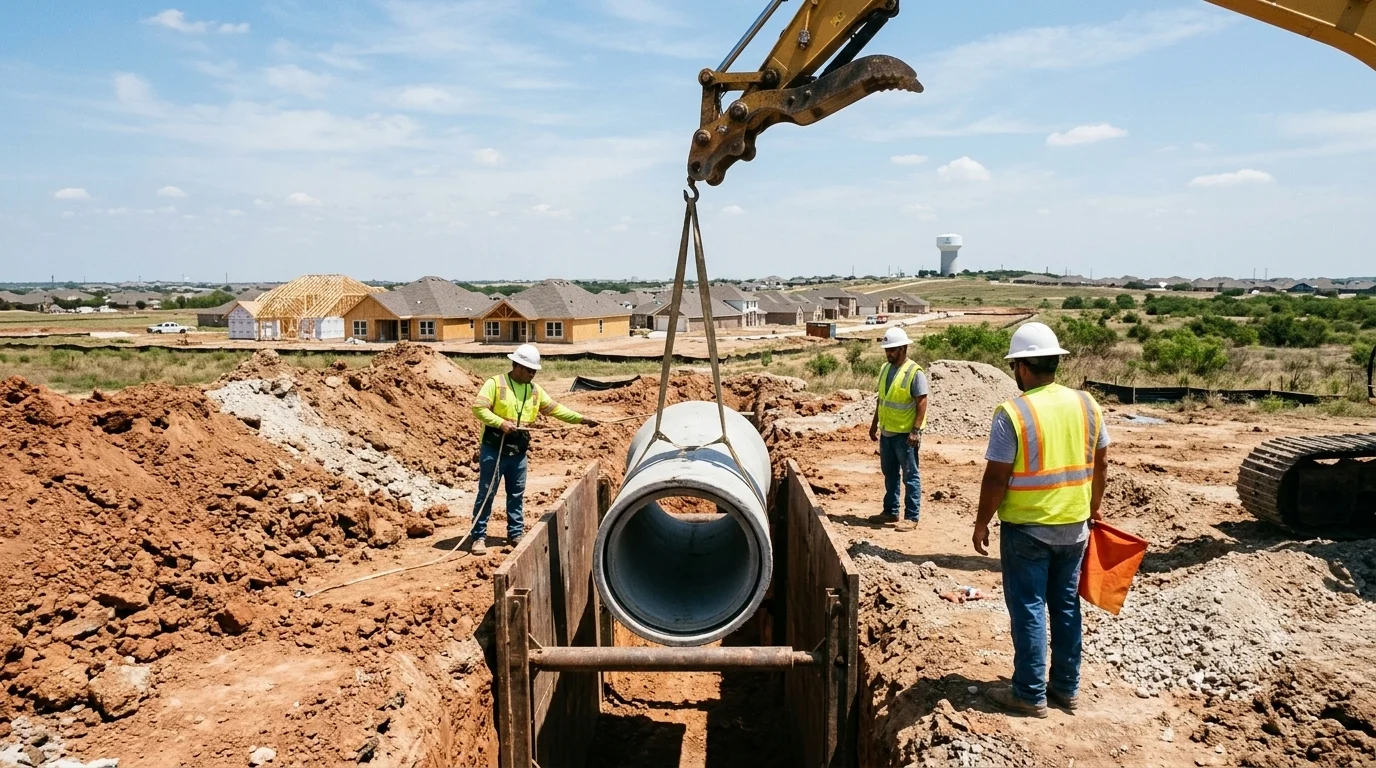
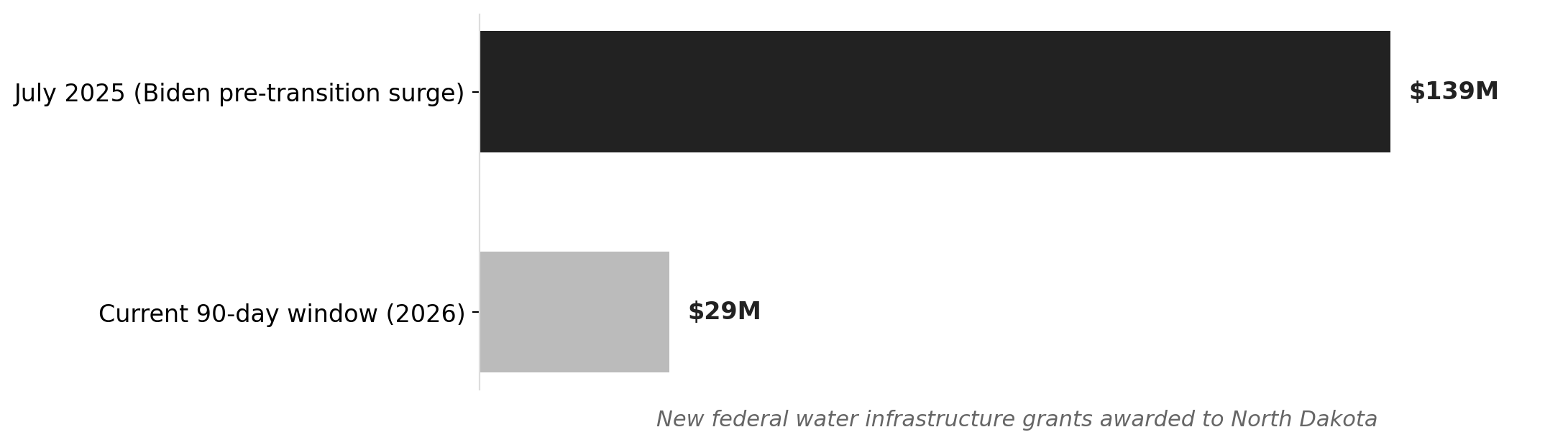
North Dakota has pulled in just $29 million in new federal water infrastructure grants over the past 90 days, against $133 million in the same window a year ago. That 78% drop looks, at first glance, like a funding cliff. It is not. It is the shadow cast by one extraordinary month.
In July 2025, North Dakota received $139 million in new water grants in a single 30-day burst. The largest piece was a $74.9 million Department of Interior award for the Garrison Diversion Unit, directed to the Three Affiliated Tribes of the MHA Nation at Fort Berthold, running through September 2029. The EPA added roughly $64 million in Clean Water and Drinking Water State Revolving Fund capitalization grants to the North Dakota Department of Environmental Quality in the same window. That single month accounts for virtually all of the year-over-year comparison. The current quarter's $29 million is not a retreat from normal. It is, more or less, the routine FY2026 Drinking Water SRF capitalization grant of $28.7 million the state has collected on schedule.
The mechanism behind July 2025 is not mysterious. The Biden administration spent its final months accelerating Infrastructure Investment and Jobs Act obligations, pushing agencies to lock in competitive awards before an incoming administration with a different set of infrastructure priorities could close the solicitations. According to water infrastructure funding researchers at WaterFM, that pre-transition acceleration was visible nationally: IIJA State Revolving Fund project-level awards in the first half of 2025 ran 53% below the first half of 2024, because so much had already been obligated in the sprint preceding the transition. North Dakota's July spike was a concentrated version of a national phenomenon.
Source: NationGraph.
The MHA Nation award carries more than accounting significance. The Garrison Dam, built in the 1950s, flooded the tribe's Missouri River bottomlands and destroyed the agricultural base the Three Affiliated Tribes had built over generations. The federal obligation that followed has been administered ever since through Interior's Garrison Diversion Unit program. The $74.9 million commitment, running through 2029, is among the largest single water infrastructure investments in the tribe's recent history and sits alongside a broader active portfolio for the nation that extends into the 2030s.
Below the headline number, North Dakota's active grant portfolio is substantial. EPA and Interior together have roughly $395 million in water infrastructure grants currently running in the state, with end dates spread as far as 2033. The state is not sitting on an empty pipeline. What is closing is the front end of that pipeline: the ability to start new major projects under IIJA authority.
The IIJA water infrastructure authorization expires September 30, 2026. FY2026 is the final year of the law's supplemental Drinking Water SRF lead-line replacement funding. The Trump administration has already closed or paused most competitive IIJA water grant solicitations, and its proposed FY2026 budget includes a 31.5% cut to Drinking Water and Clean Water SRF appropriations. The National League of Cities flagged this squeeze in December, noting that communities relying on formula-based SRF flows were likely to feel the pressure most acutely after FY2026 closes. North Dakota's DEQ is already responding: its FY2026 intended use plan caps per-system BIL lead-line grants at $3 million, citing demand that has outpaced available supply.
That cap matters in a state where 40% of the $934 million in DWSRF loan approvals through June 2025 went to systems serving fewer than 10,000 people. North Dakota has no large urban utility capable of floating bond markets to cover what federal grants once funded. Rural water districts, small municipalities, and tribal systems depend on the federal formula in ways that states with major metros do not. When the SRF supplemental funding winds down, there is no obvious local substitute.
The number to watch now is not the quarterly grant total, which will remain depressed as long as no new major competitive awards are initiated. The signal that matters is whether Congress reauthorizes IIJA water provisions before September 30, 2026, and at what funding level. Reauthorization proceedings are active in both chambers, but the gap between the current White House budget proposal and what state water agencies say they need is wide. For North Dakota, the $395 million already running will keep projects moving through the late 2020s. What happens to the systems that didn't make the July 2025 sprint is a question without an answer yet.