Montana received $20.8 million in federal transit grants in the trailing 90 days ending late September 2026, a 62% increase over the $12.9 million the state pulled in during the same window a year ago. The jump is not a windfall. It is a deadline.
The Bipartisan Infrastructure Law (IIJA, P.L. 117-58), which boosted rural transit formula funding by roughly 30% above pre-2022 levels, expires September 30, 2026. No surface transportation reauthorization bill has been introduced in Congress. When the authorization lapses, formula apportionments are expected to reset toward pre-IIJA floors, a potential drop of 20 to 30 percent in annual formula dollars for states like Montana that depend almost entirely on rural transit programs. The Montana Department of Transportation is obligating as fast as the federal pipeline allows.
The clearest evidence is in the Section 5311 Formula Grant for Rural Areas and Tribal Transit, MDT's primary funding vehicle for the network of small-city and tribal transit operators spread across 147,000 square miles. MDT received $12.6 million under Section 5311 in the current 90-day window, compared to $2.9 million in the equivalent period last year, a 4.3-times increase. That surge reflects FTA's publication of full-year FY2026 Section 5311 apportionments on March 31, 2026, under the Full-Year Consolidated Appropriations Act (P.L. 119-75), which triggered the final round of elevated formula obligations.
Source: NationGraph.
Also appearing in the current window for the first time: a $1.96 million Rural and Tribal Assistance Pilot Program grant to MDT, a newer FTA program with no equivalent award in Montana's grant record from the prior-year period. It targets the same sub-50,000-population communities as Section 5311 but operates under separate eligibility rules. Both programs share a statutory home in the IIJA and, critically, the same expiration date.
The activity is not limited to state-level formula flows. Billings, Montana's only small urbanized area, received two concurrent FTA awards in September 2026: a $2.97 million Federal Transit Formula grant under Section 5307 for operating and capital assistance, and a $1.15 million Buses and Bus Facilities grant under Section 5339 for fleet and facility investment. These programs have different eligibility structures than the rural formula grants, serving Billings as an urbanized area rather than flowing through MDT to rural sub-recipients. But they carry the same IIJA expiration pressure, and their simultaneous arrival points to a deliberate effort to move money before the authorization clock stops.
The result is that four distinct federal transit programs are converging in Montana's books in a single quarter, rural formula, tribal pilot, urbanized formula, and buses and facilities, each drawing from a different FTA account but all racing the same deadline.
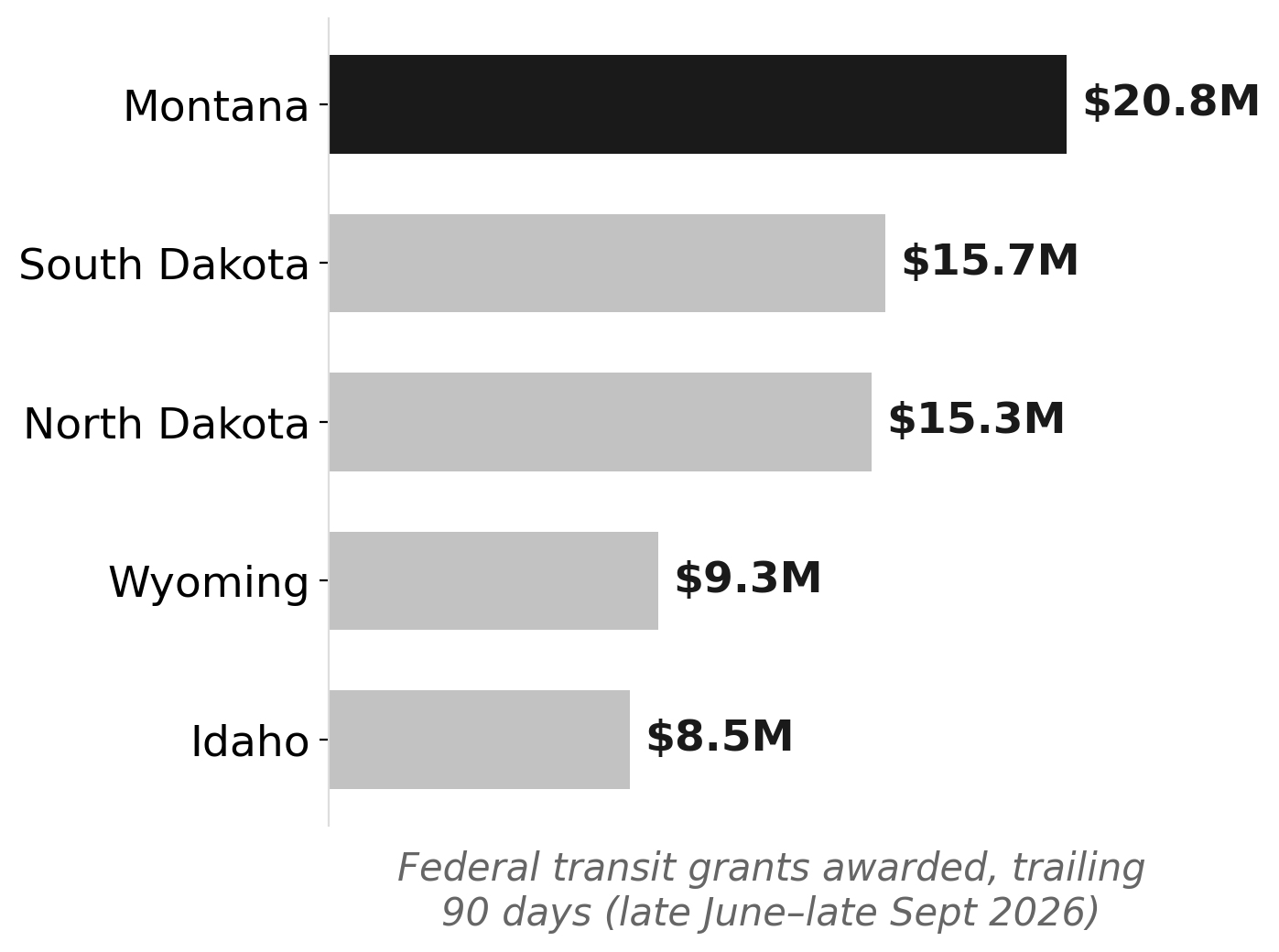
Montana's position among its neighbors makes the urgency concrete. Despite having fewer than 1.1 million residents, the state leads all five neighboring rural states in trailing-90-day transit grant volume: $20.8 million for Montana, compared to $15.7 million for South Dakota, $15.3 million for North Dakota, $9.3 million for Wyoming, and $8.5 million for Idaho. That ranking reflects both Montana's successful grant management and the structural advantages the state carries into the formula. MDT does not require local match for Section 5311 capital, and Montana's high proportion of federal public lands qualifies it for elevated federal cost-share rates under FTA's sliding-scale rules, meaning each formula dollar goes further here than in most states.
The active Montana transit portfolio now shows at least three concurrent Section 5311 MDT grants running simultaneously, including a $12.3 million rural formula grant initiated in June 2025 still active through 2027, and a $12.8 million Enhanced Mobility of Seniors and Individuals with Disabilities grant begun in May 2025. MDT is stacking obligations across grant years, building a funded runway that extends past the IIJA's expiration even if new apportionments fall.
What changes for Montanans if a reauthorization bill does not materialize? The transit.dot.gov rural formula program page describes Section 5311 as covering capital, planning, and operating assistance for communities under 50,000, which is most of Montana. Tribal communities including the Crow Nation, Fort Peck Assiniboine and Sioux, and the Chippewa Cree at Rocky Boy are active sub-recipients. A formula reset would hit operating budgets first, because capital grants can be front-loaded but operating assistance must be renewed annually at whatever the apportionment level is in the new authorization year.
The House Transportation and Infrastructure Committee and Senate Environment and Public Works Committee have held hearings on a successor bill, but as of late September 2026, no legislation has been formally introduced. State DOTs nationally have been running scenario planning for a 20-to-30-percent formula reduction. Montana has positioned itself to weather that transition better than most, but the cushion is a consequence of moving aggressively in the final months of the law that built it. The next signal to watch is whether Congress passes even a short-term extension before the fiscal year closes, and whether Montana's stacked active grants give MDT enough runway to hold the network together if it does not.