Three federal grants totaling $31.9 million landed in New Jersey's account on the same day, September 9, 2026, and all three came from the same source: the National Electric Vehicle Infrastructure Formula Program, in what amounts to the program's final fiscal year. The 90-day surge, up 131 percent from $13.8 million in the same window last year, is not a sign of a program hitting its stride. It is a state racing a clock.
The NEVI program, authorized by the 2021 Bipartisan Infrastructure Law, was designed to distribute $5 billion over five years to state departments of transportation for DC fast-charging stations along federally designated Alternative Fuel Corridors. FY2026 is the last appropriation year, with $885 million apportioned nationally. The Consolidated Appropriations Act of 2026 has already moved to transfer nearly $1 billion in undisbursed NEVI and related funds to other highway programs. Any state that has not obligated its share by the deadline loses it to other uses.
New Jersey nearly lost its share to something else first. The Trump administration froze NEVI obligations in February 2025, halting up to $1.5 billion in state commitments nationwide. New Jersey joined 13 other states in suing the U.S. Department of Transportation. The coalition secured a preliminary injunction in June 2025 and a final judgment restoring program access, as documented by the Eno Center for Transportation. That litigation did not create new money or a new program. It simply gave states back the formula funds Congress had already appropriated.
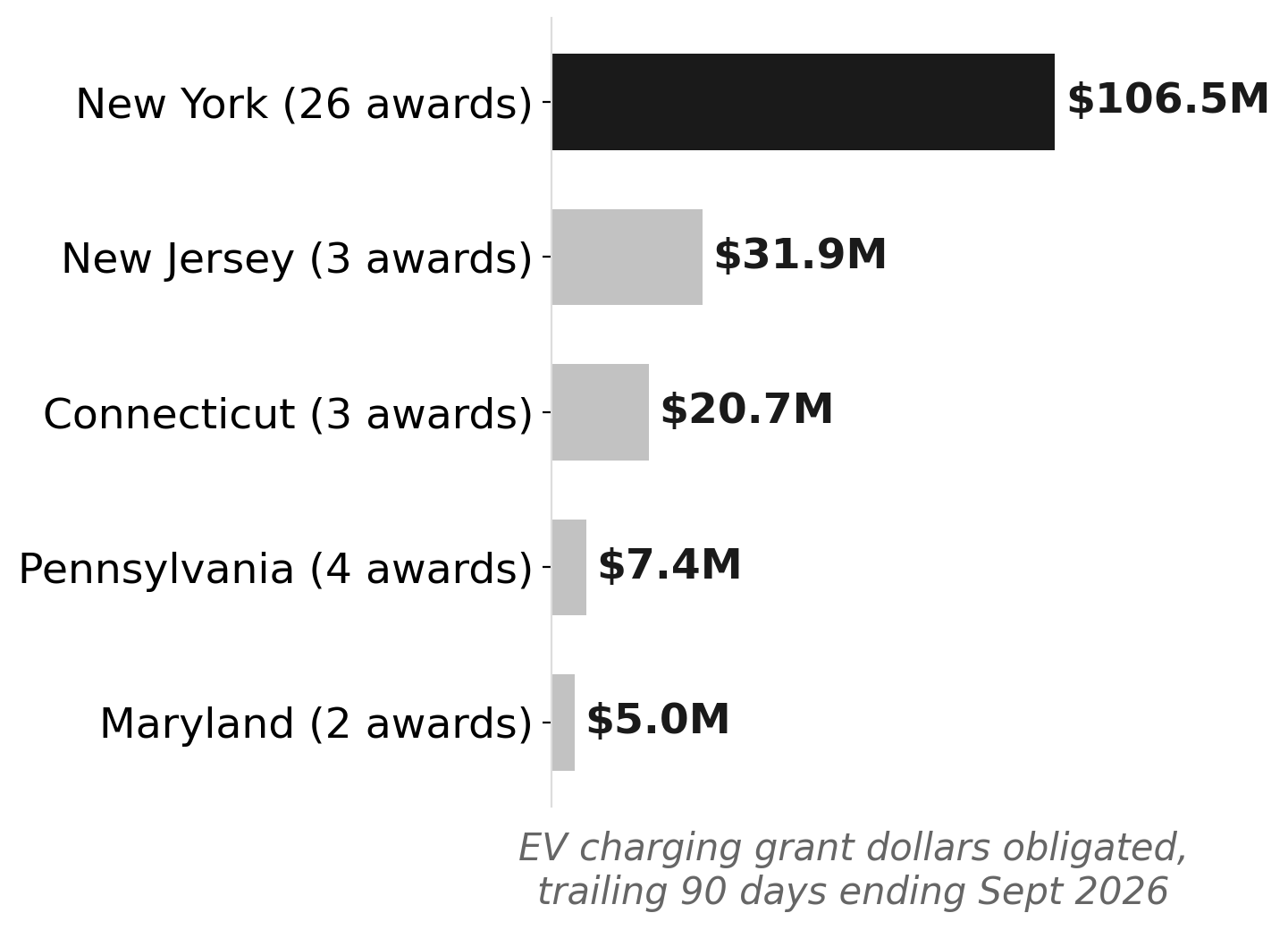
Source: NationGraph.
NJDOT moved on parallel tracks throughout. Even while the freeze was in effect, the department submitted its required state plan update to FHWA in September 2025, explicitly reserving its legal rights against the freeze-era actions in the same document. By July and August 2026, NJDOT had issued and updated multiple Design-Build NEVI Requests for Qualifications, targeting Alternative Fuel Corridors across the state. The September 9 obligation of all three remaining tranches, $15.9 million, $13.6 million, and $2.4 million, each running through 2036, followed directly from that procurement groundwork.
The three new grants bring New Jersey's total active NEVI portfolio across six awards to approximately $66.7 million. The state's full FY2022-through-FY2026 NEVI allocation totals $104.4 million, meaning the September package represents the close-out tranche of everything Congress set aside for New Jersey under the Bipartisan Infrastructure Law.
New Jersey's approach differs structurally from most of its neighbors. Where New York spread $106.5 million across 26 awards in the same 90-day window and Pennsylvania obligated $7.4 million across four awards, New Jersey is concentrating its NEVI dollars through a single-contractor design-build model. NJDOT's procurement bundles installation, operation, and five-year maintenance into one contract, targeting more than 40 DC fast-charging station locations across the state's interstate corridors, including I-95 and the New Jersey Turnpike, I-78, I-80, I-287, the Garden State Parkway, and the Atlantic City Expressway. A July 2026 peer-reviewed study of Mid-Atlantic NEVI implementation described New Jersey's approach as oriented toward "adaptive governance and infrastructure scalability," noting that New York showed the most advanced interagency coordination among the three states examined, while New Jersey's concentrated procurement model prioritized speed and contractor accountability.
That model fits the geography. New Jersey's entire interstate highway system carries federal Alternative Fuel Corridor designation, which means nearly every major travel corridor in the state is eligible for NEVI-funded infrastructure. The state's multi-agency coordination structure, spanning NJDOT, the Board of Public Utilities, the Department of Environmental Protection, and the Economic Development Authority, was built to maximize access to exactly this kind of federal formula program. A parallel stack of state-level programs, including Charge Up NJ, the Clean Fleet program, and multi-unit dwelling charger incentives, handles the demand side while NEVI funds the supply side along major corridors.
For New Jersey drivers, the September obligation means that the physical infrastructure, chargers, canopies, electrical connections, and maintenance agreements, will begin moving through the design-build procurement process this fall, with installations expected on a timeline running to 2028 or beyond under FHWA project delivery timelines. The grants themselves run through 2036, giving NJDOT a long operational runway even as the federal authorization that created NEVI expires.
The open question is what comes next. Congress has not authorized a successor program to NEVI, and the transfer of remaining national balances to other highway accounts signals no near-term appetite for renewal. New Jersey's state-level programs will continue independently, but they operate at smaller scale and without the corridor-deployment mandate that made NEVI distinctive. Whether the September 9 obligation marks the end of a buildout or just a pause depends on decisions in Washington that are not yet on any legislative calendar.