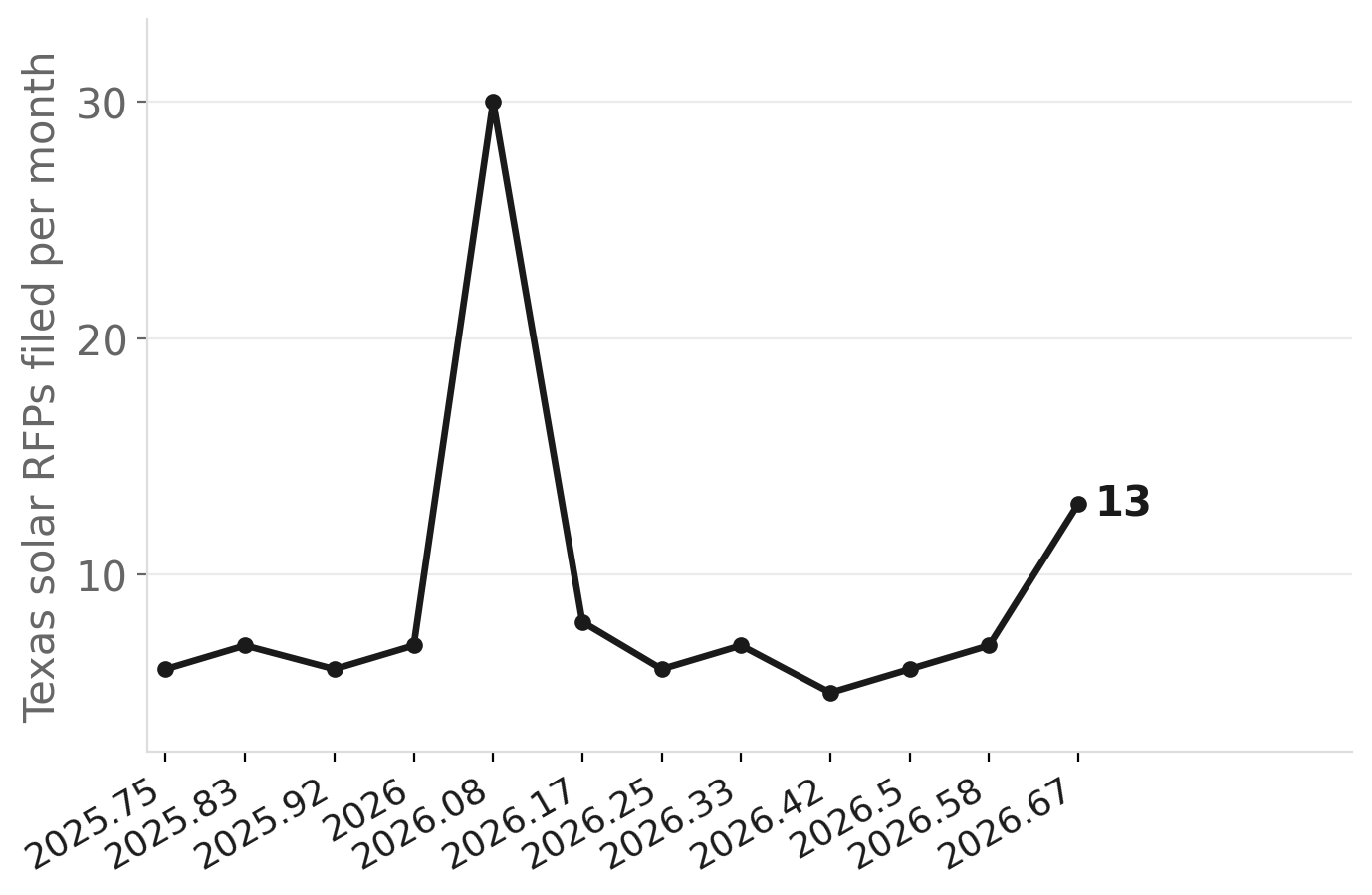
Texas municipalities have filed 13 solar RFPs in the last 30 days, roughly double the trailing 12-month average of about 6.5 per month, and the story behind that number is largely about a deadline that already passed.
H.R. 1, the "One Big Beautiful Bill Act" signed July 4, 2025, moved the federal Investment Tax Credit's solar phase-out from 2035 to 2027. It also created a hard safe-harbor window: projects that commenced construction before July 4, 2026 could lock in a four-year build period and capture the full 30% credit. That single deadline restructured municipal solar procurement across Texas for the next 18 months.
The primary rush came in February 2026, when 30 Texas solar RFPs were filed in a single month, a figure that dwarfs every other month in the data and aligns precisely with the final window for cities to get competitive bids in hand before the construction-start clock ran out. The current August-September uptick is a measurable but smaller second wave: cities that missed the safe-harbor window, or smaller jurisdictions that couldn't move that fast, are now filing anyway. Some are still positioning to capture residual ITC value on projects that can break ground before the credit phases out entirely in 2027. Others are accepting that the incentive math has changed and moving forward on economics alone.
Source: NationGraph.
The RFPs themselves reveal something important about who is actually driving this wave. This is not a utility-scale buildout story. Houston filed a bid for solar panels in school safety zones. Cedar Park issued a solicitation for solar roadway luminaires. Laredo put out an RFP for solar trail lighting. These are municipal-infrastructure projects, public works departments responding to a federal tax-credit calendar the same way they would respond to any expiring grant program. At the county level, Pecos County published wind-and-solar energy lease solicitations, while Wilson County and Hill County both show active solar tax-abatement agreements in recent meeting minutes, with developers including Moon Stone Solar, GranSolar Texas Ten, and a 400-megawatt storage project tied to Cielo Vista Solar in Duval County.
The county-level abatement agreements and the city-level ITC-driven RFPs are doing different things. Municipal solar projects, which cities typically structure through third-party ownership or power purchase agreements because they cannot directly monetize tax credits, depend heavily on the ITC to make project economics work. County reinvestment zones are a separate instrument, locally authorized tools that reduce property tax obligations for private developers, responding to the same ERCOT demand environment but serving private capital rather than public project budgets. Both are accelerating, but for distinct reasons.
Austin offers the clearest public record of how the ITC deadline shaped decision-making. The city council approved contracts in April 2026 for at least 30 megawatts of solar across city-owned facilities, with officials explicitly citing the ITC safe-harbor deadline as the reason for urgency. That kind of on-the-record acknowledgment from a major Texas city is unusual and underscores how directly the federal credit schedule was driving local procurement calendars.
Beneath the incentive story is a structural shift that will outlast the ITC in any form. EIA forecasts ERCOT solar generation will reach 78 billion kilowatt-hours in 2026, surpassing coal's projected 60 billion for the first time on an annual basis, with roughly 40% of all U.S. solar capacity additions this year coming from Texas. ERCOT's interconnection queue had reached an estimated 438,000 to 474 gigawatts of proposed demand by mid-2026, with approximately 90% attributed to data centers. Governor Greg Abbott called for a data-center interconnection audit on August 3, signaling that grid-capacity pressure has moved from a planning concern to a political one. Texas operates without a state renewable portfolio standard, so none of this activity is compliance-driven. It is purely economic, which means solar's competitiveness in ERCOT's deregulated merchant market is now the floor beneath whatever federal incentives remain.
For residents in cities that filed RFPs this summer, the near-term effect is largely invisible: public lighting upgrades, school-zone panels, trail systems. The longer-term signal is that Texas municipalities have, in the span of about 18 months, internalized solar procurement as standard capital-planning practice, not as a special initiative. Mesquite has a Solar Reinvestment Zone public hearing scheduled for September 28. Whatever the city decides will reflect both what the ITC still offers and what ERCOT's pricing already demands.
The open question heading into 2027 is whether the post-ITC economics hold for smaller cities that weren't fast enough to file in February. The data-center demand surge pressing on ERCOT suggests the grid-level case for new solar generation is not going away. Whether that translates into continued municipal procurement without the federal credit backstop is what the next wave of RFPs, or their absence, will answer.