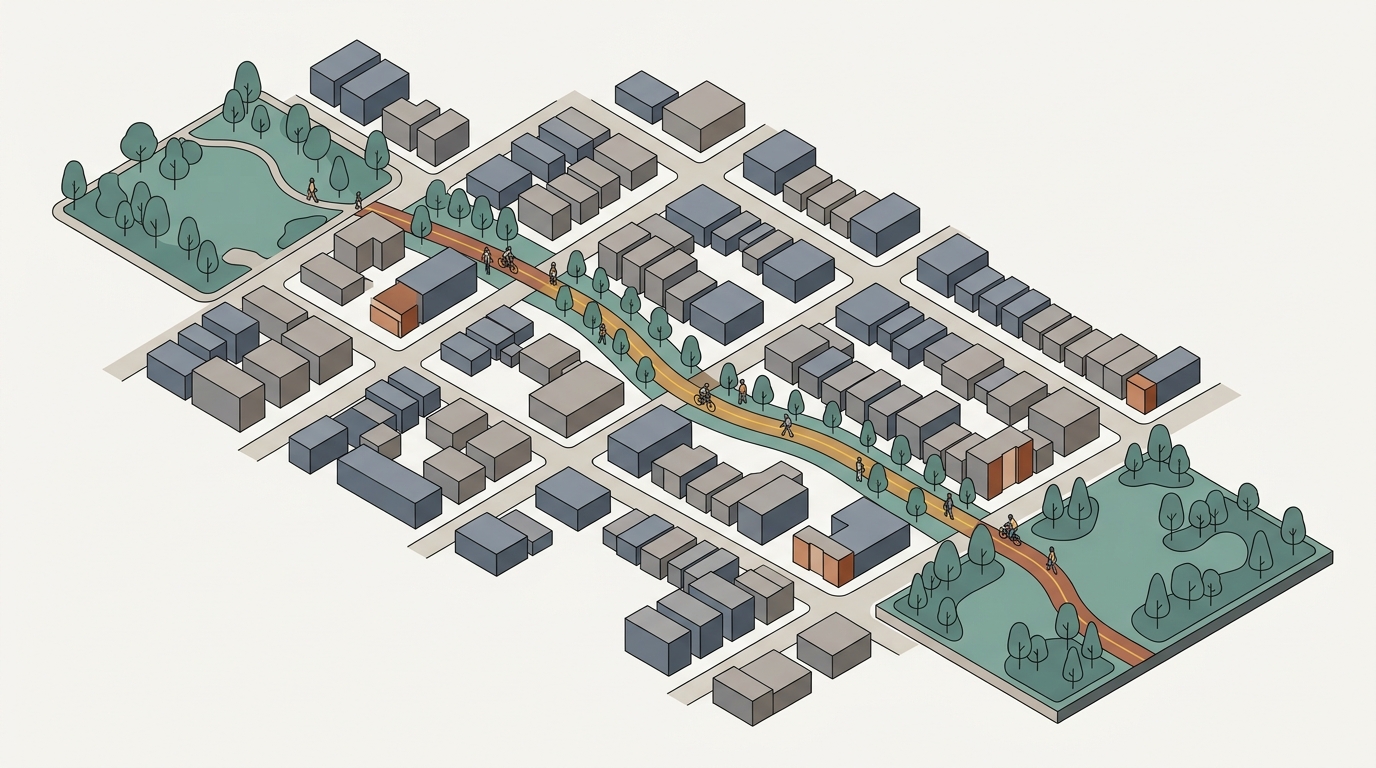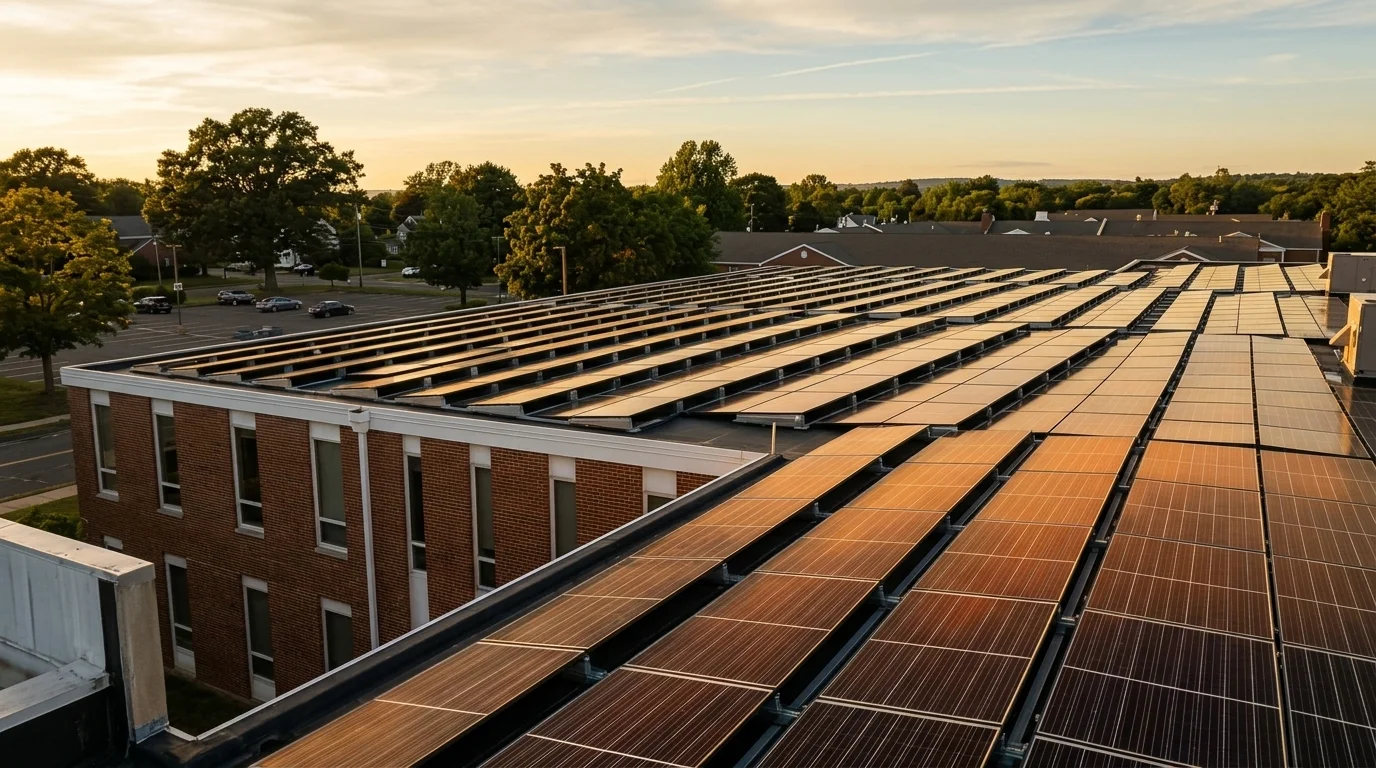
Five Connecticut institutions issued solar RFPs in the last 30 days alone, each one's first in over a year, spanning a municipal landfill, two high school campuses, a state university pilot array, and a school district rooftop project. The burst is measurable against the baseline: CT solar RFP volume has run at six to nine distinct institutions per month since February 2026, roughly double the two-to-five per month pace recorded in fall 2025. That inflection lines up almost exactly with a single event: the passage of HB 5340.
Governor Ned Lamont signed Public Act 26-127 on May 20, 2026, after the General Assembly passed it on the final day of the legislative session. The law extends Connecticut's Non-Residential Renewable Energy Solutions (NRES) tariff program, the primary vehicle for school and municipal solar since 2022, through at least 2036, creates successor programs, and mandates automated solar permitting for municipalities by 2029. As CT Public Radio reported, the bill cleared the Senate with bipartisan support after years of debate over whether Connecticut's solar incentives were structured to reach all income levels and institution types. State Sen. Norm Needleman framed the stakes plainly: solar should "deliver benefits to all, not just some."
For local governments, the practical effect was immediate. The NRES program compensates non-residential solar owners through utility tariffs, a guaranteed revenue stream that makes the economics of a school rooftop or a capped landfill pencil out over a 20-year horizon. Before HB 5340, that stream had no legislated floor past the near term, and capital planning committees at towns and school boards were reluctant to commit. The law's ten-year runway changed the calculus.
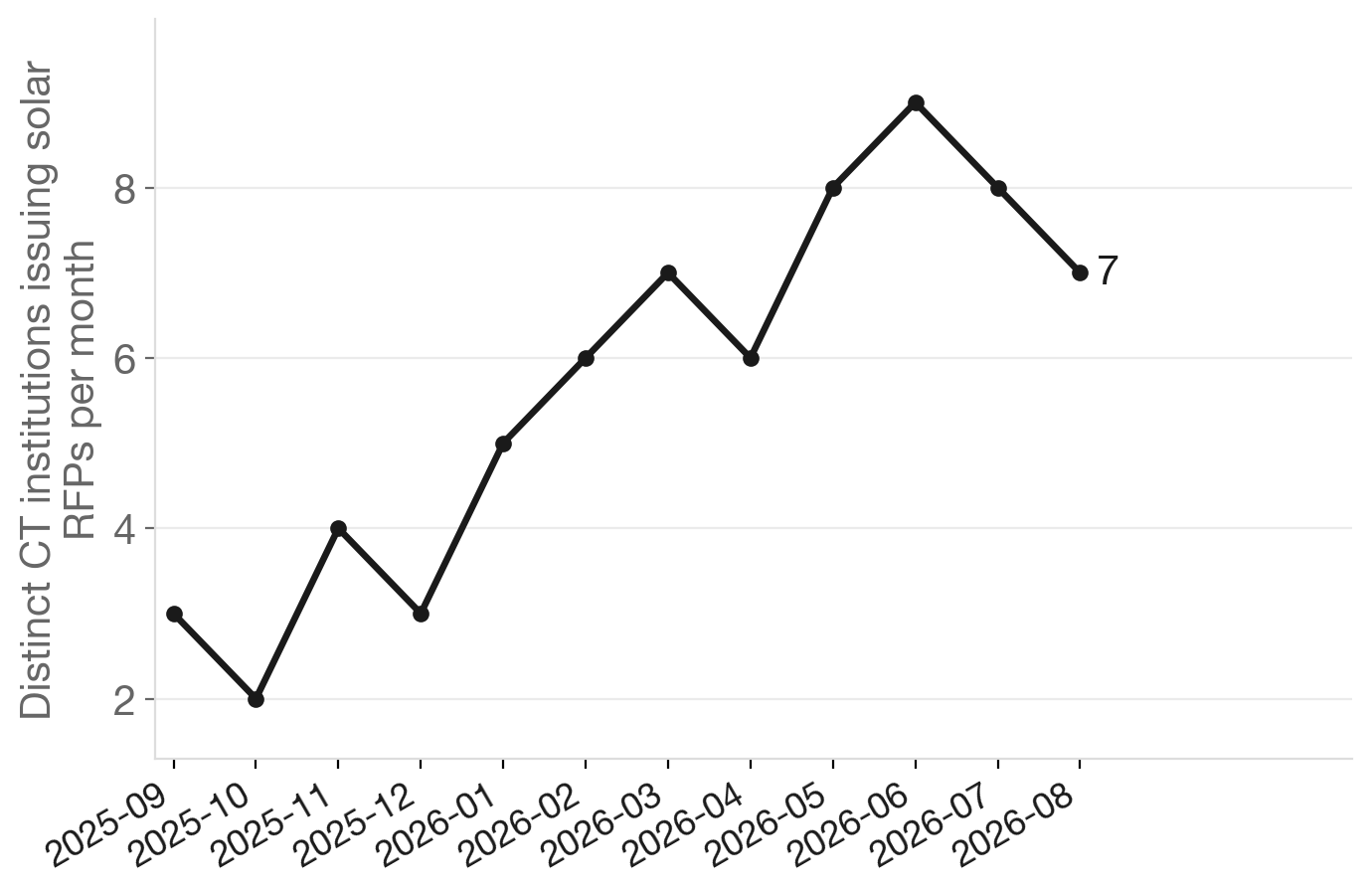
Source: NationGraph.
Bristol's solicitation is the clearest illustration. The city issued a build-own-operate RFP for solar at Central and Eastern High Schools that explicitly invokes the NRES program, keyed directly to the mechanism HB 5340 extended. A developer who wins that contract now has legal certainty about the tariff structure for the length of any reasonable financing deal. That's the kind of backstop that had been missing.
Old Lyme's bid tells a different part of the story. The town of roughly 7,700 residents is pursuing landfill-cap solar, a site type that has long made sense on paper, unusable land, municipal ownership, no displacement of other uses, but that small towns had deferred because the incentive timeline was uncertain. HB 5340's permitting mandate adds another layer: by requiring municipalities to adopt automated solar permitting tools like SolarAPP+ by January 2029, the law lowers the administrative friction that had made small-town projects disproportionately costly to develop. UConn's Discovery Drive Solar Array Pilot, open only to pre-qualified contractors, signals a project that cleared internal capital approval after the bill's passage, an advanced-planning stage that universities don't reach without confidence in the policy environment.
Connecticut's high electricity rates make this dynamic especially pronounced. Eversource and United Illuminating customers pay among the highest rates in the continental United States, so the payback math on a municipal solar array is favorable relative to most states even before incentive stacking. What the NRES program provides is the revenue certainty side of the equation; HB 5340's extension converts that from a sunsetting assumption into a durable one.
The law also positions Connecticut alongside a small group of states moving aggressively on residential solar access. PV Magazine noted that Connecticut is the sixth U.S. state to legalize plug-in solar, effective October 1, 2026, a provision aimed at renters and low-income households who can't host rooftop panels. The municipal procurement surge and the plug-in solar authorization are different policy levers, but they reflect the same legislative intent: lower the barriers to entry across every institution type and income level simultaneously.
The next signal to watch is PURA's rulemaking calendar. HB 5340 tasks the Public Utilities Regulatory Authority with designing NRES successor programs by 2028. The specifics of those programs, tariff rates, capacity caps, eligible technologies, will determine whether the current procurement wave sustains itself or peaks before the successor structure is clear. Towns and districts that move now are locking in under known NRES terms; those that wait will be making bets on a successor program that hasn't been fully designed yet. That asymmetry is likely doing as much to accelerate the current pipeline as the law itself.