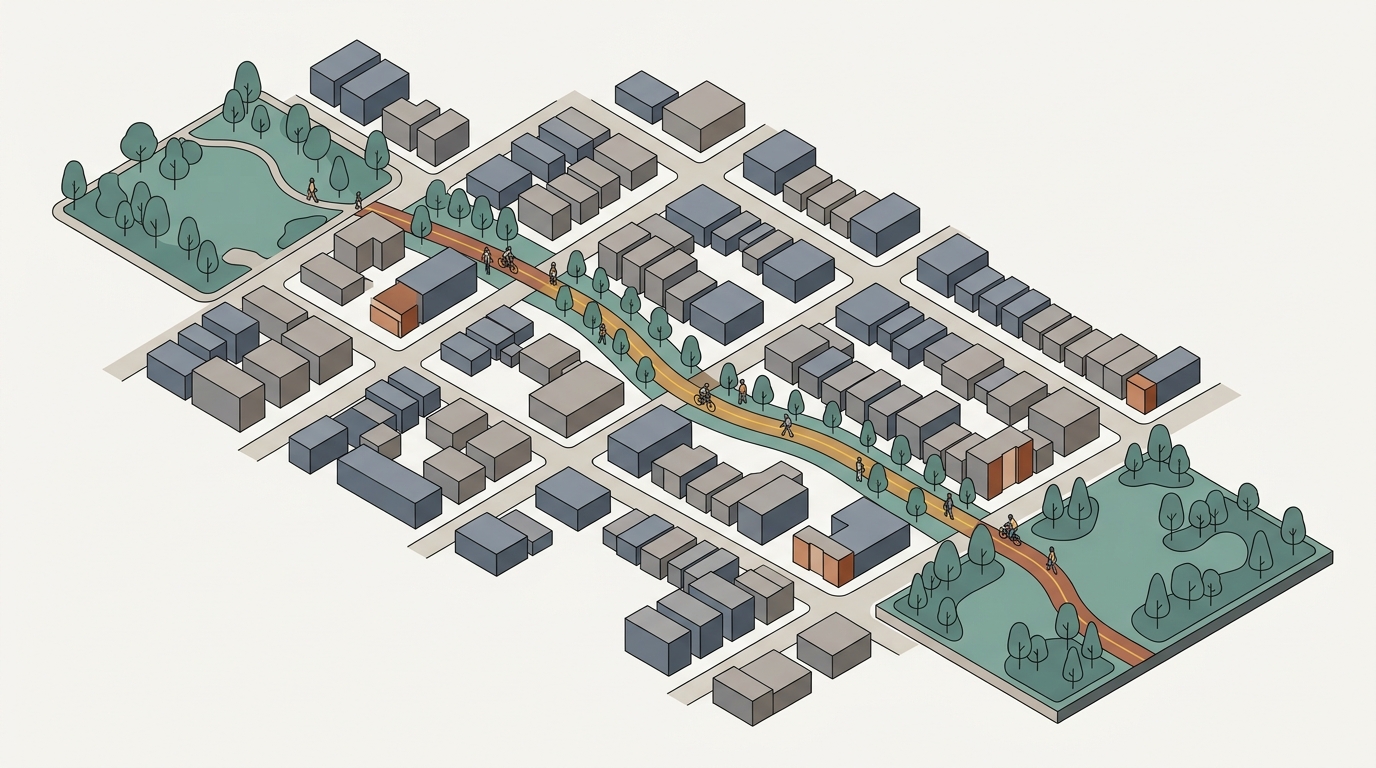
Elkhart, Indiana is moving forward with a new multiuse path that would connect two neighborhood parks on the city's south and central side, giving residents a safer option for getting around without a car.
The path will run along Baldwin Street and Bristol Street, linking High Dive Park to Walker Park. For people who live nearby and rely on walking or cycling for daily transportation, not just recreation, the corridor currently offers little protection from traffic. That's a familiar problem in mid-sized Midwestern cities where postwar street design was built around cars.
Elkhart (population roughly 54,000) has a poverty rate near 20 percent, above state and national averages, and a large share of residents who depend on non-motorized travel. A connected, safe path between two parks can function as real transportation infrastructure in neighborhoods like these, not just an amenity.
The project is funded through federal transportation dollars administered by the Indiana Department of Transportation under its Local Public Agency program, which channels federal active transportation funding to cities and counties for exactly this kind of project. The federal Bipartisan Infrastructure Law, passed in 2021, significantly expanded national investment in bicycle and pedestrian facilities, and Elkhart has been among the Indiana cities actively pursuing those funds as part of a broader quality-of-life push since the city's economy was devastated by the 2008-2009 recession.
The new path fits into a longer-term vision for trail connectivity in Elkhart County, which has been working toward a more complete regional network for years. City planning documents going back to 2019 identified gaps in pedestrian and bicycle connections between parks and neighborhoods as a priority.
The city is now in the process of selecting engineers and designers for the project. How quickly construction follows will depend in part on how smoothly the federally required contracting process moves. LPA-administered projects in Indiana have sometimes faced delays due to the complexity of federal compliance requirements, though no specific concerns have been raised about this one.