Seven PFAS-related procurement contracts have been posted by Maryland public agencies in the past 30 days, against a 12-month monthly average of 1.6, a 342% spike that has accelerated sharply since May. The timing is not coincidental. On May 19, 2026, EPA Region 3 announced $9.687 million in new Emerging Contaminants grant funding for Maryland. The following day, EPA published a proposed rule to extend the PFOA/PFOS drinking water compliance deadline from 2029 to 2031 and to rescind maximum contaminant level limits entirely for four other PFAS compounds. Communities holding unspent federal dollars read that combination clearly: the money is here, the rules may be loosening, and the window to lock in treatment designs is now.
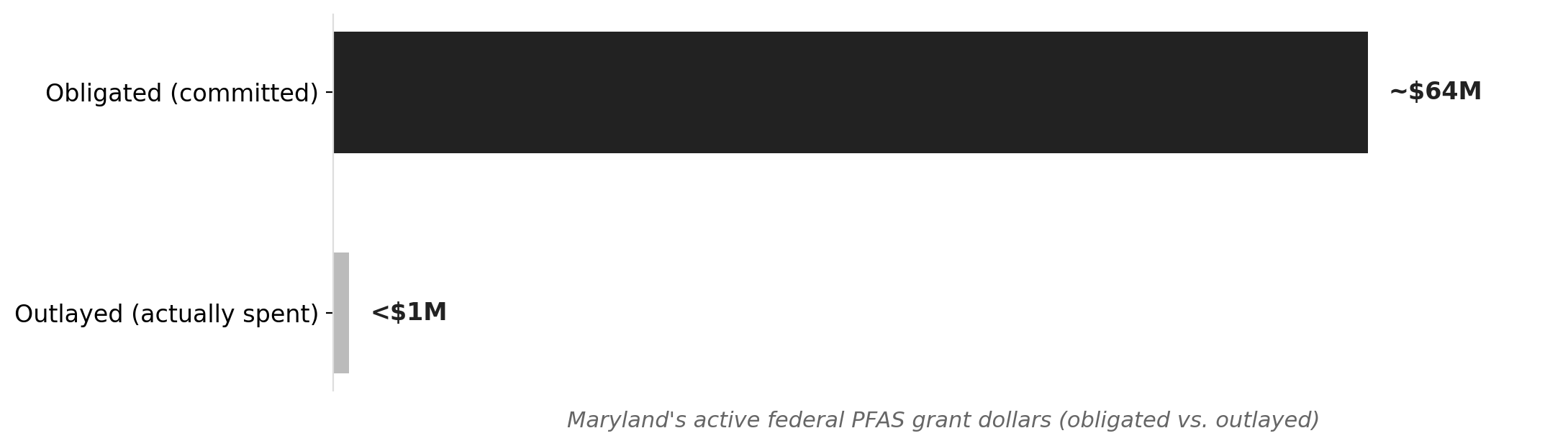
Maryland's active EPA PFAS grant portfolio totals roughly $64 million in obligated federal funds, anchored by a $26.9 million Drinking Water State Revolving Fund award and two Emerging Contaminants grants totaling $28.4 million. Less than $1 million of that EPA money has been outlayed. That gap, between dollars committed and dollars spent, is what the current RFP surge is closing.
The procurement activity is concentrated in a handful of jurisdictions but spans the full range of what remediation actually requires. Frederick County has re-issued its Bradford Estates Water Treatment Plant Upgrade solicitation multiple times since April 2026, seeking a full PFAS removal system, UV disinfection, and ion-exchange cartridge filter upgrades. The repeated re-issuances point to procurement difficulty, which itself signals how new and technically demanding this infrastructure category is for smaller water systems. The Washington Suburban Sanitary Commission is moving at a different scale: its progressive design-build RFP for a PFAS pilot treatment plant at the Potomac Water Filtration Plant, which serves Prince George's and Montgomery counties, has a bid deadline of August 20, 2026. Harford County Public Schools, meanwhile, is soliciting PFAS evaluation, design, and grant-writing services for five schools, explicitly bundling grant pursuit into the contract scope, a sign that school systems have identified federal dollars as available but need help capturing them before program rules change.
Source: NationGraph.
The structural reason Maryland is further along than its neighbors is its military geography. The state hosts ten installations with documented PFAS contamination, including Aberdeen Proving Ground, Fort Meade, Joint Base Andrews, and Naval Air Station Patuxent River. Decades of aqueous film-forming foam use at those bases has leached into shallow aquifers that feed both base housing and surrounding civilian municipal wells. Maryland's narrow coastal plain, wedged between the Chesapeake Bay and the Piedmont, gives contamination plumes short distances to travel. Pennsylvania and Virginia show zero PFAS procurement RFPs in the same 30-day window; Maryland's combination of military density, shallow hydrology, and an active MDE five-phase PFAS sampling program running since 2020 has put its localities further along the translate-diagnosis-to-procurement pipeline.
The contamination map is also widening beyond military bases. Montgomery County recently disclosed a PFAS plume in Muddy Branch Creek originating from its former Public Safety Training Academy in Rockville, a reminder that AFFF foam use was not limited to federal facilities and that the remediation burden extends to municipal fire training sites as well.
The EPA's proposed rollback, whose public comment period closed July 20, 2026, creates an unusual dynamic. Normally, a weakening of federal standards would reduce urgency. Here it is producing the opposite effect. Grant agreements tied to current MCLs require treatment systems to meet those limits as written. If the rules are revised after a community has designed its infrastructure around the 2026 standards, the treatment capacity may exceed whatever federal floor remains, but the grant money, once spent, is spent on the original design. Communities are therefore racing to reach the design-complete threshold before a revised rule changes the terms of what they are building and potentially the terms under which future federal dollars are awarded. Maryland's April 2027 deadline, by which all public water systems must report PFAS monitoring results to consumers and issue public notices for any violations, adds a hard operational clock to what is already a financial one.
For residents served by the Potomac Water Filtration Plant or the Bradford Estates system, the practical outcome is that treatment infrastructure is being procured now at federal expense, which means construction timelines and rate impacts depend heavily on whether grant disbursements stay on schedule. The next signal to watch is whether EPA finalizes the MCL rollback before or after WSSC's August 20 bid deadline. If the rule is finalized in its proposed form before bids close, it could force WSSC and other large systems to recalculate their design specifications mid-procurement, a disruption that smaller utilities, already struggling to re-issue RFPs, are even less equipped to absorb.