California water agencies issued 15 PFAS treatment RFPs in the last 30 days, against a 12-month average of roughly 5.8 per month, a 2.6-times spike that is still building. June logged 9. July is already at 12 with a week remaining. The procurement surge is concentrated in Southern California, where Orange, Los Angeles, and San Bernardino counties account for all 15 bids, and where the aquifers supplying drinking water to millions of residents are among the most PFAS-contaminated in the country.
Three deadlines landed on the same calendar, and agencies are responding all at once.
The first was the California State Water Resources Control Board's General Order DW-2025-0002-DDW, issued December 12, 2025, which requires every community water system in the state to begin PFAS initial monitoring. That order set compliance clocks running for hundreds of utilities simultaneously. The second is money: California's FY 2026-27 Drinking Water State Revolving Fund cycle makes $464.6M in IIJA-backed PFAS grants and principal forgiveness available this cycle, and the Bipartisan Infrastructure Law's appropriation authority is approaching its expiration. Agencies that do not have contracts in place cannot draw down grants. The third trigger is the one that produced the apparent paradox driving the current rush.
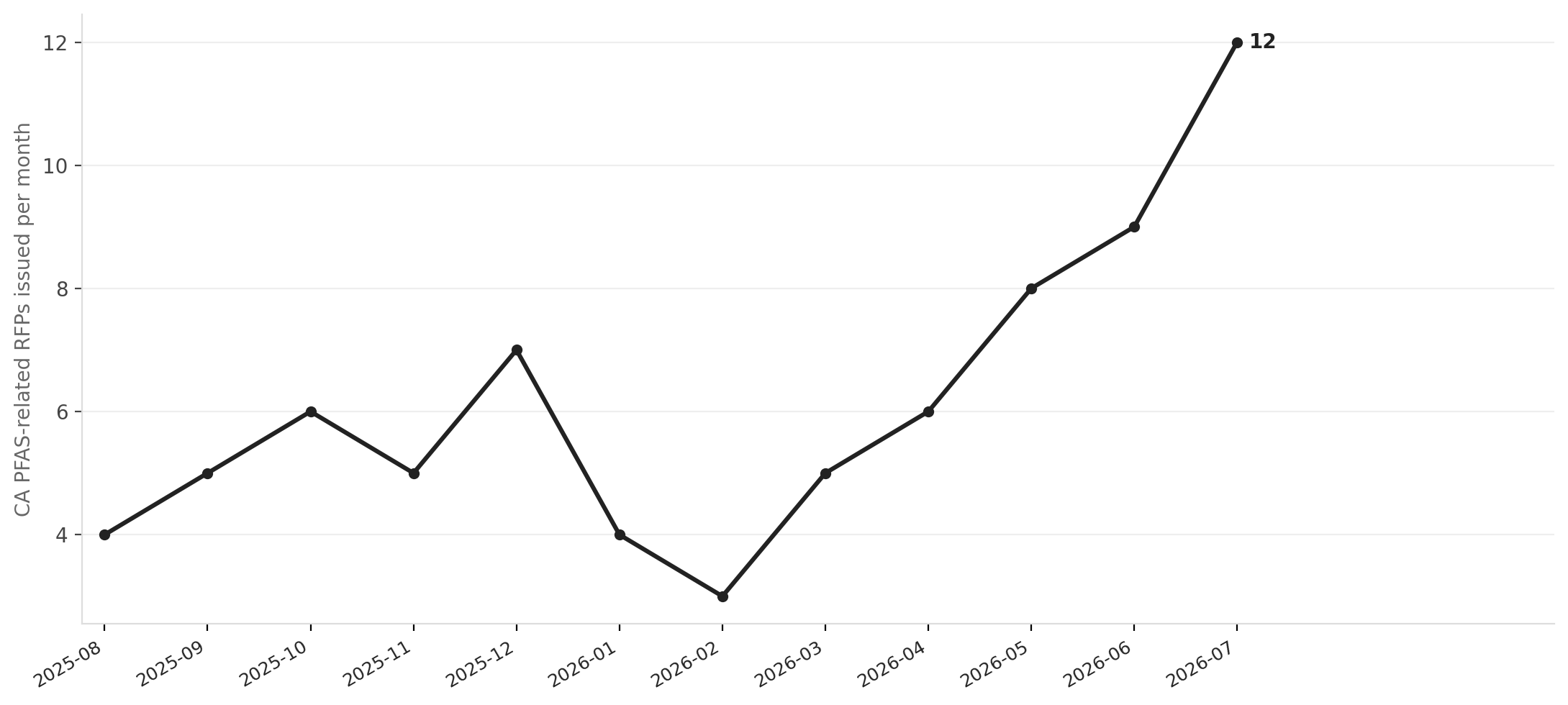
Source: NationGraph.
In May 2026, the EPA proposed rescinding its Maximum Contaminant Levels for four PFAS compounds, PFHxS, PFNA, GenX, and PFBS, while retaining the 4 parts-per-trillion limit for PFOA and PFOS. Nationally, that looked like a rollback. In California, it accelerated procurement. The state's own advisory levels for those four compounds already require agencies to act regardless of what the federal floor does, and the California Office of Environmental Health Hazard Assessment is separately developing a Public Health Goal for PFHxS that will eventually anchor a state MCL stricter than the rescinded federal standard. California utilities cannot wait for the federal picture to stabilize; they must build to California standards, and the federal money to help them do it is running out.
No single agency illustrates the pressure more clearly than Orange County Water District. It accounts for 7 of the 15 current RFPs, covering treatment plant buildouts and construction management for named city wells in Santa Ana, Garden Grove, Fullerton, and Fountain Valley. The district supplies drinking water to 2.5 million people through a groundwater basin where more than 100 wells have been confirmed PFAS-impacted, and its own estimates put total mitigation costs at $1.8 billion over 30 years. It received a $30M Bureau of Reclamation grant in January 2025 for that program. Then, on May 27, 2026, the EPA announced $15.7M for seven additional Southern California PFAS projects, layered on top of $77.3M in Emerging Contaminants grant commitments already announced for California. For OCWD, each new grant tranche raises the urgency to have shovel-ready contracts that can absorb the money before the funding window closes.
Across the state, California now holds $142M in PFAS federal grants committed in the last 24 months, second among large states only to New York's $175M. The active portfolio is larger still: two EPA Drinking Water SRF tranches to the State Water Board, each in the $97-to-100M range, run through 2030, and a $97.6M award that began in July 2025 is already flowing to local systems. A $6.45M EPA congressional directive separately targets the Western Municipal Water District of Riverside County. The sheer scale of available capital is creating its own procurement pressure, agencies that move slowly forfeit their share.
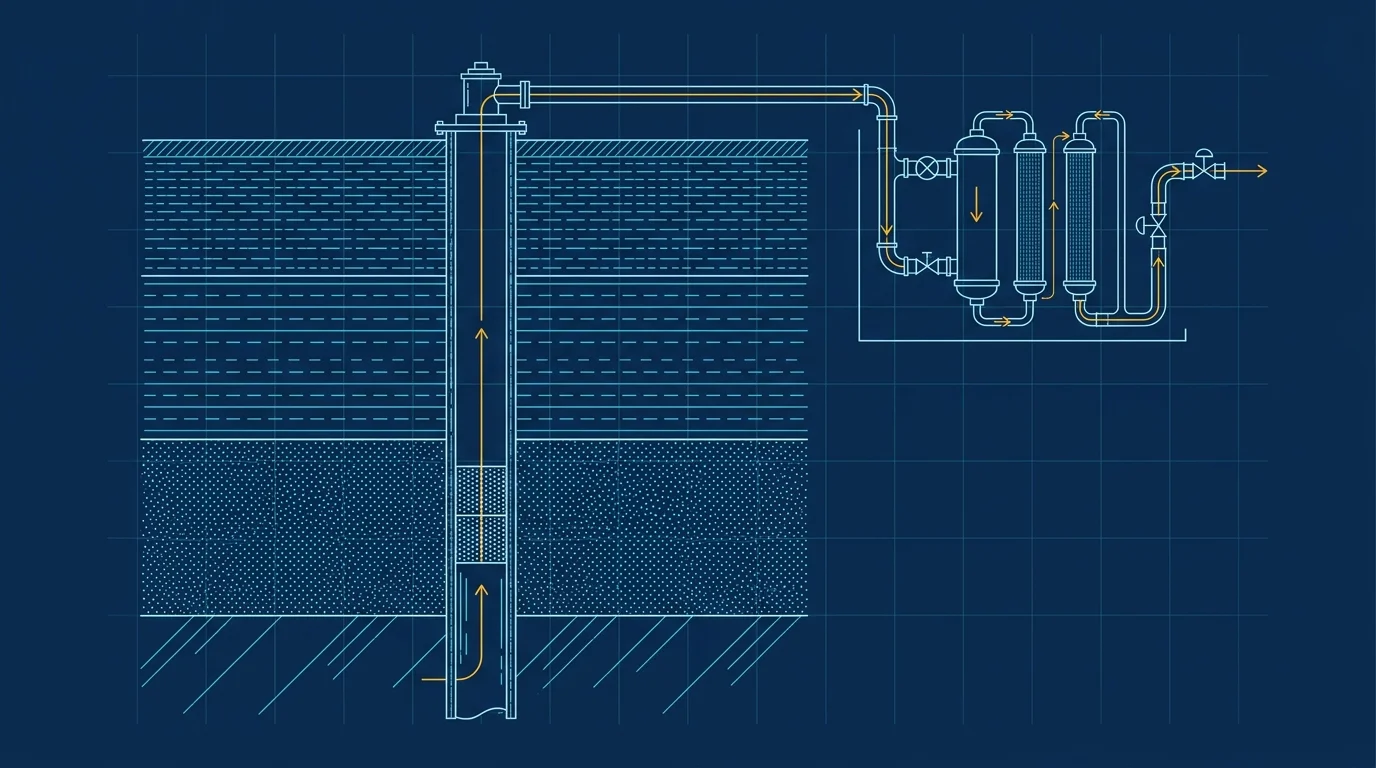
For residents in Orange, Los Angeles, and San Bernardino counties, the immediate consequence is construction. Treatment systems for PFAS, granular activated carbon filters, ion exchange resins, high-pressure membrane systems, are capital-intensive and take years to permit, build, and commission. The RFP wave happening now is the precursor to a multi-year buildout of drinking water infrastructure across the region's most affected communities. Rate impacts will follow; OCWD's $1.8B cost estimate is a figure that will eventually be distributed across its service area.
The next signal to watch is California's own MCL rulemaking. The State Water Board is developing enforceable state MCLs for PFAS that will be stricter than the federal floor. Once those are finalized, agencies currently operating under advisory levels will face hard compliance deadlines, and the federal funding that could offset construction costs will largely be gone. The utilities procuring now are betting that locking in contracts and grant commitments before that rulemaking lands is cheaper than scrambling for financing afterward. The July RFP count suggests that bet is being placed widely, and fast.