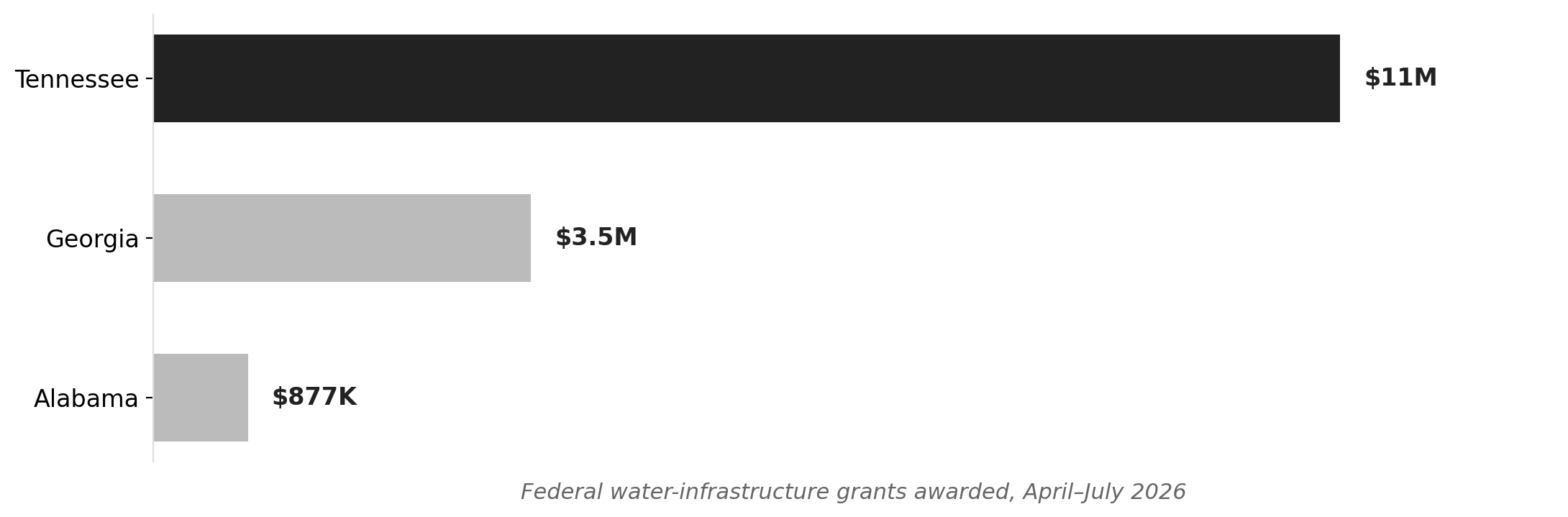
Federal water infrastructure grants flowing into Tennessee reached $11 million in the 90 days ending early July 2026, a 2,126% jump from $494,900 in the same window a year ago. No peer state in the Southeast comes close: Georgia drew $3.5 million in the same period, Alabama $877,000. The surge is not a routine budget cycle. It is the product of two separate federal money streams that happen to be cresting at the same moment, and both carry expiration pressures that will not repeat.
The two grants driving the immediate spike are an $8.57 million Abandoned Mine Land Reclamation award from the Interior Department's Office of Surface Mining Reclamation and Enforcement, which started July 1 and runs through June 2031, and a $2.44 million EPA recycling infrastructure grant to Metro Nashville-Davidson County that began in May. The mine reclamation money is consequential beyond its dollar figure: Tennessee is designated an "uncertified" state under the Surface Mining Control and Reclamation Act, meaning it still carries priority unreclaimed legacy coal sites on the Cumberland Plateau, and it receives an annual formula share of the roughly $725 million OSMRE distributes nationally each year under the IIJA. That stream runs through 2036, but the underlying IIJA water authorization does not.
FY2026 is the final year of the Infrastructure Investment and Jobs Act's five-year, $50 billion water program. Every major EPA water grant mechanism, the Drinking Water and Clean Water State Revolving Funds, the Emerging Contaminants grants for small and disadvantaged communities, and the PFAS-targeted EC-SDC program, was authorized through this fiscal year. EPA Region 4 Administrator Kevin McOmber announced a $10.5 million EC-SDC PFAS grant for Tennessee on May 19, 2026, part of the last large tranche under that authorization. When the fiscal year closes, Congress would have to pass new water infrastructure legislation to maintain anything close to this funding level. No such reauthorization is currently on the floor.
Source: NationGraph.
Layered on top of the IIJA's final-year push is a separate stream that most southeastern states did not receive at the same scale. Hurricane Helene made landfall in September 2024 and triggered a federal major disaster declaration for eastern Tennessee on October 2. The American Relief Act of 2025 (P.L. 118-158), passed in December 2024, directed supplemental State Revolving Fund dollars to Helene-impacted states. EPA allocated $58 million to Tennessee on September 30, 2025: $44.3 million for the Drinking Water SRF, $8.2 million for the Clean Water SRF, and $3.5 million for decentralized systems. North Carolina received a larger share given the scale of its Helene damage, but Tennessee's allocation dwarfs what any peer state received through normal annual SRF appropriations.
The result is a $771 million active EPA water grant portfolio currently running in Tennessee, the bulk of it in nine SRF grants and a $39.8 million WIIN/EC-SDC emerging contaminants award, with most of those commitments running through 2029 to 2032. The state is not simply receiving a one-time check. It is managing multiple multi-year federal obligations simultaneously, each with its own compliance, draw-down, and reporting requirements. Tennessee TDEC has assembled a university consortium, including Tennessee Tech and Vanderbilt, to deploy emerging-contaminants technical assistance to smaller utilities using IIJA capacity grant funding, a sign that the state is trying to build absorptive infrastructure alongside the financial commitments.
Absorptive capacity is the real variable here. Rural water systems and legacy mine-impacted communities in eastern Tennessee often lack the engineering staff and grant administration resources to move quickly on federal dollars. The AMLR grant's five-year runway to 2031 provides some relief, but EPA's SRF and EC-SDC awards typically require project-ready applications and matching timelines. EPA's water resilience funding framework emphasizes expedited draw-downs for disaster-recovery SRF allocations, which adds pressure on state program offices already managing the IIJA closeout.
For Tennesseans, what this means in practical terms is that the next two to three years represent the best-funded window for water system upgrades the state is likely to see for at least a decade. Utilities serving communities near former coal mines in Morgan, Scott, and Campbell counties are the most direct beneficiaries of the AMLR stream. Small systems dealing with PFAS contamination, concentrated in the Cumberland Plateau and parts of Middle Tennessee, are the target of the EC-SDC PFAS grant McOmber announced in May.
The next signal to watch is whether Congress moves on any successor to the IIJA water authorization before the end of FY2026. Absent new legislation, the pipeline that produced this 2,126% spike closes. What remains will be the multi-year obligations already on the books, and the question of whether Tennessee's water agencies spent the window well.