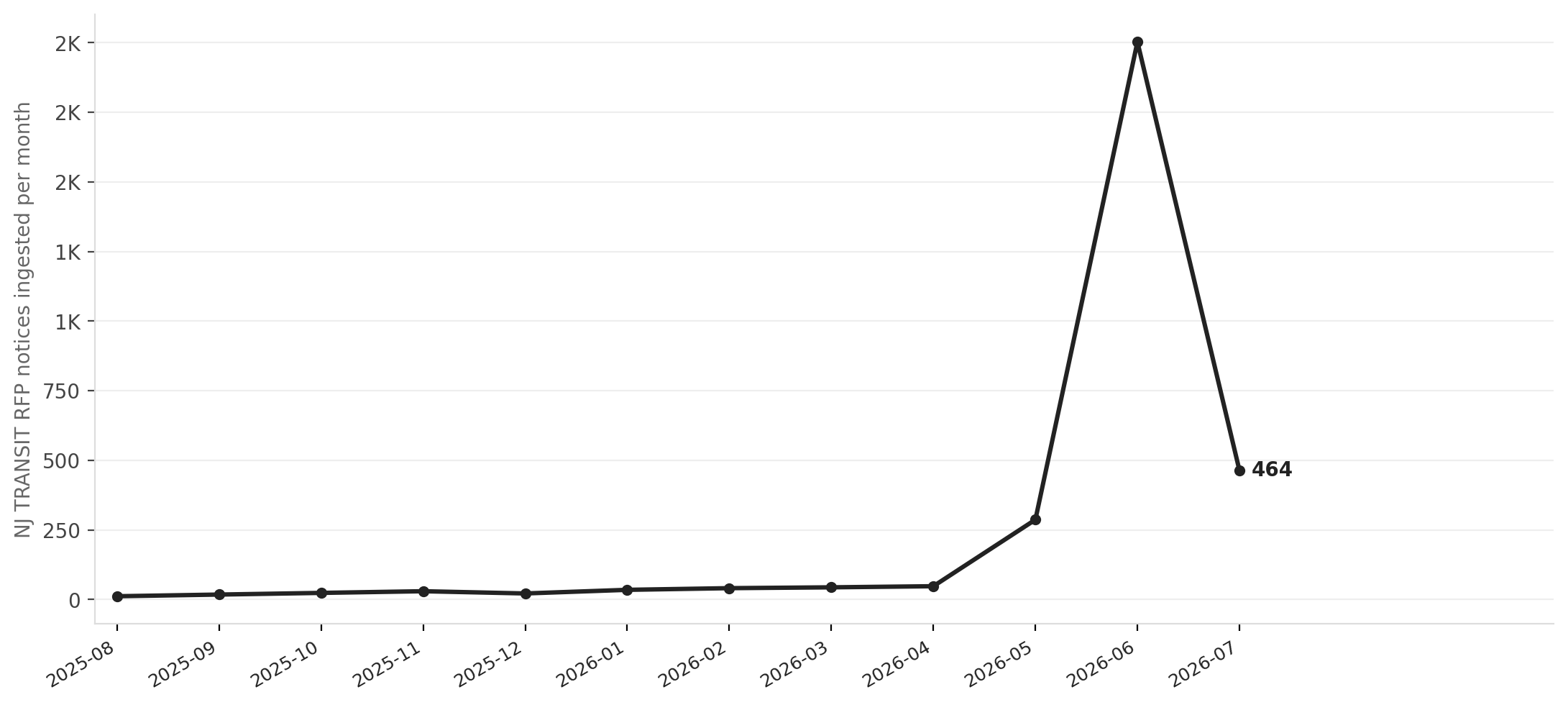
NJ TRANSIT's procurement portal pushed roughly 2,054 contract notices into NationGraph's database between June 7 and July 7, 2026, about 65 to 70 per day, against a prior 12-month statewide average of 84 per month. The first instinct is to call it a data artifact. The second instinct, after reading the notices, is to realize that NJ TRANSIT is, in fact, trying to buy everything at once.
The notices are real: cooperative purchasing agreements, bus fleet auctions, LiDAR and perception-software evaluations, enterprise document-management contracts, staffing agreements. The spike reflects both a bulk portal-sync event that opened NationGraph's feed to the agency's system and genuinely elevated procurement volume underneath it. Monthly counts tell the story: NJ transit RFPs ran at 2 to 48 per month from August 2025 through April 2026, jumped to 287 in May, hit 2,003 in June, and logged 464 in the first seven days of July alone. The machine turned on.
Two structural forces converged to flip the switch. First, NJ TRANSIT's Board adopted a $1.684 billion FY2026 Capital Funding Appropriation, $768 million from the Federal Transit Administration, $767 million from the NJ Transportation Trust Fund, and $74 million in other sources, setting a procurement calendar that is now executing at full speed. Second, Governor Mikie Sherrill appointed Kris Kolluri as both NJ TRANSIT President/CEO and NJ Turnpike Authority Executive Director simultaneously in January 2026, concentrating transit procurement authority in a single executive with explicit cross-agency coordination power. That dual role is structurally unusual; nothing like it has existed in New Jersey transportation governance in recent memory.
Source: NationGraph.
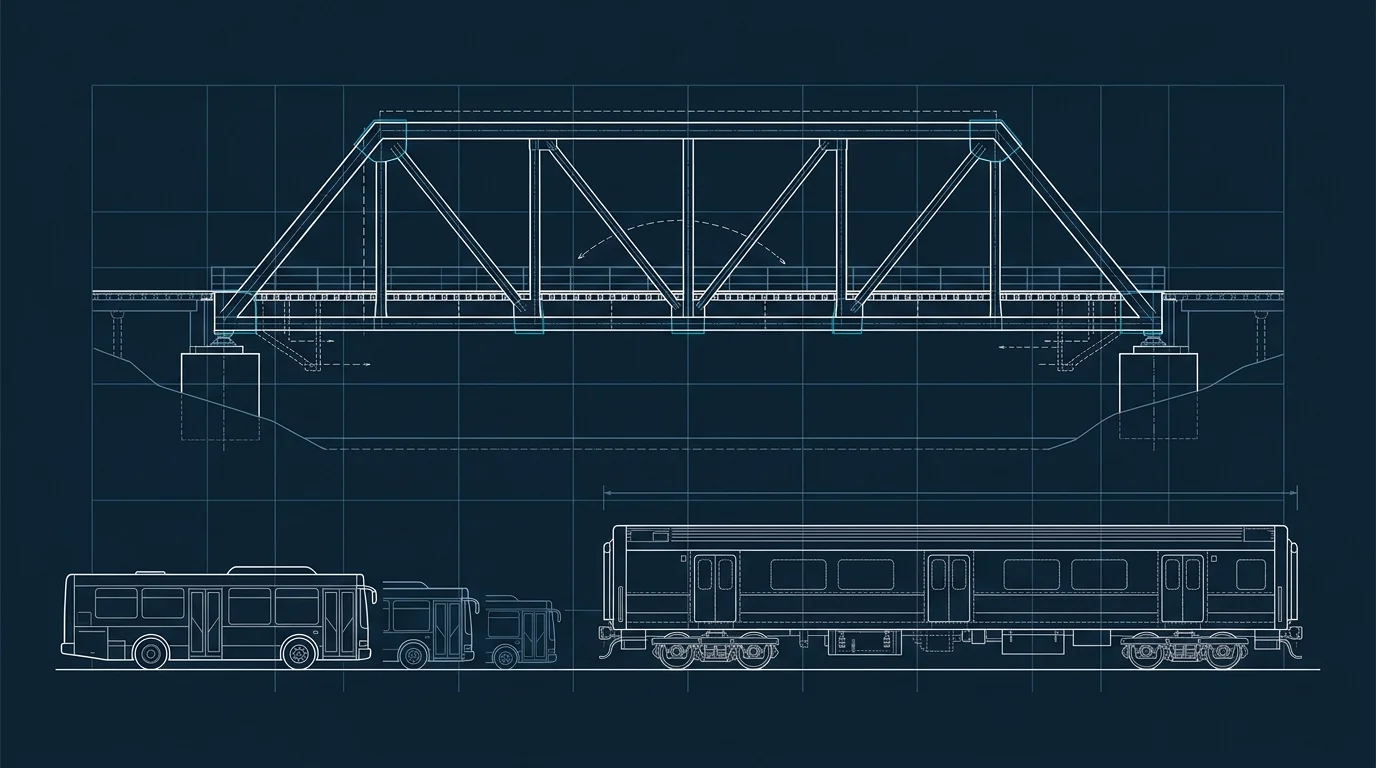
The scope of what is being purchased matters as much as the volume. NJ TRANSIT has ordered 374 Multilevel III railcars from Alstom, the first of which arrived at the Meadows Maintenance Complex in Kearny in April 2026. Up to 40 are expected in passenger service by the end of this year. The agency simultaneously authorized 1,400 additional New Flyer buses on top of a completed 550-unit base order, targeting a fully modernized bus fleet by 2031. On the infrastructure side, Amtrak and NJ TRANSIT announced initial construction on the Sawtooth Bridges Replacement Project in June 2026, backed by a $133 million Federal-State Partnership grant. The bridges being replaced are nearly 120 years old and sit on the Northeast Corridor, the most heavily trafficked passenger rail segment in the United States.
The technology layer is still ahead. NJ TRANSIT recently issued an RFI for a Unified Customer Communications System, with an industry day scheduled for August 2026 and a contract award targeted for 2027. LiDAR and perception-software evaluations are already in the current procurement wave. Agency officials have described the overall $3 billion modernization program as the most ambitious upgrade cycle in the agency's 47-year history.
The federal grant stack underpinning all of this is substantial and largely pre-positioned. NJ TRANSIT holds at least six active DOT grants totaling more than $2 billion in obligated principal, anchored by a $773 million Public Transportation Emergency Relief grant running through 2031 and a $294 million State of Good Repair grant active through September 2026. The capital appropriation is drawing on that foundation and deploying it now.
For the 925,000 people who ride NJ TRANSIT on an average weekday, the immediate implication is a transit system in construction-mode simultaneity: railcar deliveries, bus fleet turnover, a bridge replacement on a live Northeast Corridor line, and a communications-system overhaul, all running in parallel. That level of concurrent execution is unusual and carries coordination risk, which is part of the reason Kolluri's dual-agency role was structured the way it was. The FIFA World Cup 2026, with New Jersey serving as a primary shuttle hub, functions as the hard deadline that makes delays politically visible.
The signal to watch next is how many of the June procurement notices translate into executed contracts by year-end. The July count, already at 464 in seven days, will indicate whether the agency is sustaining the pace or pulling forward demand it cannot immediately absorb. The $294 million State of Good Repair grant expires in September 2026, creating a spending deadline that will push at least one tranche of awards before summer ends.