New Jersey municipalities issued 21 flood-control RFPs in the 30 days ending June 8, 2026, more than double the trailing 12-month average of roughly 10 per month. The spike is not a sign of a sudden flood emergency. It is a sign that years of accumulated federal grant commitments have finally reached the spending phase at the same moment, and the clock is running.
The trigger was a single federal action. On April 22, 2026, FEMA announced $42 million in Flood Mitigation Assistance awards specifically for New Jersey, part of a nationally coordinated release of more than $250 million that the agency explicitly described as clearing a funding backlog, one it noted was being processed "even 67 days into the current lapse in appropriations." That announcement told procurement offices across the state that money long promised was now real. RFPs followed within days.
Passaic County accounts for 10 of the 21 solicitations, which is consistent with its position as the state's most structurally exposed jurisdiction: the Passaic River Basin covers 950 square miles of dense, historically flood-prone terrain, and only 15 of its 119 municipalities participate in FEMA's Community Rating System. Camden, Essex, Somerset, and Union counties each added two to four more solicitations, sketching a procurement front that runs from the northern highlands down through the coastal plain.
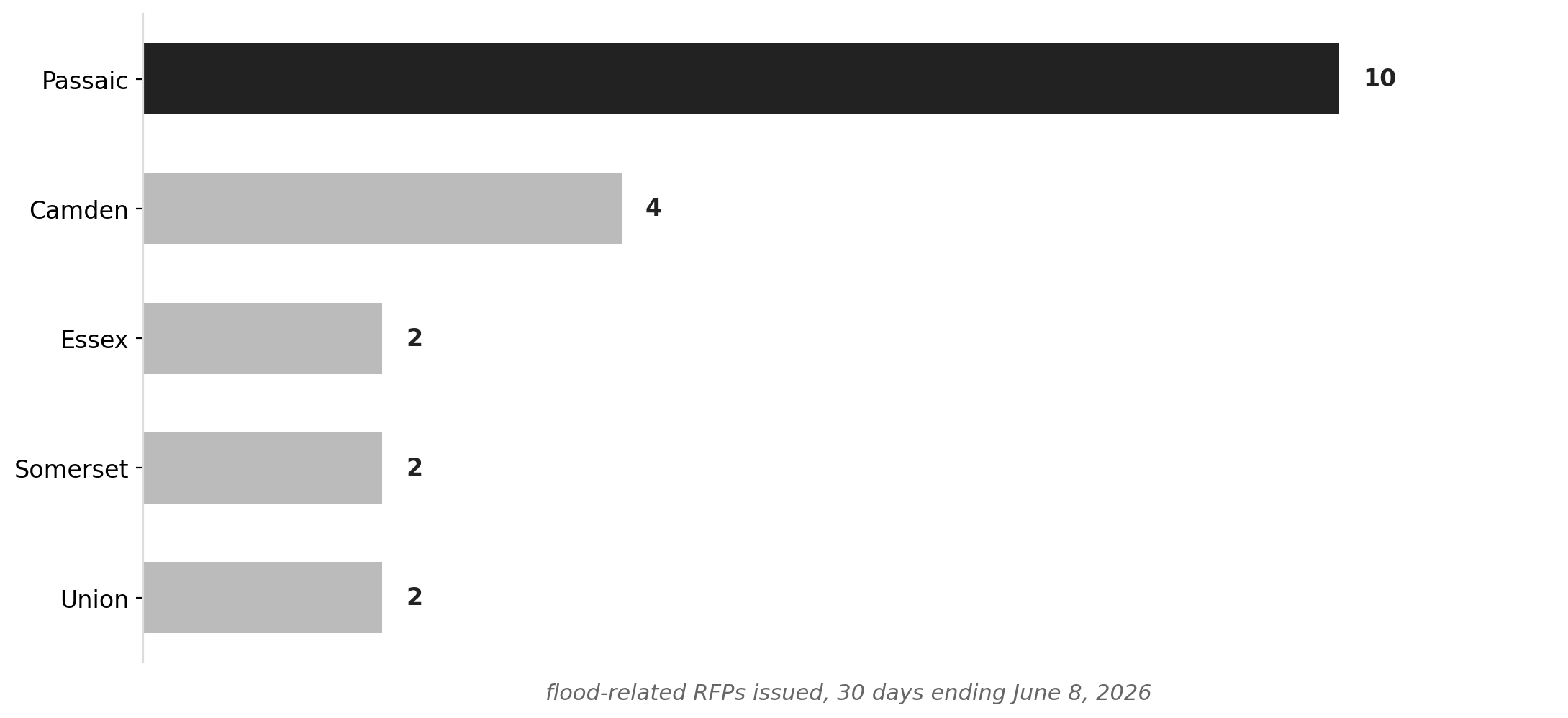
Source: NationGraph.
The new $42 million is almost secondary to what is already sitting in the pipeline. New Jersey's total active federal flood grant portfolio stands at $337 million obligated across 22 grants, with only $79.8 million disbursed. That leaves roughly $257 million in committed federal money that has been awarded but not yet spent, a figure larger than the new announcement by a factor of six. The NJ Department of Law and Public Safety alone holds $59.4 million in active FMA grants running through 2029, across two tranches issued in 2024 and January 2026. For municipalities, the procurement sprint is not about chasing new money. It is about finally being legally and administratively positioned to spend money that has been sitting in federal accounts for years.
A second deadline is compressing the timeline further. FEMA's FY2024 Swift Current opportunity, a $500 million national pool that was unpublished in March 2025 and only republished on April 30, 2026, carries an August 6, 2026 application deadline. Communities that want to compete for that tranche have roughly 90 days from republication to assemble applications, which means hired consultants and scoped projects need to exist now. Somerset County's active solicitation for an FMA Acquisition Consultant reads directly as a response to that deadline.
The specific projects coming to market illustrate the range of work involved. The April FEMA release included $12.5 million for Essex County pump stations and $9.3 million for Cape May bulkheads. On the municipal side, Rahway has rebid its Hamilton Stage Flood Hardening project, Millburn is soliciting a mitigation assessment for Van Winkle Brook, and the Port Authority has an active solicitation for a Holland Tunnel flood-storage facility. These are not conceptually similar projects, they span buyouts, pump infrastructure, creek engineering, and critical transportation hardening, but they share a procurement calendar driven by the same federal release window.
The regional context for this moment includes one recently completed project that signals what execution at scale looks like: the Passaic Valley Sewerage Commission's 2.5-mile floodwall in Newark, part of an approximately $800 million infrastructure initiative protecting roughly 1.5 million residents. That project's completion, combined with NJ DEP's Bureau of Climate Resilience Design and Engineering managing $380 million in active Rebuild by Design projects for the Meadowlands and Hudson River corridors, suggests the institutional capacity to absorb this procurement wave exists in the region, but only if contracts are awarded and project teams are in place before grant timelines begin to lapse.
New Jersey's flood grant history runs long. NJ Transit still holds a $183.7 million public transportation emergency relief grant from 2016, a Sandy-era commitment, with only $72.2 million disbursed and a timeline running to 2030. The state carries institutional memory of what happens when procurement moves slowly: years of undisbursed funds, delayed construction, and communities left exposed through successive storm seasons after Ida in 2021 layered new damage onto Sandy-era unfinished work.
The August 6 Swift Current deadline is the next hard signal to watch. Whether NJ communities can convert this procurement sprint into submitted applications, and whether FEMA's appropriations situation stabilizes enough to process them, will determine whether the $257 million pipeline flows or stalls again.