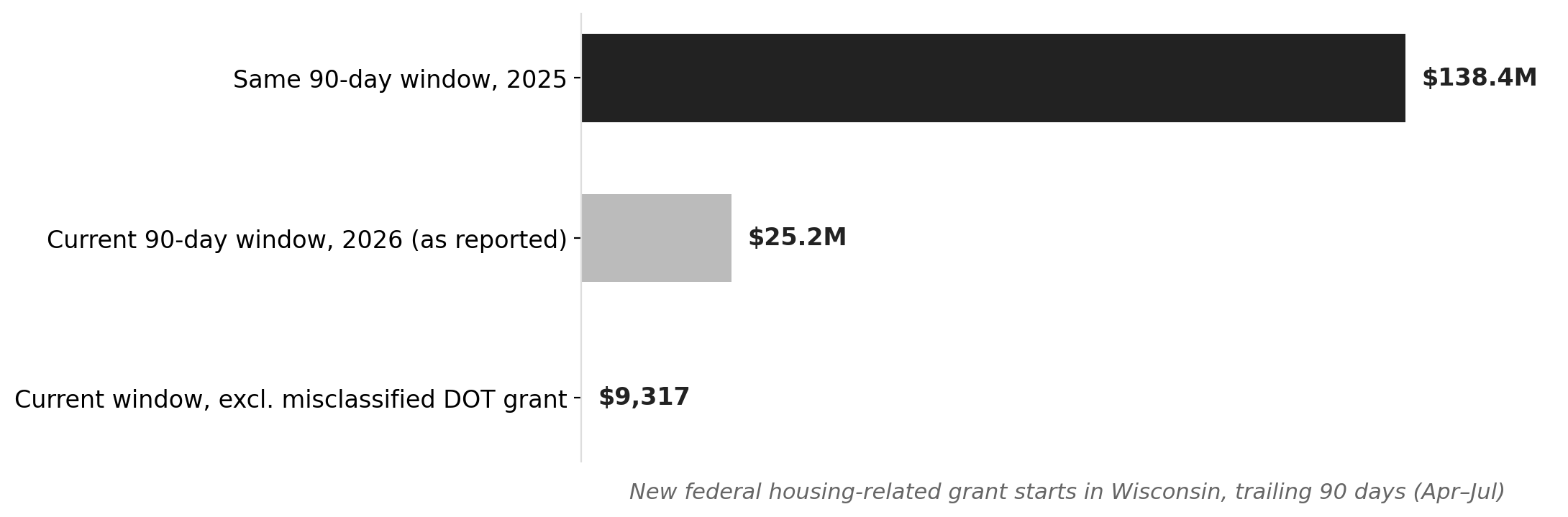
New federal housing grant commitments to Wisconsin have fallen 82% in the last 90 days, dropping from $138.4 million in the same spring window last year to $25.2 million today. That number is almost entirely a fiction: $25 million of it is a single Department of Transportation infrastructure award to the City of Appleton, categorized under "National Infrastructure Investments" and having nothing to do with housing. Strip it out, and Wisconsin's actual new HUD housing pipeline for the past three months consists of three Section 8 micro-renewals totaling roughly $9,300. For a state of six million people, the 20th largest in the country, that is as close to zero as a federal grant ledger can get.
This is not a Wisconsin accounting anomaly. Illinois, Michigan, and Ohio each drew hundreds of millions in new housing grants during the same window last year. In the current 90-day window, they are near zero too. The freeze is national, and it runs directly through a cascade of federal disruptions that have effectively stopped new housing grant commitments even as the existing portfolio, Wisconsin alone carries $593 million in active HUD awards across 525 grants, continues to run.
The proximate cause is a pile-up of structural breakdowns at HUD. Congress did not pass a final FY2026 HUD appropriations bill until the Consolidated Appropriations Act of March 2026, meaning the agency operated under a continuing resolution for months with no authority to issue new competitive grants. The Trump administration's FY2026 budget proposed eliminating the Section 8 Housing Choice Voucher program entirely, a $36 billion annual program, and replacing it with a state block grant called the State Rental Assistance Program. Neither the House nor the Senate version of the FY2026 Transportation, Housing and Urban Development bill fully funded existing vouchers: the House bill would have left 181,900 fewer assisted households; the Senate version, 107,800 fewer. Amid that uncertainty, agencies that would normally be issuing renewal vouchers are waiting.
Source: NationGraph.
The Continuum of Care program, which funds permanent supportive housing and homeless services, has compounded the freeze. The FY2026 CoC Notice of Funding Opportunity had not been published on its expected Q2 2026 schedule as of late March, meaning projects that budgeted for January 2026 funding received nothing. HUD staff reductions in 2025 slowed grant processing further. Then Trump's "Ending Crime and Disorder on America's Streets" executive order restructured the eligibility rules for homelessness funding, attaching conditions that Wisconsin and more than 20 other states sued HUD to block. Active litigation between a state and its primary housing grantor does not accelerate grant issuance.
Wisconsin is acutely exposed to CoC disruption in particular: 52% of the state's permanent housing funding flows through that program. The National Alliance to End Homelessness projects that the proposed CoC cuts would cause permanent housing loss for 2,379 Wisconsin residents. Rep. Gwen Moore, who represents Milwaukee, has called the proposed cuts "catastrophic", a word that fits the math, given that the Milwaukee Housing Authority received a $20.2 million Section 8 block and an $8.5 million Public Housing Capital Fund award in the same spring window last year and has received effectively nothing new this spring.
The weatherization side of the ledger is equally quiet. A year ago, the Wisconsin Department of Administration received a $12.4 million DOE Weatherization Assistance Program grant in this window, one of the state's most consistent annual housing-adjacent awards, particularly important in a cold-weather state where energy costs are a direct driver of housing stability. No comparable award has arrived this cycle. Wisconsin's weatherization program serves approximately 2,400 households annually and depends on that federal anchor; its absence from the current grant ledger is another signal that the pipeline freeze extends well beyond HUD proper.
What does this mean for someone living in Wisconsin? The $593 million in active HUD awards means that existing housing subsidies, shelter contracts, and public housing operations are still funded through their current grant periods. The crisis is not that checks are bouncing today. The crisis is that the next round of commitments, the contracts that local housing authorities, nonprofits, and weatherization agencies would normally be signing right now for fiscal year 2026 and beyond, do not exist yet. When existing grants expire, there is no confirmed successor funding to replace them.
The next signal to watch is the FY2026 CoC NOFO publication date. If HUD issues the notice this summer, some of the pipeline gap may close before winter. If it slips into fall or later, Wisconsin housing providers will be making staffing and capacity decisions based on a federal commitment that has not materialized. The state's lawsuit against HUD's rule changes is also still pending; its outcome will determine whether Wisconsin agencies can even compete for CoC funds under the new eligibility structure. Both clocks are running.