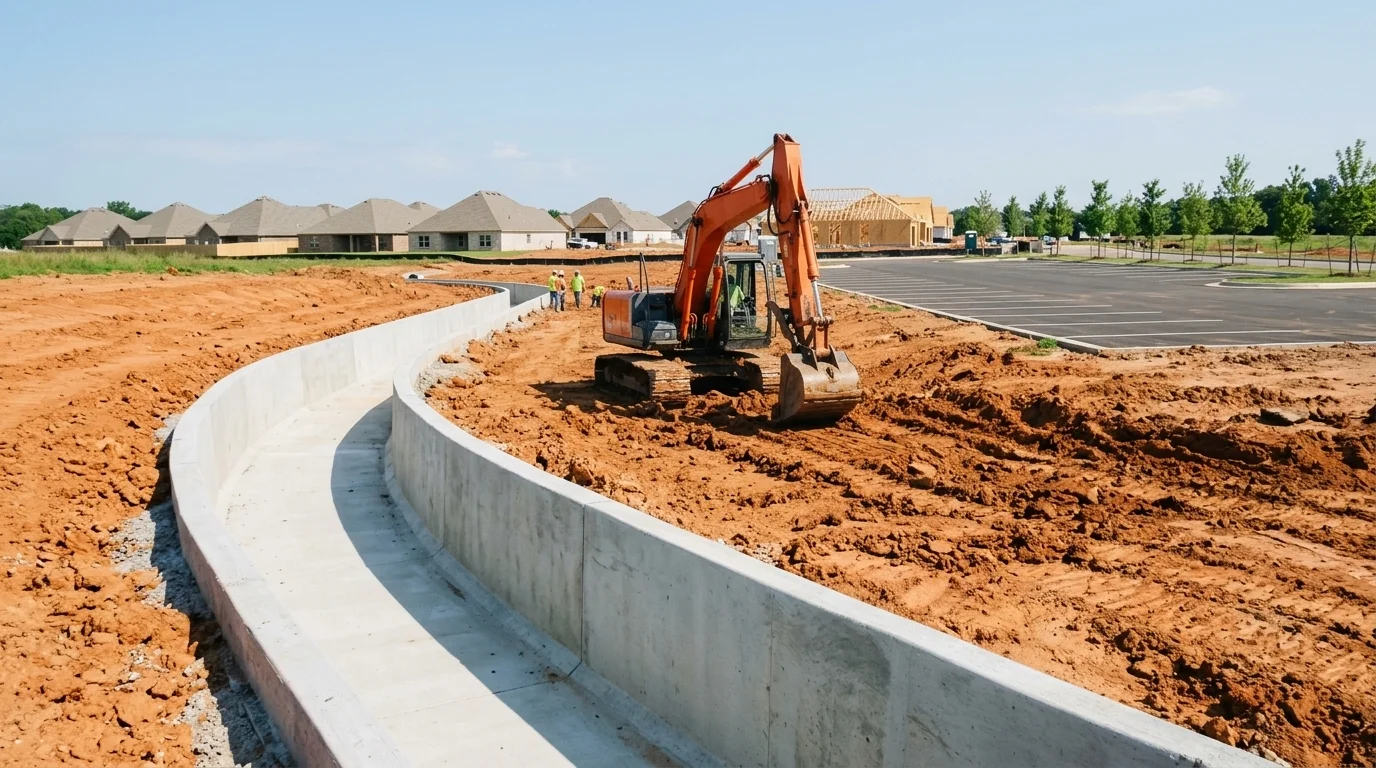
Arkansas posted six stormwater management RFPs in the last 30 days, against a 12-month monthly average of roughly 1.25, a nearly fivefold spike driven almost entirely by one city that has grown faster than almost anywhere else in the mid-South.
Bentonville accounts for four of those six bids. Two cover updates to the SW 2nd Street and NW O Street Phase 1 drainage project; two more address NW Tiger Boulevard and NW G Street corridor improvements. West Memphis and Heber Springs round out the cluster, each posting one pump or drainage RFP of their own. The broader pattern is visible in the time series: Arkansas averaged one to two stormwater RFPs per month throughout the second half of 2025, making the August-September 2026 concentration a genuine departure, not a seasonal blip.
The immediate cause is regulatory, not political. Bentonville operates under ADEQ NPDES MS4 General Permit ARR040000, the Clean Water Act framework that requires municipalities to maintain and continuously update a Stormwater Management Program as their urbanized footprint expands. Bentonville's footprint has been expanding fast. The city grew 14 percent between 2020 and 2024, adding more than 7,500 residents and reaching roughly 63,000 people by 2025, making it one of the two fastest-growing cities in Arkansas in consecutive Census Bureau releases. That growth is corporate-campus-driven: the Walmart supplier ecosystem has pulled distribution centers, tech offices, and residential subdivisions into Benton County at a pace that typical MS4 permit planning cycles were not designed to absorb. Each new subdivision roof and parking lot that goes in becomes impervious surface the stormwater system has to manage. The permit doesn't pause while the city catches up.
A second pressure layer arrived in 2025 when Governor Sanders signed Arkansas Act 578, which refers a $500 million general obligation bond measure to the November 2026 ballot. If voters approve it, the Arkansas Natural Resources Commission would disburse the proceeds for water, wastewater, drainage, and flood-control projects statewide, the largest single infusion of state water infrastructure capital in recent Arkansas history. Current bond authority under the existing program is expected to be depleted by summer 2027, which means the window between a November approval and that depletion date is narrow. Municipalities that arrive at ANRC without a defined project scope, a contractor relationship, or a completed RFP process will be behind. Act 578 does not fund Bentonville's current projects, those are compliance-driven capital expenditures, but it creates a strong positioning incentive for cities to have construction-ready designs in hand before the funding window opens.
A separate piece of 2025 legislation, Act 812, establishes a $25 million-per-year Water and Sewer Treatment Facilities Grant Program drawn from state interest earnings, with 20 percent earmarked for rural systems serving fewer than 1,200 people. That program is already active and distinct from the bond measure.
Federal funding is also flowing, though at smaller scale. Arkansas holds an active EPA Clean Water State Revolving Fund portfolio of $48.1 million across five currently active grants. In June 2026, the Arkansas Department of Agriculture received $3.175 million through EPA's Clean Water Act Section 319(h) program for 18 statewide water quality projects. A separate EPA Sewer Overflow and Stormwater Reuse Municipal Grant carries $1.19 million currently active in Arkansas through 2028. These are real dollars, but they are pass-through grant programs for specific project types, not a capital pipeline large enough to address what the EPA itself estimated in 2022: a $5.4 billion, 20-year sewer improvement need statewide.
That gap between need and available funding is precisely what makes the November 2026 bond vote consequential and the current RFP surge legible. Bentonville is not waiting to see what voters decide. It is doing what a fast-growing city under active federal permit obligations must do: move capital projects through the procurement queue on a schedule dictated by impervious surface math, not by ballot calendars. The bond vote, if it succeeds, may finance the next round. The permit requires this one.
For residents of the Northwest Arkansas corridor, the practical signal is contractor mobilization along several drainage corridors in and around central Bentonville over the next construction season. For smaller cities watching the November ballot, the Bentonville pipeline offers a template: cities that have already scoped and bid their projects will be positioned to move quickly if ANRC begins disbursing new bond proceeds in 2027. Cities that haven't started that process will be waiting in line.
The vote itself is the next hard date. An Arkansas extension analysis of Act 578 notes that the measure would represent a significant expansion of the state's existing water bond program. Whether it passes or fails, the procurement activity already underway in Bentonville will have locked in contractors, scopes, and timelines that the rest of the state is still sketching on paper.