Federal mental health grants to Colorado have reached $10.7 million in the trailing 90 days (April through July 2026), a 242% increase over the $3.1 million awarded in the same window a year ago. The number looks like a policy victory for a state that consistently ranks among the worst in the country for suicide rates. Look at who received the money and the picture changes considerably.
The University of Colorado captured $9.97 million of that total, or 93%, spread across 14 HHS grants. Colorado State University collected another $738,000 across two awards. Together, the state's two flagship research universities absorbed essentially all of the new federal dollars classified under mental health. Not one of the major grants in this cohort went to a treatment clinic, a county behavioral health authority, or a community nonprofit.
The driver here is not a sudden federal focus on Colorado's mental health crisis. It is a broad expansion of NIH extramural research funding in FY2026 that touches mental health as a co-topic across multiple institutes, including NIDDK, NCI, NICHD, and NINDS. Grant titles in this cohort span diabetes, cancer treatment, child health, and infectious disease; mental health appears in the research descriptions as a secondary focus, not the primary program aim. The Anschutz Medical Campus, the Rocky Mountain region's largest academic medical research institution and a perennial top-20 NIH recipient, is structurally positioned to absorb exactly this kind of broad NIH surge. Regional peers Arizona ($12.1 million) and Utah ($10.2 million) received comparable levels in the same window, suggesting the Mountain West universities are collectively benefiting from the same NIH funding cycle rather than any Colorado-specific initiative.
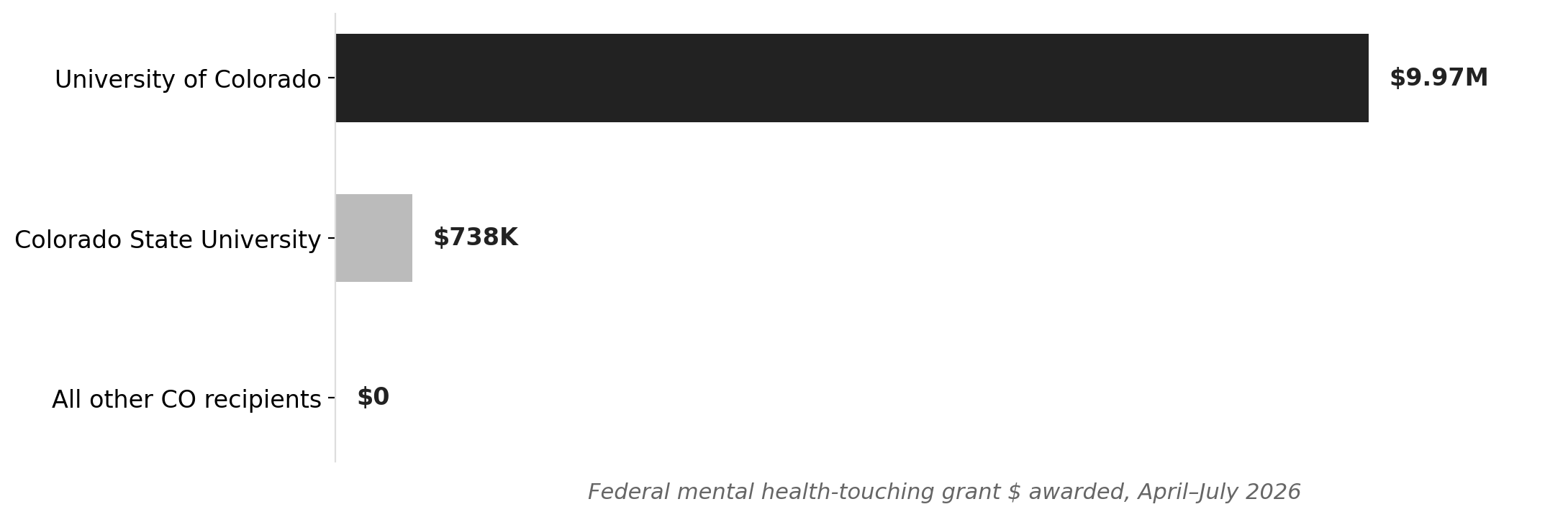
Source: NationGraph.
The prior-year baseline makes the contrast sharper, and also complicates the comparison. In the same 90-day window in 2025, the dominant recipients were the Colorado Department of Local Affairs and community nonprofits drawing on HUD Continuum of Care homeless-services grants. Those are service-delivery dollars, designed to put case managers and psychiatric liaisons in front of people experiencing homelessness and mental health crises. This year's cohort is almost entirely research funding, a structurally different category that produces journal articles and clinical trial data rather than bed-days or therapy hours. The 242% figure is real, but it is comparing two different kinds of federal spending.
What makes this worth watching is what is happening simultaneously at the county and municipal level. Jefferson, Pueblo, and San Miguel counties all have active procurement processes for jail-based behavioral health services. Aurora is running a school telehealth contract competition. The Fort Logan Mental Health Institute, the state's flagship public psychiatric hospital, is in Phase 3 of a capital renewal process. These procurements are largely funded through state appropriations, Medicaid, and county general funds, not from the federal research pipeline that is currently flooding Anschutz. The agencies running those RFPs are not competing for NIH dollars; they are working a different funding architecture entirely.
Colorado's total active mental health grant portfolio across all current federal awardees exceeds $330 million. The University of Colorado alone holds $160.7 million in currently running HHS grants that touch mental health. The Colorado Department of Human Services carries $48.3 million and the Colorado Department of Public Safety holds $17.6 million, the latter reflecting the state's investment in jail diversion and crisis response programs. Those service-side totals are substantial, but they accumulated over years of prior awards. In the current 90-day window, new service-side dollars are conspicuously absent.
The gap between these two tiers, a well-capitalized research system and a service system that is actively bidding for contracts to staff detention centers and rural school telehealth lines, is not new to Colorado or to any state with a major academic medical center. Research funding and service funding flow through different federal agencies, different appropriations, and different political coalitions. NIH dollars to Anschutz do not become psychiatric beds in Pueblo County, regardless of what the grant descriptions say about mental health as a study variable.
The question that follows from this data is whether FY2026 is producing any comparable surge in SAMHSA community mental health block grants or Medicaid behavioral health waivers to Colorado, categories that would show up differently in federal grant databases. SAMHSA's FY2026 grant announcements and Colorado's Medicaid behavioral health expenditure reports would show whether the service tier is keeping pace with the research tier, or falling further behind. Those numbers are worth watching as the state's county-level procurement wave moves toward award decisions later this year.