Tennessee has posted 23 stormwater management RFPs in the last 30 days, against a real monthly baseline of six to eight. The surge, concentrated almost entirely in Nashville's suburban growth ring, arrived within three weeks of a regulatory clock resetting on October 1 that nobody in the industry could defer.
The trigger is the 2026 NPDES Construction General Permit (TNR100000), which TDEC issued on September 10, 2026 and which replaced the expiring 2021 permit without a gap in coverage. Every construction operator disturbing one or more acres in Tennessee is now operating under new rules. Two required weekly site inspections must now be spaced at least 48 hours apart, down from the 72-hour minimum in the prior permit. More urgently, every active permittee must file an updated Stormwater Pollution Prevention Plan by October 1, 2027. City engineers and contractors who had SWPPP templates dialed in for the old permit now need new ones, and they are calling consultants in bulk.
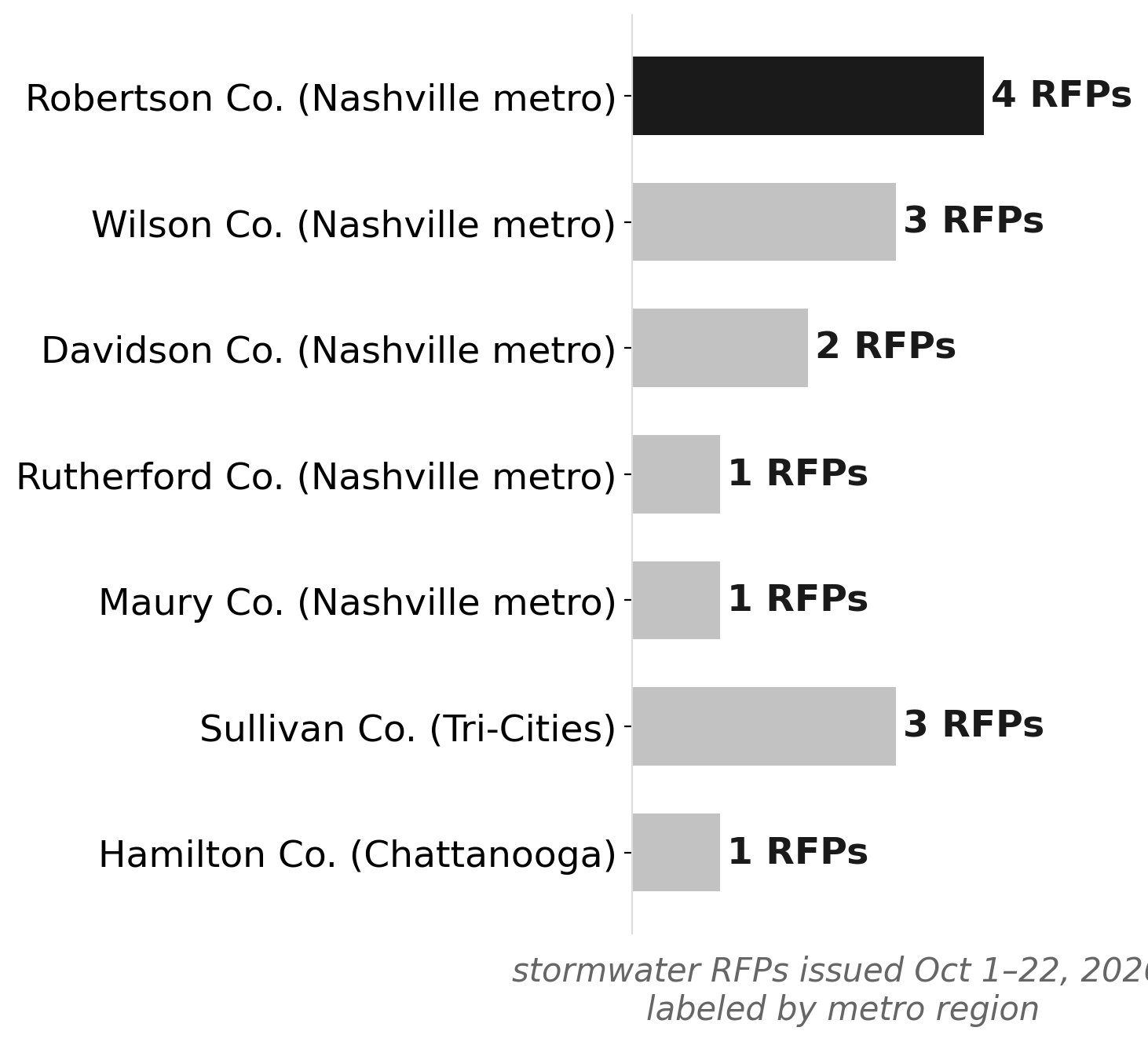
The geography of the RFP spike tracks almost exactly onto Tennessee's construction boom. Robertson County, anchored by White House, accounts for four of October's RFPs. Wilson County, which includes Mount Juliet and Lebanon, accounts for three, as does Sullivan County around Kingsport. Davidson, Rutherford, Maury, and Hamilton counties have each added one. According to the Tennessee State Data Center, Wilson County grew 18 percent since 2020, adding roughly 27,000 residents; Lebanon alone grew 38.8 percent; Rutherford County added 45,000 residents. Tennessee added 63,785 residents in 2025 alone, ranking eighth nationally in raw population growth. The faster a county grows, the more land-disturbance permits it carries, and the more SWPPP obligations stack up simultaneously when a permit generation resets.
Source: NationGraph.
The RFP types make clear this is a full compliance scramble, not a single project category. Counties and municipalities are issuing contracts for asset management plans covering drinking water, sewer, and stormwater together; for drainage rehabilitation and pipe lining; and for on-call contractor pools that give city engineers a standing roster when a complaint or inspection finding forces quick action. That breadth signals jurisdictions building capacity for an ongoing compliance obligation, not a one-time capital project.
The 2026 CGP is the primary driver of the October spike, but it arrives as the second half of a two-permit regulatory reset within 15 months. TDEC's separate Multi-Sector General Permit (TMSP, TNR050000), which governs industrial stormwater discharges from private facilities with significant materials exposed to rainfall, took effect July 1, 2025, with a September 30, 2025, reapplication deadline for existing industrial permittees. The two permits serve different regulated communities and run on different timelines, but together they have put virtually every category of stormwater permit in Tennessee through simultaneous renewal. As Trinity Consultants noted at the time of the TMSP's issuance, TDEC itself flagged high-volume processing delays around that earlier deadline. The CGP renewal is now producing the same demand pressure on the municipal and construction side.
Adding another layer, TDEC updated its Erosion Prevention and Sediment Control Handbook effective January 9, 2026, raising technical standards that cities must now fold into their local MS4 stormwater programs. An MS4 program governs how municipalities manage post-construction stormwater runoff, and those programs must stay consistent with state technical guidance. A city that updated its EPSC practices in January now faces a construction permit that reshapes site-level inspection requirements in October. The compliance stack is not one item tall.
For a city engineer in Spring Hill or a contractor breaking ground on a subdivision in Robertson County, the immediate practical question is staffing: the new permit's inspection and documentation requirements are more prescriptive than what they replaced, and the window to get compliant SWPPP language in place before the first regulatory audits is under a year. The RFP wave suggests many jurisdictions have decided the answer is to hire outside. Federal funding is present but modest: an EPA Clean Water State Revolving Fund grant of $11.86 million runs through 2031, and a $666,000 EPA stormwater reuse grant runs through 2029. Neither explains the timing of October's spike. This is a permit deadline moving the market.
The next signal to watch is whether the RFP volume holds through November or collapses once the initial scramble clears. If the permit's new inspection-spacing and SWPPP-update requirements generate enforcement actions on unprepared sites in early 2027, a second wave of remediation contracts is plausible. The October 1, 2027, SWPPP deadline is the harder clock. Right now, every city engineer who has not started that clock is still three weeks behind.