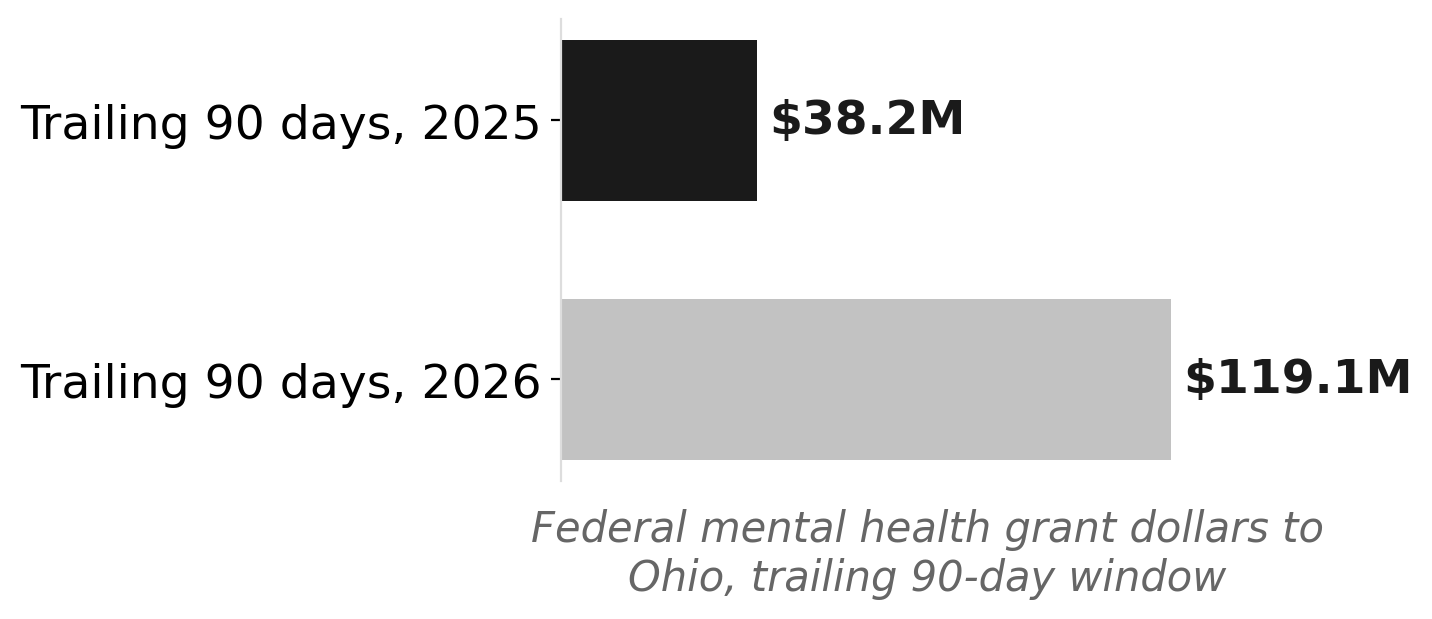
Federal mental health grants flowing to Ohio have hit $119.1 million in the last 90 days, up from $38.2 million in the same window a year ago, a 212% increase driven by two forces that have almost nothing to do with each other, except that both landed at once.
The larger of the two is a federal legal accident. A U.S. district court ruled on June 29, 2026, that HUD violated the Administrative Procedure Act when it restructured its Continuum of Care competition, invalidating the agency's FY2025 renewal cycle. Congress, through the Consolidated Appropriations Act of 2026 (P.L. 119-75), mandated that HUD release the delayed funds in quarterly tranches: $349 million went out March 31, then $1.09 billion on April 27. Ohio's share of those renewals, awards that in a normal year would have been processed in October or November, compressed into a July 1 start date for two Cincinnati and Columbus-area nonprofits. Strategies to End Homelessness Inc. received $31.2 million and Community Shelter Board received $24.6 million, together accounting for $55.8 million of Ohio's 90-day surge. That money is not new; it is late.
The second force is more deliberate. Ohio's Am. Sub. House Bill 96, the FY2026-27 operating budget signed by Governor Mike DeWine, renamed OhioMHAS as the Ohio Department of Behavioral Health effective October 1, 2025, created six new state behavioral health block grants, covering mental health, crisis services, prevention, substance use, recovery supports, and criminal justice, and appropriated $1.23 billion for the agency in FY2026. That figure comes with a catch: the General Revenue Fund contribution was cut 13%, with the budget explicitly projecting increased federal award volume to compensate. DBH Director LeeAnne Cornyn's agency is, in other words, structurally incentivized to maximize federal capture. The remaining $61.9 million in Ohio's 90-day total comes from 87 HHS and SAMHSA grants, including a $7.3 million SAMHSA 988 and Behavioral Health Crisis Services award to the Ohio Department of Mental Health, starting September 30, 2026 and running through 2029, plus a cluster of NIH research grants to Case Western Reserve University and Ohio State University.
Source: NationGraph.
These two mechanisms are parallel, not linked. Ohio's budget law did not cause the HUD CoC timing shift, that was federal litigation and a congressional mandate. What HB 96 did was create a more aggressive, better-resourced agency on the receiving end when the money arrived. The result is that Ohio now slightly edges Pennsylvania ($116 million across 118 grants in the same window) and nearly doubles Michigan ($62 million), its closest Midwest peers in federal behavioral health receipts.
The distinction matters for anyone trying to read Ohio's $119 million as a policy signal. About half of it reflects what happens when federal homelessness funding gets trapped in court for months and then releases at once: it inflates whatever state happens to be in the queue. The other half reflects a genuine expansion of behavioral health infrastructure in a state with long-standing urgency, Ohio has among the highest opioid mortality rates in the country, and its Continuum of Care geography spans dense urban cores in Columbus, Cincinnati, and Cleveland alongside a Balance of State CoC covering 80 rural counties.
The budget bet carries its own risk. Ohio's new state block grants, the Mental Health State Block Grant, the Crisis Services State Block Grant, and four others, are GRF appropriations disbursed by the DBH director to local Addiction, Mental Health, and Substance Abuse (ADAMHS) boards. They are designed to complement federal flows, not replace them. But the FY2026 CoC NOFO published June 1, 2026 introduced structural changes to the competition: roughly 30% of funding is being redirected toward transitional housing and away from permanent supportive housing, and more renewal funding is now competitive rather than automatic. Ohio's July awards are renewals under the old framework. Next year's cycle will be different, and potentially smaller or harder to win.
The number to watch is not the 90-day total but what follows it. Ohio's active HHS mental health grant portfolio carries $541 million in total obligations, with $210 million already outlayed, the new awards land on a large existing base. If HUD's reformed competition reduces Ohio's CoC renewals in the next award cycle, the GRF cut built into HB 96 leaves the state's ADAMHS boards with less cushion than the current headline suggests. Director Cornyn's agency will need to demonstrate whether the institutional restructuring that helped absorb this year's compressed federal calendar can also compete successfully under a CoC framework that is, by design, less forgiving of incumbents.