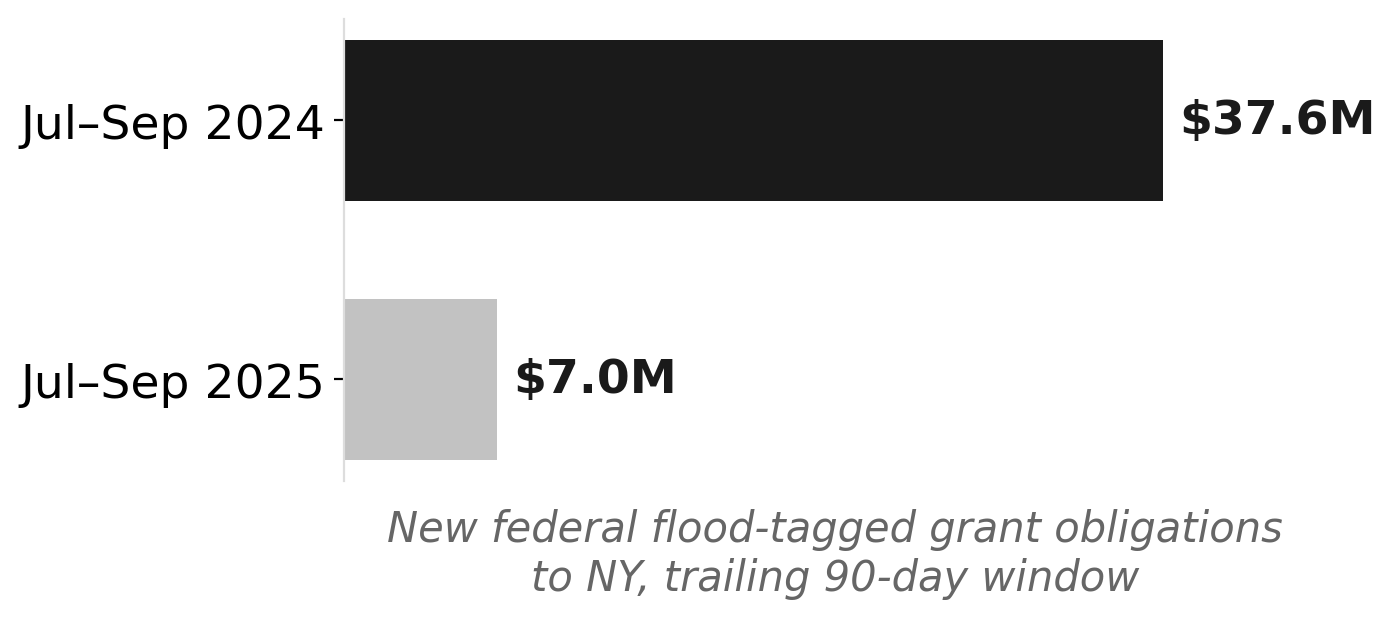
New York received $7.0 million in new federally tagged flood-control grants in the 90 days ending September 2026, against $37.6 million in the same window a year earlier. That 81 percent drop overstates the collapse somewhat, last year's figure included a single $33.28 million MTA transit drainage award that skews the comparison, but the underlying gap is real, and it has a specific cause: the Trump administration's April 4, 2025 termination of FEMA's Building Resilient Infrastructure and Communities program, the largest pre-disaster mitigation grant vehicle in the federal government, which froze more than $380 million in pre-approved flood-resilience funding for 38 New York projects and left the state's pipeline nearly empty.
FEMA announced the BRIC termination calling the program "wasteful and ineffective," canceling it mid-cycle and withdrawing the FY2025 Flood Mitigation Assistance funding opportunity, a separate $600 million program targeting NFIP-insured structures facing repetitive flood loss, at the same time. The two programs are distinct instruments: BRIC funds infrastructure hardening and community resilience projects broadly, while FMA specifically reduces damage to insured properties. Both channels closed at once, cutting two separate holes in New York's flood resilience pipeline.
Governor Hochul put the state's BRIC exposure at more than $325 million within days of the termination. Senator Schumer wrote to FEMA Secretary Noem naming specific projects: flood mitigation work in Central Harlem and East Elmhurst, neighborhoods whose subway corridors flooded again during a July 2025 storm that accelerated a 20-state legal challenge. New York Attorney General Letitia James joined that coalition. On December 11, 2025, a federal district court in Massachusetts declared the BRIC termination unlawful in *Washington et al. v. FEMA*. A March 6, 2026 enforcement order gave FEMA 21 days to reissue the FY2024 funding notice.
Source: NationGraph.
FEMA complied on paper. The agency reopened a combined FY2024 and FY2025 BRIC application window, which closed July 23, 2026. But compliance with a court order to reopen applications is not the same as obligating funds. As of late September 2026, no new BRIC awards appear in New York's grant records. The legal victory produced a process, not a check.
What New York did receive in the window tells the story of what remains when the major programs are absent. A $4 million Weill Cornell disaster-health research grant. A $1.25 million state DOT street-drainage project in Northport. Roughly $696,000 in FMA Swift Current dollars, released through a separate sub-program triggered by presidential disaster declarations. Two DHSES hazard mitigation grants totaling about $2.45 million. No flood-infrastructure project of meaningful scale broke ground with new federal dollars during those three months.
FEMA did partially restore FMA funding nationally in April 2026, announcing approximately $235 million against the $600 million that had been withdrawn, and New York received roughly $2 million of that round. That partial restoration addresses one of the two severed channels at reduced scale, leaving the larger BRIC channel still in legal and administrative limbo.
The gap is obscured, for now, by the sheer scale of New York's legacy flood portfolio. Nearly $720 million in active federal obligations flows through the state's flood-related grant accounts, dominated by $503 million for the MTA and $191 million for NYCDOT in post-Hurricane Sandy Emergency Relief grants that run through 2027. Those are recovery instruments from a storm that struck in 2012, not pre-disaster investment. They do nothing for the Hunts Point food-supply peninsula in the Bronx, the inland flash-flood corridors exposed by Hurricane Ida in 2021, or the 19 frozen BRIC projects inside New York City alone. The Sandy money is the balance in an account that is no longer being replenished.
The National Flood Insurance Program pays out after water enters homes. BRIC was designed to keep the water out. With that program's future tied to judicial enforcement rather than a functioning appropriations pipeline, the question facing engineers and local planners is whether FEMA will actually obligate awards from the reopened window or whether the applications filed before July 23 will age into the same limbo as the 38 projects frozen in April 2025.
The next signal to watch is FEMA's obligation record for the combined FY2024/FY2025 BRIC cycle. If awards begin to appear in grant databases before the end of 2026, New York's 38 frozen projects may finally move. If they don't, the state will enter another hurricane season having won its lawsuit and lost its funding.