Federal grants for water infrastructure newly starting in Alabama total just $6.1 million over the past 90 days, against $42.3 million in the same window last year. That 86% drop sounds alarming. It is also, in large part, a statistical mirage, and the real story underneath is more consequential than the headline number suggests.
The prior-year comparison is dominated by two Abandoned Mine Land Reclamation grants totaling roughly $40.9 million, awarded by the Department of Interior to the Alabama Department of Workforce under the Surface Mining Control and Reclamation Act. Those are mine remediation awards, not EPA water programs. Strip them out and the year-over-year gap shrinks considerably. But a genuine gap remains, and it matters: zero new EPA State Revolving Fund, Emerging Contaminants, or Drinking Water grants have started in Alabama in the trailing 90 days, even as the federal program that funds them is running out of time.
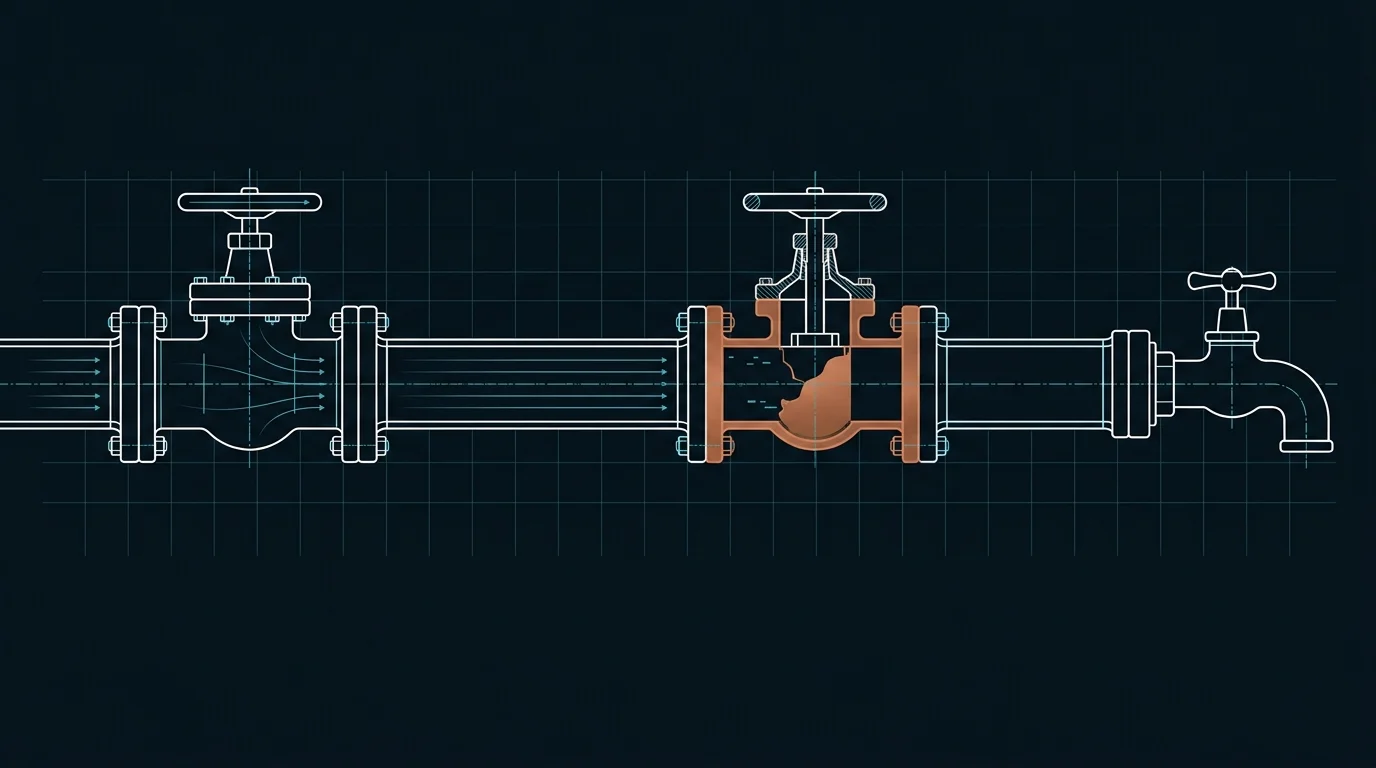
The reason is a national bottleneck, not an Alabama-specific failure. As WaterFM's tracking of IIJA disbursements shows, project-level water awards fell 53% in the first half of 2025 compared to the same period in 2024. EPA executive-order disruptions, significant staff reductions, and prolonged regulatory uncertainty over PFAS contaminant rules have created a backlog of applications that agencies like Alabama's ADEM have done their part to prepare, but cannot move forward without EPA processing grants on the other end.
Source: NationGraph.
ADEM completed both its FY2025 Drinking Water SRF and Clean Water SRF IIJA Intended Use Plans in the spring of 2026, filing formal public comment periods that closed May 21, 2026. Those plans represent Alabama's formal queue for how it intends to deploy IIJA capitalization grants once EPA obligates them. The applications are in. The money is not.
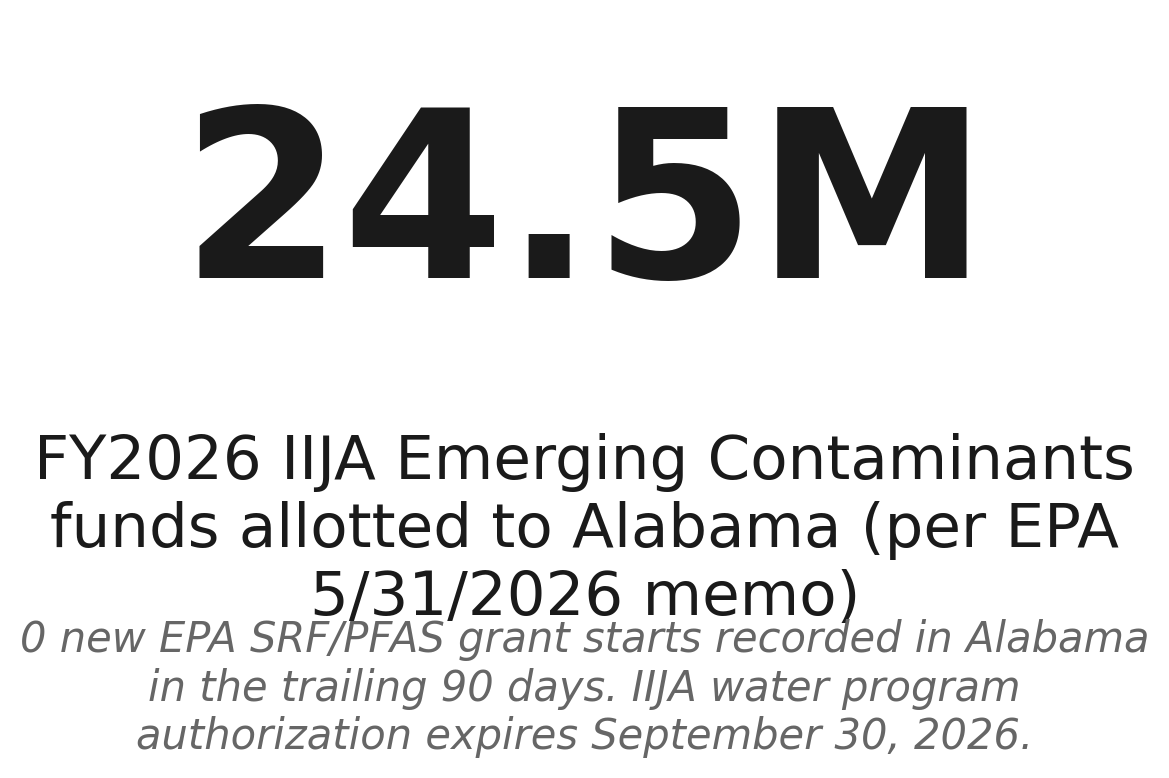
The dollar amounts at stake are not trivial. EPA's May 2026 allotment memo formally allocates $24.5 million in FY2026 Emerging Contaminants (PFAS) funds to Alabama. A separate $13.6 million FY2025 EC tranche is also sitting in ADEM's IUP pipeline. Both tranches are designed to flow through EPA's Drinking Water SRF to help public water systems test for and remediate PFAS contamination, a particular priority in Alabama given the number of small and rural systems in Black Belt counties that lack the financial capacity to address emerging contaminants on their own. Under IIJA equity provisions, many of those communities qualify for principal forgiveness, meaning the money functions as a grant rather than a loan. The allotment is made. The obligation is not.
EPA did announce $878,000 in Sewer Overflow and Stormwater Reuse Municipal Grant funding for Alabama in April 2026, a separate direct-grant program for communities dealing with untreated sewage overflows. That money is real and starting to move. But it is a fraction of the SRF pipeline, and it does not substitute for the capitalization grants that feed the revolving funds municipalities draw on for major infrastructure projects.
All of this is colliding with a hard deadline. The IIJA's water program authorization expires September 30, 2026. Congress is working on reauthorization, but no legislation has passed, and the uncertainty has created what amounts to a planning freeze at state agencies that cannot commit subawards to municipalities against funds that may or may not be obligated before the clock runs out. The White House's FY2026 budget proposed a 31.5% cut to Drinking Water and Clean Water SRF appropriations, adding a second layer of pressure on a program already behind schedule.
For Alabama municipalities, particularly smaller systems that depend on SRF capitalization grants to finance upgrades they cannot bond for independently, the practical effect is delay. The $390-plus million in active EPA water grants Alabama is currently running through DWSRF, CWSRF, and related programs continues to disburse, existing projects are not stopping. The gap is in new starts, and new starts are what keeps the pipeline from running dry after 2026.
The next signal to watch is whether EPA processes Alabama's FY2025 IUP capitalization grant obligations before the September 30 expiration. If those grants are obligated by then, Alabama's SRF programs can continue lending to municipalities through the normal revolving cycle even if IIJA supplemental funding does not continue at current levels. If they are not obligated in time, the state's queue of drinking water and wastewater projects, some of them serving communities with documented public health needs, moves further into an uncertain future.