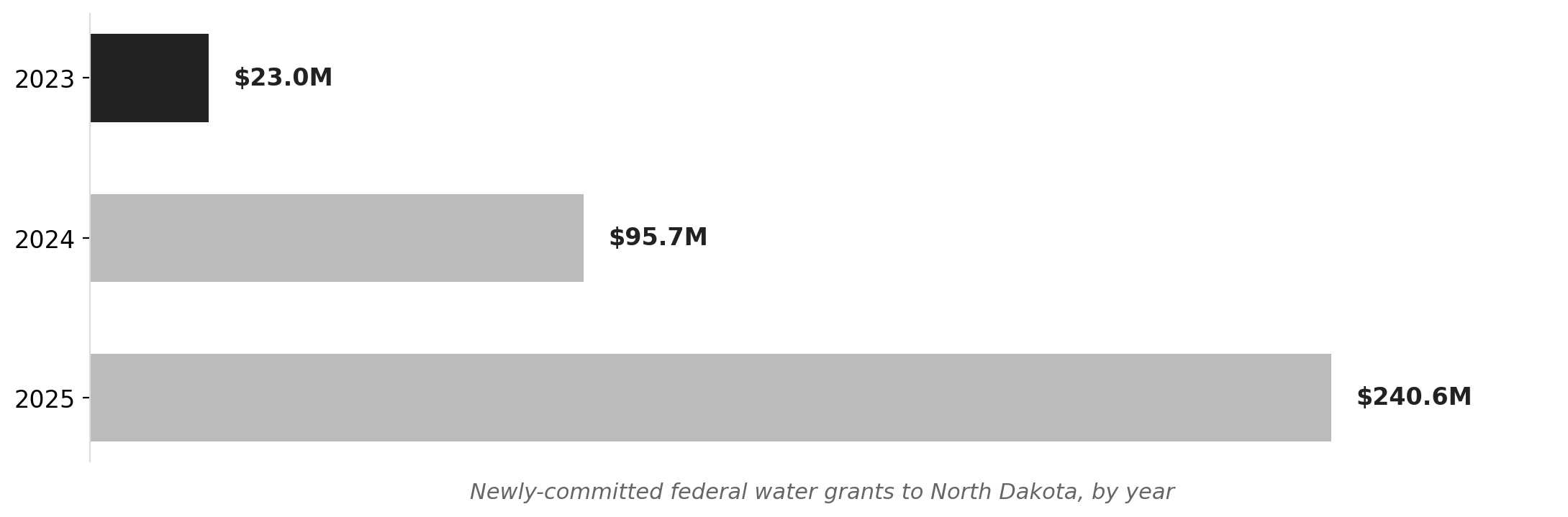
North Dakota received $240.6 million in newly-committed federal water grants in 2025 alone, up from $95.7 million in 2024 and just $23 million in 2023, a tenfold escalation that makes this the largest single sustained water infrastructure investment the state has seen in at least two decades. With the Infrastructure Investment and Jobs Act authorization set to expire on September 30, 2026, the state has roughly 115 days to obligate whatever remains, and the clock is running hard.
The driver is straightforward: the IIJA authorized approximately $50 billion nationally for water infrastructure, channeled through EPA's Drinking Water and Clean Water State Revolving Funds, with a hard use-it-or-lose-it deadline built into the authorization window. Congress has already signaled it will not extend the same generosity indefinitely. FY2026 spending legislation rescinded $2.3 billion from other IIJA programs while leaving water SRFs intact, making them a rare survivor among program cuts. States that don't move quickly risk watching unobligated dollars evaporate.
North Dakota is moving. The EPA has committed $164.9 million across 12 grants to the state in the past 18 months, the bulk going to the North Dakota Department of Environmental Quality as Drinking Water and Clean Water SRF tranches. A $28.65 million DWSRF grant started January 1, 2026. In December 2025, the State Water Commission approved an additional $30.4 million in state cost-share funding, with Lt. Gov. Michelle Strinden citing water reliability as essential "to support existing users and accommodate future growth." The East Central Rural Water District received more than $25 million of that cost-share commitment, the kind of rural system that federal SRF dollars are specifically designed to reach but rarely reached at this scale before IIJA.
Source: NationGraph.
The most consequential single award in the portfolio is a $74.9 million Interior Department grant to the Three Affiliated Tribes for the Garrison Diversion Unit, awarded July 2025 and running through 2029. The Garrison Dam, built in the 1950s, flooded roughly 150,000 acres of Fort Berthold Reservation land and disrupted water infrastructure the tribes had relied on for generations. The Garrison Diversion Unit is the long-promised federal corrective, and the July 2025 grant represents the largest infusion into that project in years. For the Mandan, Hidatsa, and Arikara Nation, the funding is less a windfall than a partial accounting of a debt that has compounded for 70 years.
The newest layer is PFAS. On May 21, 2026, the EPA announced a $9.4 million EC-SDC grant to North Dakota specifically to address PFAS contamination in drinking water, with EPA Region 8 Administrator Cyrus Western citing the need to help small and rural communities understand "the scope and scale" of the contamination they face. The ND DEQ had already telegraphed this priority: its 2025 Intended Use Plan amendment added a new PFAS-specific priority tier to the project ranking system, elevating emerging-contaminant projects above the standard queue. The grant and the IUP change together signal that PFAS remediation is now a first-order state commitment, not a waiting-list item.
The scale of North Dakota's per-capita funding tells the structural story. At $1,578 per resident, the state ranks third nationally in IIJA water funding behind only Alaska and Montana. That figure reflects two realities: North Dakota has roughly 780,000 people spread across 70,000 square miles, and many of its water systems were built in the mid-20th century for a different economy and a smaller population. Pipeline projects in this geography are capital-intensive by necessity, serving relatively few ratepayers per mile of pipe, which makes federal cost-share not just helpful but essential to project viability. Without IIJA, most of these projects would sit in planning documents indefinitely.
Nationally, only about 18 percent of total IIJA SRF appropriations have reached the project level via subawards, meaning the bulk of committed funds are still moving through state pipelines. For North Dakota, that implies continued RFP and contract activity well into 2027 even after the authorization window closes on September 30. The state's active water grant portfolio, counting grants currently in performance, totals well over $400 million, with end dates running as late as 2032.
What to watch: the September 30 deadline is not the end of spending, but it is the end of new federal commitments under IIJA. Any projects that haven't been obligated by then will need to compete for a much thinner pool of post-IIJA funding. The DEQ's PFAS priority tier means communities with documented contamination have a faster path to the front of the queue right now than they are likely to have again. Whether small rural water districts and tribal utilities can move fast enough to absorb what's available, before the window shuts, is the question the next four months will answer.