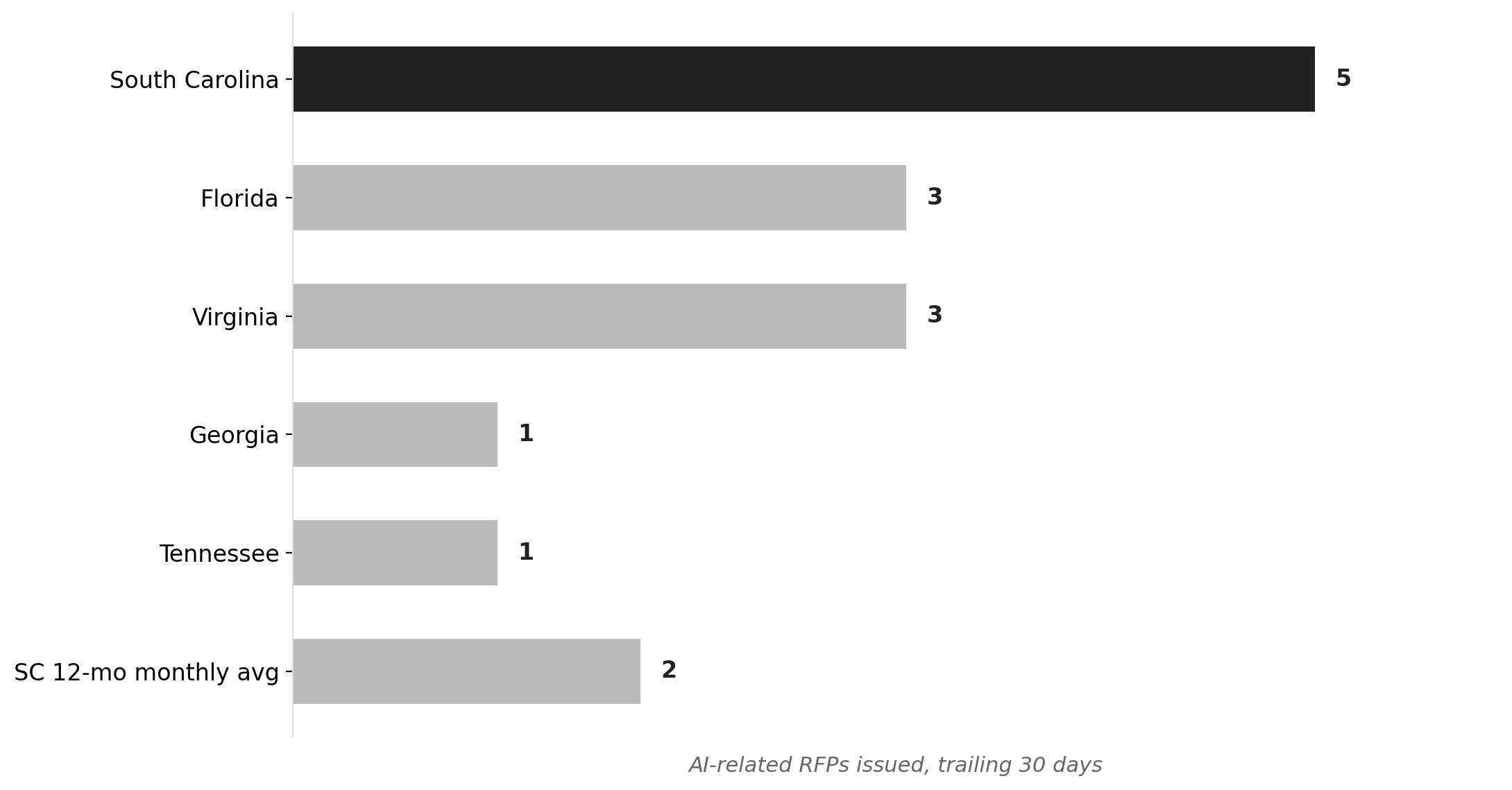
South Carolina's public agencies issued 5 AI-related RFPs in the last 30 days, three times the state's monthly average of roughly 1.7 over the prior year, and more than any other southeastern state in the same window. Florida and Virginia each managed three; Georgia and Tennessee each posted one. The numbers are a procurement signal, but the more telling detail is what South Carolina is actually buying: not AI tools, but AI strategy.
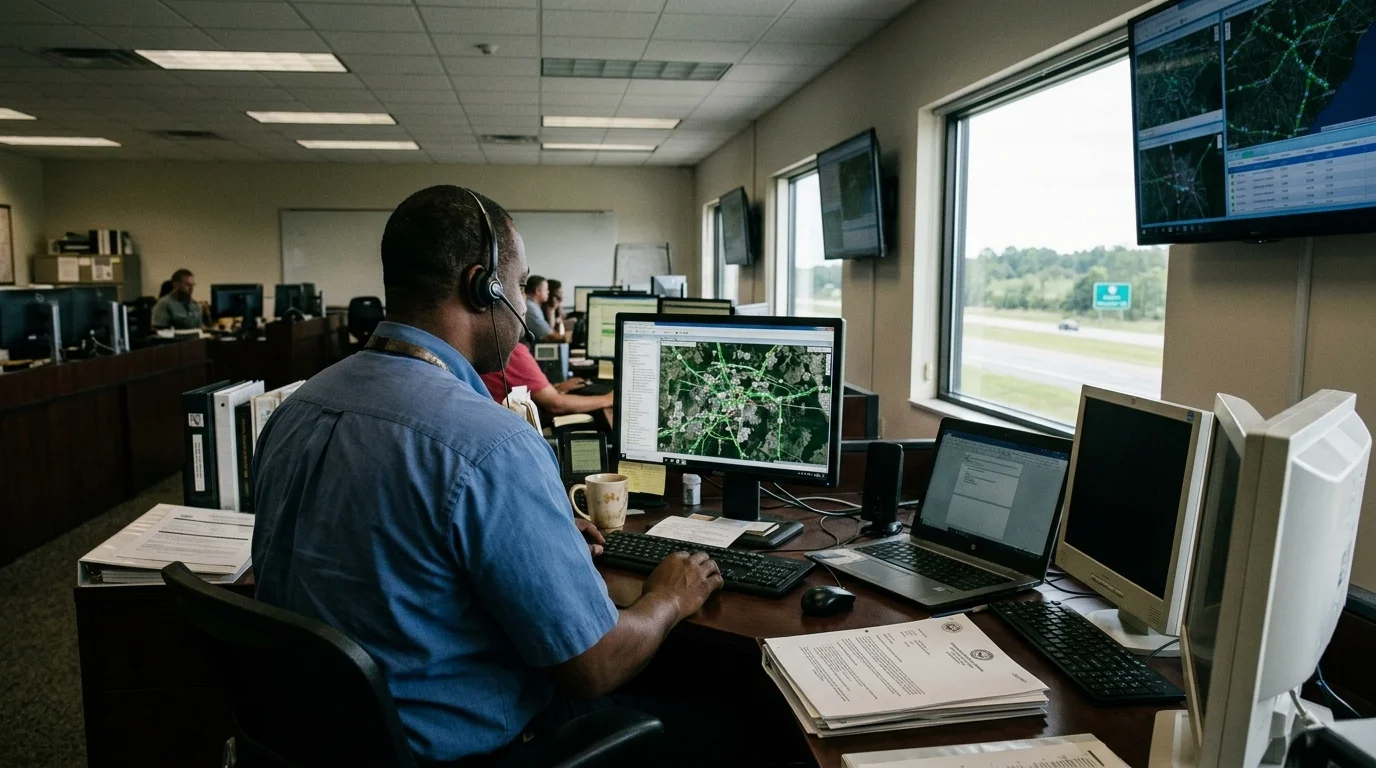
The anchor procurement is a request issued by the South Carolina Department of Transportation on May 24, updated June 17, and due July 9. SCDOT is not shopping for a chatbot or a traffic-monitoring algorithm. It is hiring a firm to build an enterprise technology and AI strategic roadmap, covering IT, operational technology, and data governance across the agency. When a state's largest infrastructure agency goes out to bid for a plan rather than a product, the bureaucracy has moved past the question of whether to adopt AI and is now working out the mechanics of how.
That shift has two clear catalysts. The first is the South Carolina Department of Administration's statewide AI Strategy, published in June 2024 and developed with Gartner through an inter-agency AI Workgroup. The document organized the state's approach around three pillars, Protect, Promote, Pursue, and gave every state agency a shared vocabulary and a procurement mandate. State CIO Nathan Hogue has been the public face of execution ever since, including the late-2025 launch of Bradley, an AI-powered citizen services assistant built with Tyler Technologies that went live for public use. That implementation sent a visible signal downward through state government: the strategy had teeth.
Source: NationGraph.
The second catalyst arrived from Washington. President Trump's December 11, 2025 executive order, which established a federal preemption framework for state AI laws and stood up a DOJ AI Litigation Task Force to challenge conflicting state regulations, effectively removed the legislative brake that might have slowed agency procurement. South Carolina's General Assembly had been moving cautiously: the 2025-2026 session has produced at least four AI bills, including the Right to Compute Act (HB 4657) addressing critical infrastructure risk and a consumer protection bill (SB 963) requiring risk management for high-risk AI systems. With federal preemption signaling that state-level AI regulation faces an uphill legal fight, agencies had less reason to wait for the legislature to draw lines before they started spending.
The procurement burst is concentrated at the institutional layer. Coastal Carolina University's separate RFP for an AI-integrated learning management system reflects a parallel push in higher education. That sector also holds a substantial federal AI research portfolio: South Carolina institutions carry more than $55 million in active AI-related federal grants, with Clemson University accounting for $9.6 million in new awards since 2024. NSF has committed $15.6 million in new AI grants to South Carolina schools over the past 24 months, largely through its EPSCoR program for historically underfunded research states. The Medical University of South Carolina is building an AI Center for Health Innovation anchored in electronic health records going back to 2012, a project its chief AI officer outlined at an EPSCoR and AI Integration Symposium in March 2026.
The prior 12 months of procurement data shows this is not a slow linear build. AI RFP volume in South Carolina spiked to nine in December 2025 and seven in July 2025 before settling back to baseline. The episodic nature of those earlier bursts suggests institutional clusters rather than a steady drumbeat. What's different now is the presence of SCDOT. Transportation is the largest agency footprint in the state. If that roadmap contract converts into implementation work, it establishes a template that a dozen other agencies can replicate. South Carolina's IT governance is centralized through OTIS and the Department of Administration, which means a single successful procurement at this scale carries an outsized multiplier across the rest of state government.
For residents, the most immediate visible change is the Bradley assistant, already handling citizen inquiries. The next signal to watch is the SCDOT award, expected after the July 9 deadline. If the resulting roadmap produces implementation contracts in the fall procurement cycle, the current RFP spike will look like the beginning of a sustained run rather than another episodic burst.