Twenty-six Pennsylvania municipalities issued stormwater engineering RFPs in the last 30 days, spanning 20 counties from Allegheny to Wayne, and 17 of them had not put out a stormwater solicitation in over a year. That number is not a coincidence. It is what eight years of deferred compliance looks like when a deadline finally stops moving.
The deadline is September 30, 2026. That is when every municipality covered by Pennsylvania DEP's NPDES PAG-13 General Permit for Small Municipal Separate Storm Sewer Systems must submit a Notice of Intent to the state or face operating without a permit. The permit was first issued in 2018, extended, extended again, and most recently pushed via the Pennsylvania Bulletin in May 2024. Now, as PA DEP has made clear, it is not moving again. The new permit takes effect October 1, 2026.
The PAG-13 reissuance affects 493 existing municipal permittees plus a new cohort of municipalities newly designated as urbanized areas under the 2020 census, expanding the compliance universe at the same moment it tightened the clock. Pennsylvania already administers one of the largest MS4 permit universes in the country, with 1,059 regulated small stormwater systems spread across more than 2,500 municipalities, townships, and boroughs. Fragmented authority and repeated deadline extensions created a decade of institutional inertia. That inertia is now breaking simultaneously across the Commonwealth.
Source: NationGraph.
The procurement surge is statewide, not concentrated in any single metro. Allegheny County alone accounts for four institutions, Bellevue, Carnegie, Forest Hills, and Neville Island, that have each entered the market in the last 30 days. Bucks County shows Morrisville and Warminster procuring in the same window. But the list extends to smaller jurisdictions in Northumberland, Berks, Perry, and Clinton counties, a geographic spread that reflects how many rural and suburban governments sat out 2025 entirely and are now forced into procurement at the same time as their neighbors.
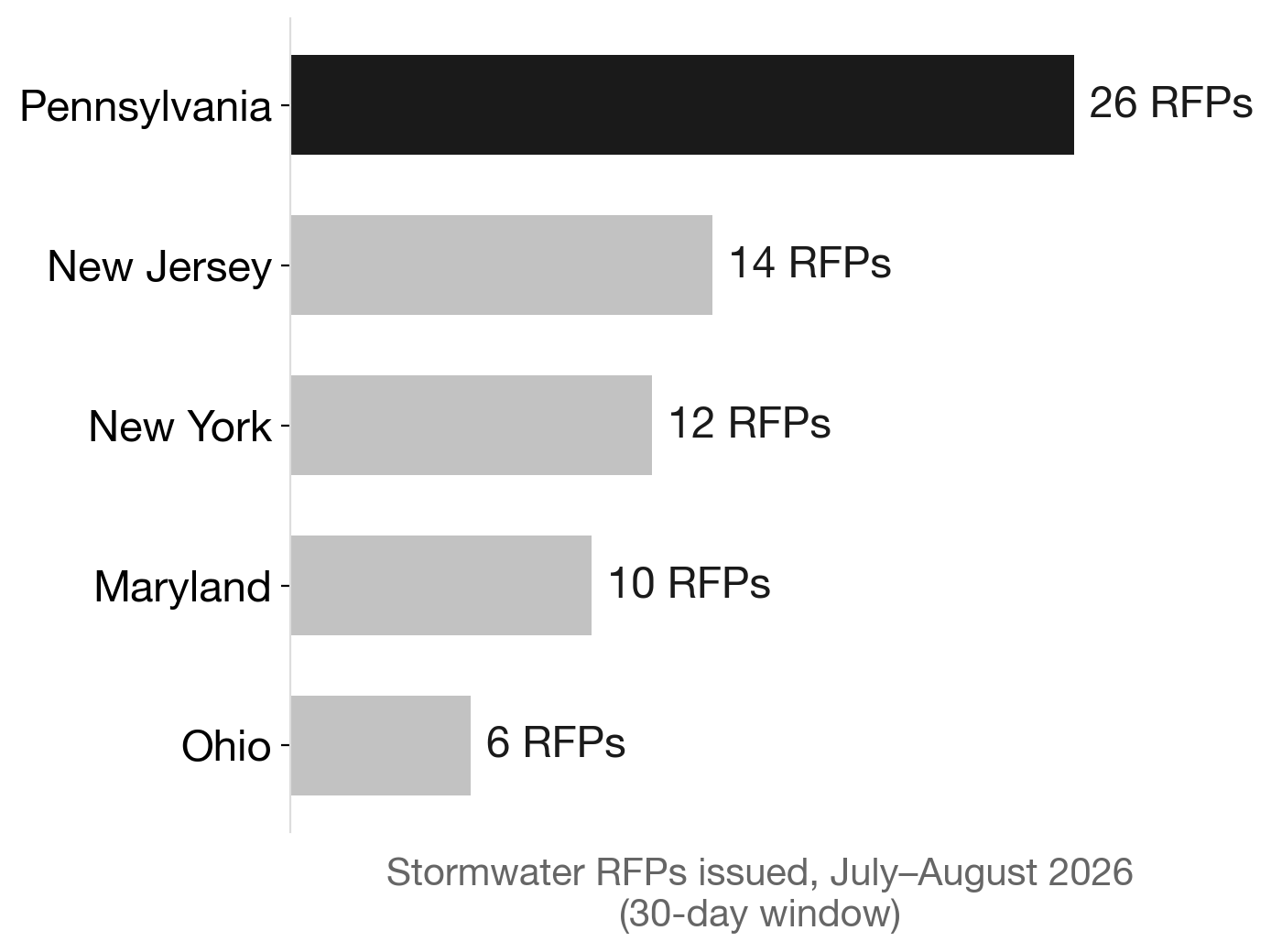
Pennsylvania's 26 active institutions outpace every neighboring state combined: New Jersey issued 14 stormwater RFPs in the same window, New York 12, Maryland 10, Ohio 6. That gap is not explained by Pennsylvania's size alone. It reflects the specific structure of the PAG-13 reissuance, a single hard deadline, applied to a large and fragmented municipal universe, after years of extensions taught local governments that deadlines were negotiable.
The permit also introduces a fundamental methodology shift that raises the engineering workload. The PAG-13 reissuance replaces Pollutant Reduction Plans with Volume Management Plans, requiring municipalities to reframe their compliance approach around stormwater quantity, not just pollutant loads. Volume Management Plans are due by September 30, 2028, but municipalities cannot begin drafting them without engineering assessments that start now. Engineering firm RETTEW has publicly warned that municipalities without engineering support already under contract risk missing the NOI submission window entirely, a note that lands differently with the deadline seven weeks out.
The stakes extend beyond state compliance. Pennsylvania sits inside the Chesapeake Bay watershed, meaning MS4 stormwater discharges carry federal TMDL obligations for nitrogen and phosphorus reduction. A municipality that misses the PAG-13 NOI deadline is not just out of compliance with PA DEP; it is potentially contributing to a federal Bay cleanup liability that spans six states and has been under court-enforceable commitments since 2010. That federal layer gives PA DEP limited flexibility to grant further relief, even if political pressure to do so materializes.
Philadelphia adds its own pressure. The Philadelphia Water Department proposed updated stormwater regulations that took effect July 1, 2026, tightening local compliance requirements on top of the state permit reissuance. For municipalities in and around the city, two regulatory clocks are running at once.
Legislatively, Pennsylvania HB 659, introduced in February 2025, would expand county-level stormwater planning authority and authorize new water resources management authorities, signaling that Harrisburg sees the current MS4 framework as a floor, not a ceiling. The bill has not yet passed, but its introduction reflects awareness that Pennsylvania's fragmented stormwater governance has structural problems the PAG-13 deadline alone will not resolve.
For residents in the 20 counties currently seeing RFP activity, the near-term consequence is visible procurement: engineering contract awards, consulting studies, and preliminary infrastructure assessments appearing in local government agendas over the next several weeks. The longer-term consequence, for municipalities that clear the NOI deadline and begin Volume Management Plan development, is capital spending on detention infrastructure, green stormwater systems, and drainage retrofits spread across the 2027-2028 budget cycle.
The signal to watch is October 1. PA DEP's NOI portal will reflect which of Pennsylvania's 1,059 regulated MS4s submitted and which did not. Those that missed will face enforcement exposure entering the 2027 legislative and budget season, at the same moment HB 659 is still in play.