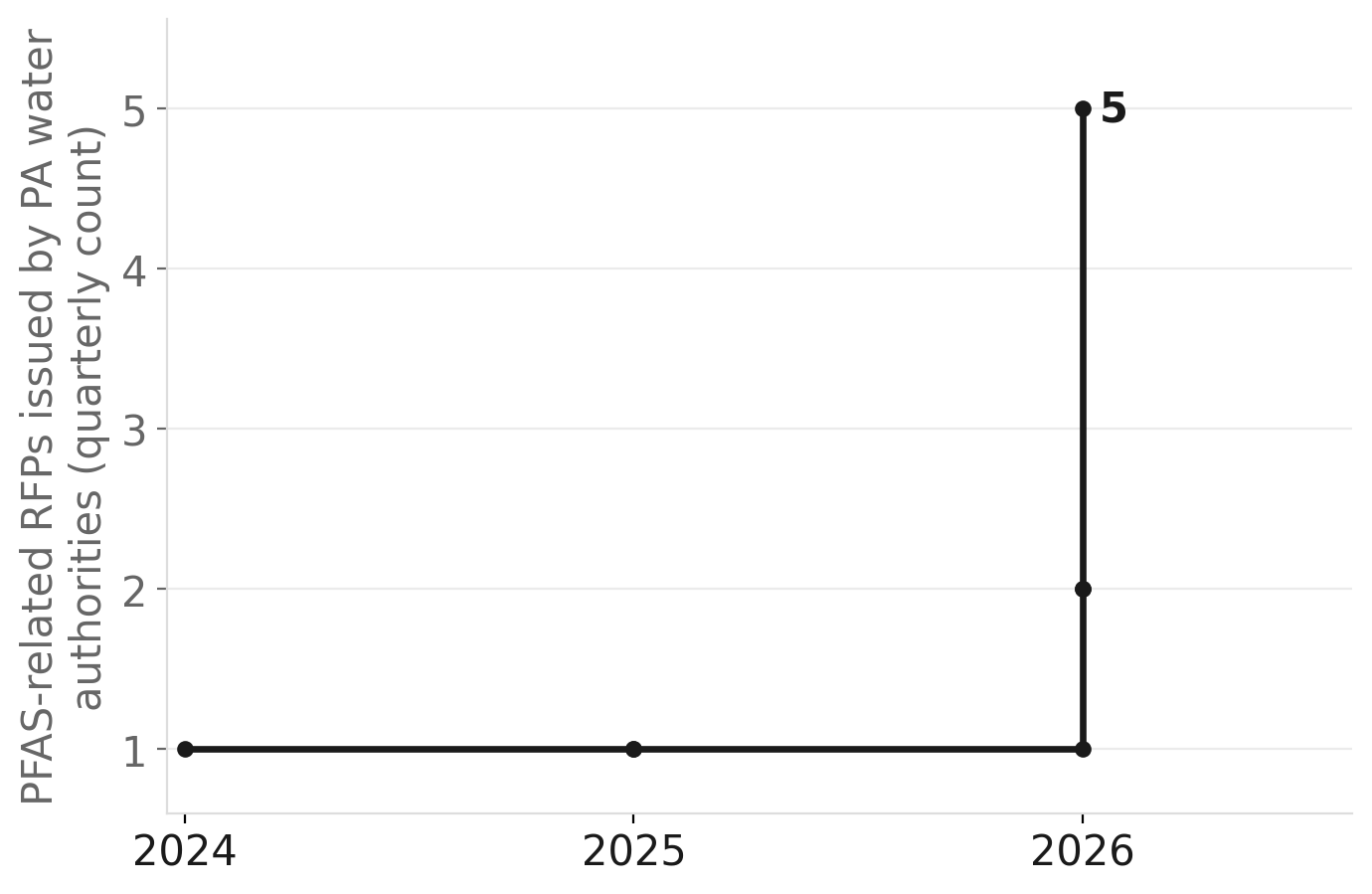
Five Pennsylvania water authorities issued PFAS-related procurement solicitations in the last 30 days, against a trailing 12-month average of roughly one per month. The 4.6x spike is not scattered across the Commonwealth. Every one of those five RFPs comes from the same few square miles of suburban Philadelphia: North Wales Water Authority in Montgomery County, Warminster Township Municipal Authority in Bucks County, and Doylestown Township Municipal Authority in Bucks County. The geography is not a coincidence.
These communities sit on top of the Naval Air Warfare Center Warminster Superfund plume, one of the most extensively documented military-origin PFAS contamination zones in the Northeast. Decades of firefighting foam use at the now-shuttered base drove perfluorinated compounds into the groundwater that multiple overlapping water authorities draw from. The contamination has been known for years. What changed in 2026 is that utilities now have mandatory monitoring results in hand, and in Pennsylvania, those numbers carry legal weight.
Pennsylvania's Department of Environmental Protection finalized its own PFAS maximum contaminant levels in January 2023: 14 parts per trillion for PFOA and 18 parts per trillion for PFOS. Those limits, stricter than the federal standard at the time, made Pennsylvania one of a small group of states where non-compliance is already a legal liability rather than a future planning horizon. Mandatory quarterly monitoring began for large systems in January 2024 and for smaller systems serving 350 or fewer people in January 2025. By the time comprehensive monitoring got underway in 2024, roughly 19% of Pennsylvania's 3,000-plus public water systems were showing PFAS levels above EPA guidelines. Two full years of quarterly data cycles have now accumulated, and for the Bucks and Montgomery County authorities, the results are forcing action.
Source: NationGraph.
The financial architecture to support that action is substantial. PENNVEST, the Commonwealth's water infrastructure financing authority, approved a historic $559.4 million single-round investment in January 2026, the largest in the authority's history, and it included multiple PFAS-specific grants to Bucks County water systems. Those are state revolving fund dollars, not federal grants. Layered on top are two EPA WIIN Act Emerging Contaminants grants, passed through PENNVEST as the state administering authority, totaling $112.1 million: a $37.5 million grant beginning June 2024 and a $74.6 million grant beginning September 2025. A separate pair of federal Drinking Water State Revolving Fund grants adds another $51.3 million. The active federal PFAS grant portfolio for Pennsylvania now totals $166.9 million across 15 active grants. These are three distinct mechanisms, a state regulatory mandate creating the compliance obligation, PENNVEST direct grants providing state capital, and federal passthrough grants subsidizing the most burdened systems, and all three are operating simultaneously in the Bucks and Montgomery County corridor.
There is a fourth dynamic worth watching. The EPA's May 2026 proposed rule, signed by Administrator Lee Zeldin, would extend the federal PFAS treatment compliance deadline from April 2029 to April 2031 for utilities that formally apply for an extension. On its face, a two-year extension looks like pressure relief. In practice, it may be adding pressure. The EPA's proposed rule requires applicants to demonstrate they are actively taking procurement steps, meaning a utility that wants the extension must show it is already in the market for treatment equipment. For small systems in Pennsylvania, where the state MCL rule creates a separate 2027-era compliance clock regardless of what EPA does, the federal extension proposal does not eliminate urgency; it may be crystallizing it.
Aqua Pennsylvania, the largest private water utility in the state, has moved accordingly. President Marc Lucca has stated publicly that his company must complete PFAS treatment installation essentially by 2027 to meet Pennsylvania's state standards, and construction on six treatment facilities in Bucks, Chester, and Luzerne Counties was expected to begin by summer or fall 2026.
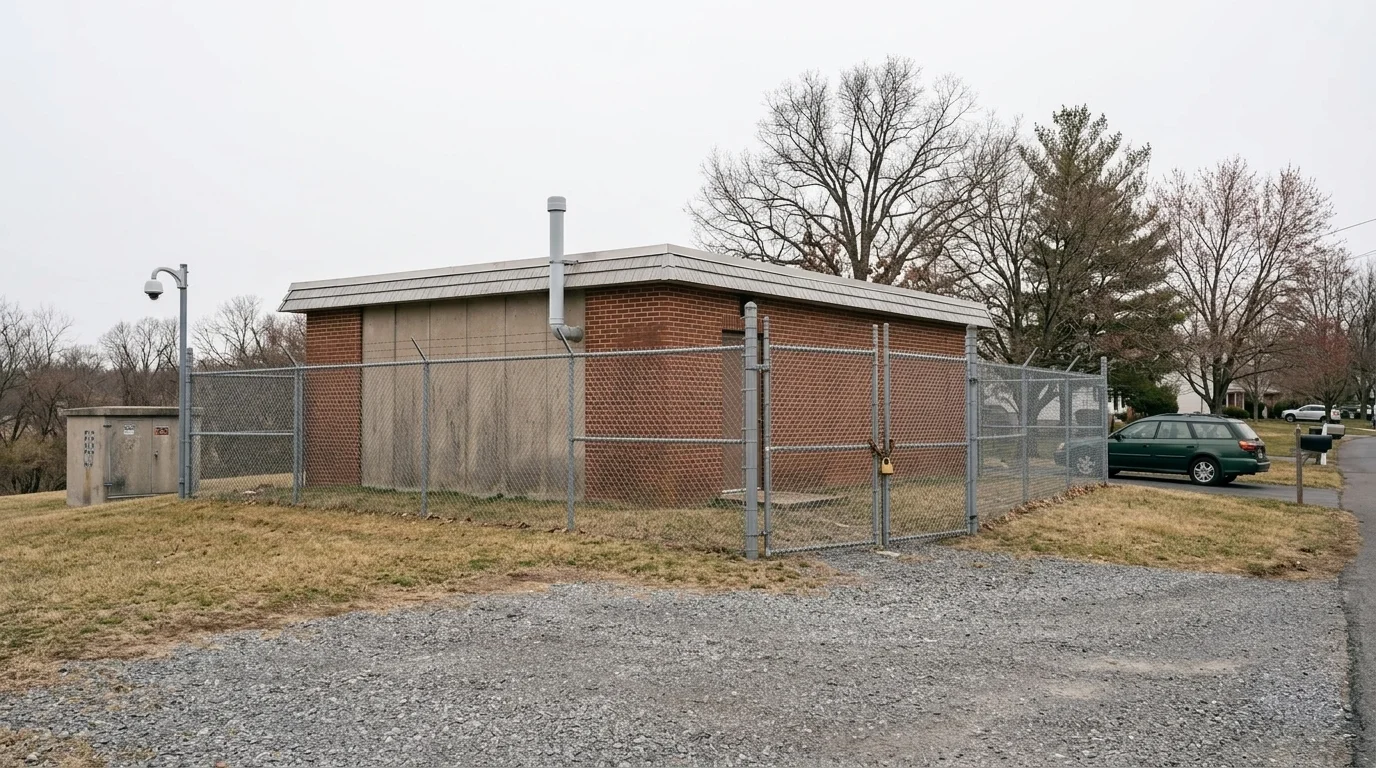
The RFP cluster visible in the data right now represents the municipal end of that same pressure. Warminster Township Municipal Authority is procuring treatment across 11 wells. Doylestown Township is upgrading a well house. North Wales has issued two separate solicitations with multiple rounds of updates, a sign of active contractor engagement rather than exploratory scoping.
The regulatory frontier is also still expanding. In July 2026, PA DEP proposed new monitoring requirements for PFAS in biosolids through three new general permits, signaling that the compliance perimeter extends beyond drinking water into wastewater and agricultural land application. That rulemaking has not yet taken effect, but it signals that the regulatory cycle that produced the current RFP spike in drinking water procurement is not finished.
For residents in these townships, the practical implication is that the treatment systems being designed and bid right now are the infrastructure that will determine what comes out of their taps in 2027 and beyond. The construction window before state compliance deadlines close is measured in months, not years. The next signal to watch is whether PENNVEST's next funding round, and any finalization of the EPA's extension rule before the end of 2026, pulls additional municipalities out of monitoring mode and into procurement.