Federal electric vehicle grants to Connecticut have reached $19 million in the last 90 days, a 203 percent jump from the $6.3 million obligated in the same window a year ago, and virtually all of it is aimed at a single, urgent goal: getting 30 battery-electric buses rolling on the CTfastrak Hartford-to-New Britain corridor before the political and legal ground shifts again.
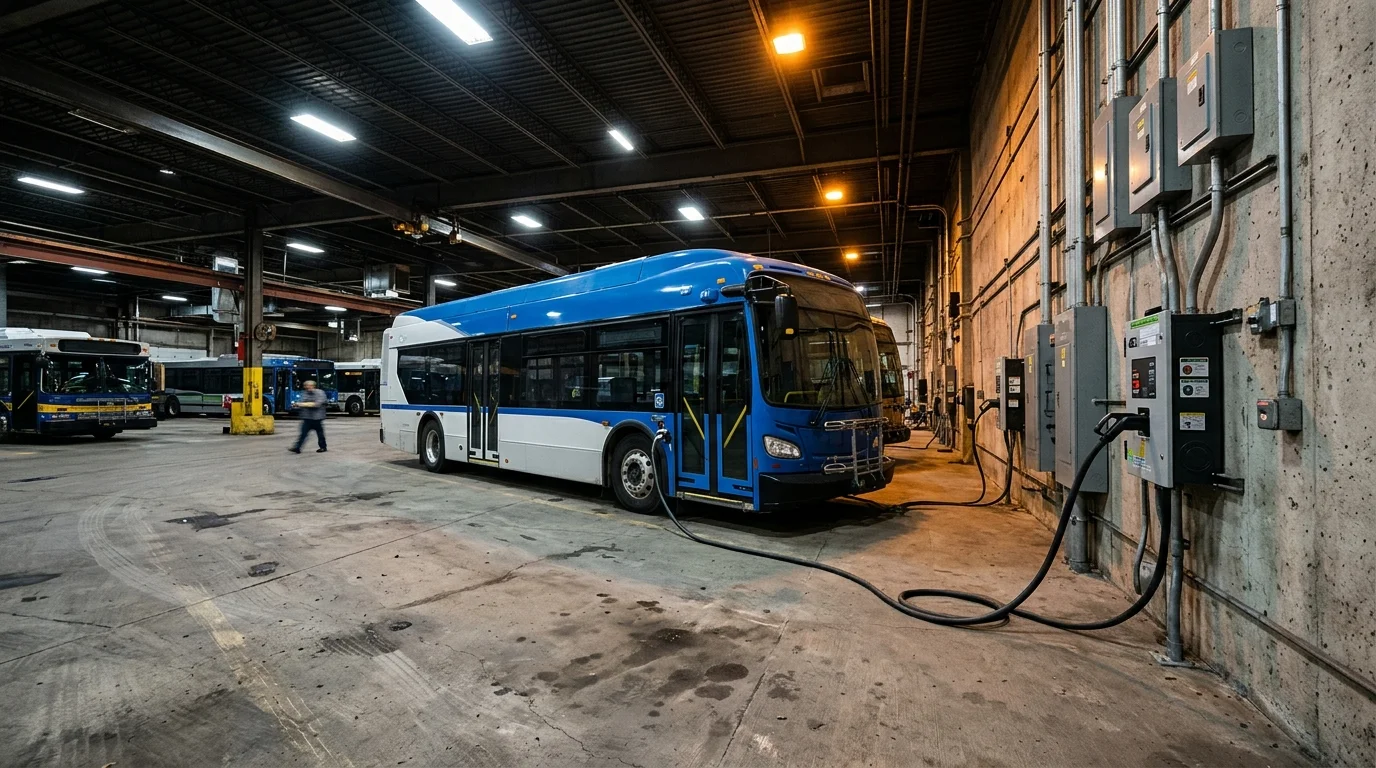
The surge traces directly to a July 31, 2026 Federal Transit Administration award, a $19 million State of Good Repair grant to the Connecticut Department of Transportation that funds the buses, charging infrastructure at CTDOT's Hartford depot, and a hard target of completing CTfastrak's full fleet electrification by 2027. CTfastrak is currently a hybrid diesel-electric operation. When that conversion closes, it will be the first major BRT system in New England running entirely on battery power, serving more than 14,000 daily riders.
The grant itself is the visible tip of a much larger sprint. Connecticut's active federal EV-related portfolio now exceeds $400 million, spanning FTA formula funds, NEVI corridor grants, EPA clean-vehicle awards, and an NSF program. The pace of state procurement has accelerated in parallel: EV-related RFP issuances ran at roughly one per month before 2026 and jumped to five in July 2026 alone. The state is not building toward something. It is executing.
Source: NationGraph.
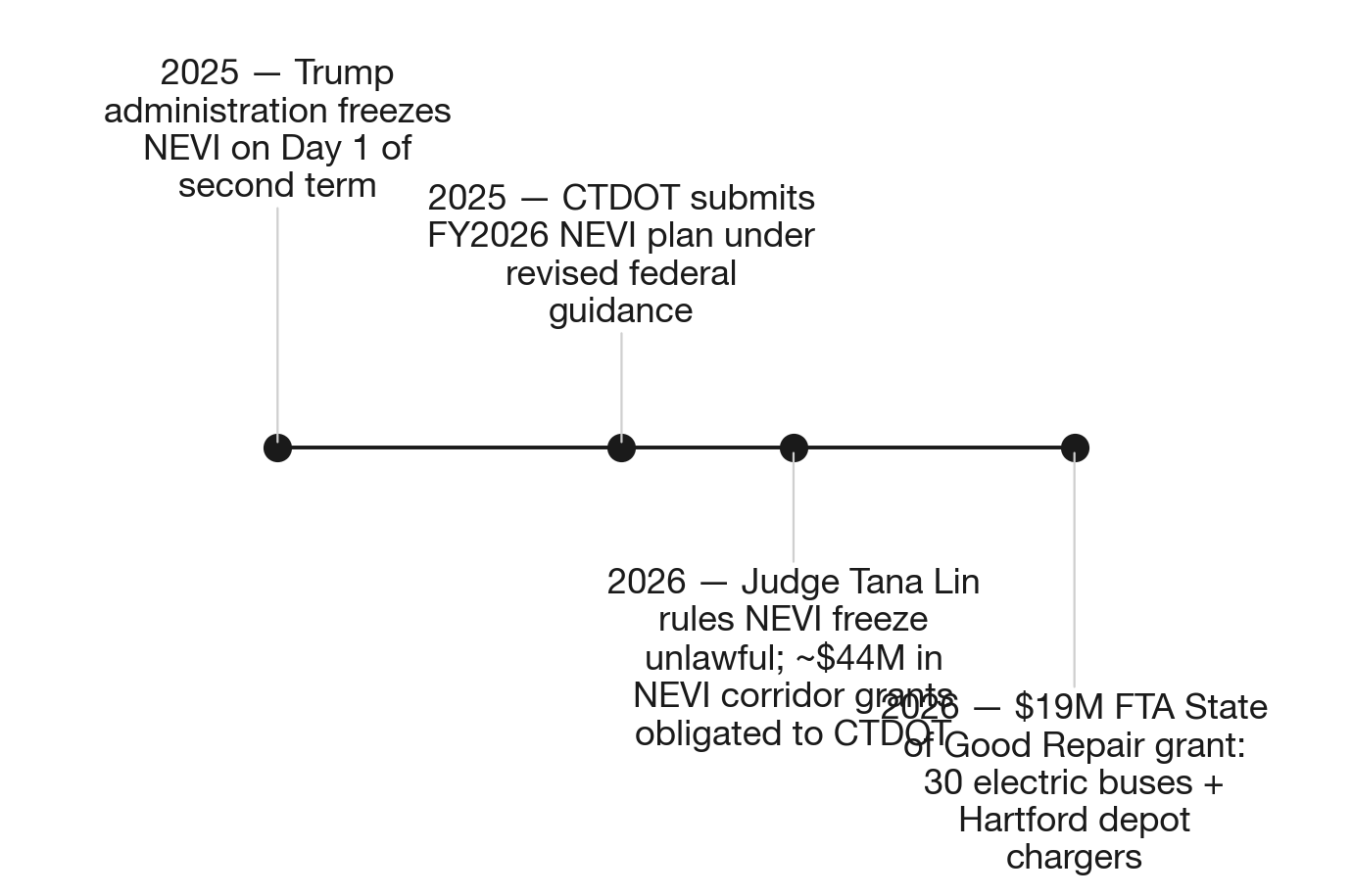
The reason for the urgency is specific. The Trump administration froze NEVI funding on its first day in office in January 2025, halting a $4.4 billion national program to build out highway charging corridors. In January 2026, U.S. District Judge Tana Lin of the Western District of Washington ruled the freeze unlawful and ordered the Department of Transportation to release the withheld funds. Connecticut had positioned itself to move the moment that order landed: CTDOT had filed its FY2026 NEVI deployment plan in September 2025, one of the earliest states to comply with FHWA's revised guidance. Four NEVI corridor grants totaling roughly $44 million were obligated to Connecticut in January 2026 alone, within weeks of the ruling.
Congress then moved in the other direction. A February 2026 budget resolution signed by President Trump cut more than $500 million from NEVI nationally. Connecticut Public Radio reported that Connecticut stood to lose roughly $1.3 million in uncommitted Phase 2 funds, enough for two or three DC fast chargers, because the rescission hit states proportionally based on uncommitted balances. The relative exposure was small because Connecticut had moved its committed funds faster than most peer states. The EV Club of Connecticut summarized the outcome in April 2026 as the state making it through the NEVI gauntlet mostly intact.
That sequencing, early plan submission, fast commitment, minimal uncommitted balance, is not an accident. It reflects a deliberate posture that CTDOT Deputy Commissioner Laoise King described as continuing to move forward with grant awards regardless of the federal turbulence. Governor Lamont's Executive Order 21-3, signed in 2021, requires zero-emission public transit buses statewide by 2035. A separate ZEV fleet mandate for state agencies took effect January 1, 2026. The federal money accelerates a timeline the state was already committed to; the question was always whether the dollars would arrive before the politics shifted.
Nationally, the scale of what remains unspent makes that question consequential well beyond Connecticut. As of January 2026, states had drawn down only about 2 percent of NEVI's available funds, roughly $94 million of $4.4 billion, according to data cited by ACT News. That means enormous sums are still sitting in federal accounts, subject to future executive action, budget rescissions, or additional litigation. States that have already received obligation letters and signed procurement contracts are in a materially stronger legal position than those still waiting for approvals.
For riders on CTfastrak, the practical stakes are straightforward. The corridor is already ranked the best BRT system in the United States by the Institute for Transportation and Development Policy. The electrification adds quieter operation, lower operating costs, and eliminates diesel and hybrid emissions along a 9.4-mile dedicated busway running through Hartford and New Britain. Whether that conversion is complete by 2027, as the grant mandates, depends in part on whether the funding holds through what could be another round of federal challenges.
The next signal to watch is whether FHWA issues any revised stop-work guidance following the February rescission, and whether the remaining uncommitted NEVI Phase 2 funds Connecticut still has on the table survive the next budget cycle. CTDOT's bus procurement contract, once signed, will likely determine how much legal protection the state has if federal administrators try to claw back any portion of the July award.