Five California school institutions issued their first safety-related RFP in more than a year during a single 30-day window ending in early August 2026, a compressed burst that reflects two entirely separate policy clocks hitting simultaneously. Zoom out to the full month of July and the first week of August, and the number climbs to 13 school safety procurements across California institutions. Monthly volume has stayed elevated since February 2026, peaking at 21 institutions in March and holding between 10 and 14 through the summer. This is not a seasonal blip.
The reason two deadlines collided at once comes down to a state law and a federal grant program that were designed independently but landed in the same fiscal quarter. California SB 848, signed October 7, 2025 and effective January 1, 2026, required school governing boards to adopt written facility safety policies by July 1, 2026. That deadline has now passed. What follows adoption is procurement: boards that signed off on safety plans in June and July are now issuing the RFPs to actually build what they promised. At the same time, the DOT's FY2025 Safe Streets and Roads for All program awarded $982 million nationally, with California receiving two major new obligations in July 2026 alone, $27.6 million to the Alameda County Transportation Commission and $14.9 million to the City of Vacaville. Newly obligated federal grants carry spend-down requirements; grantees have to start contracting quickly or risk losing the money.
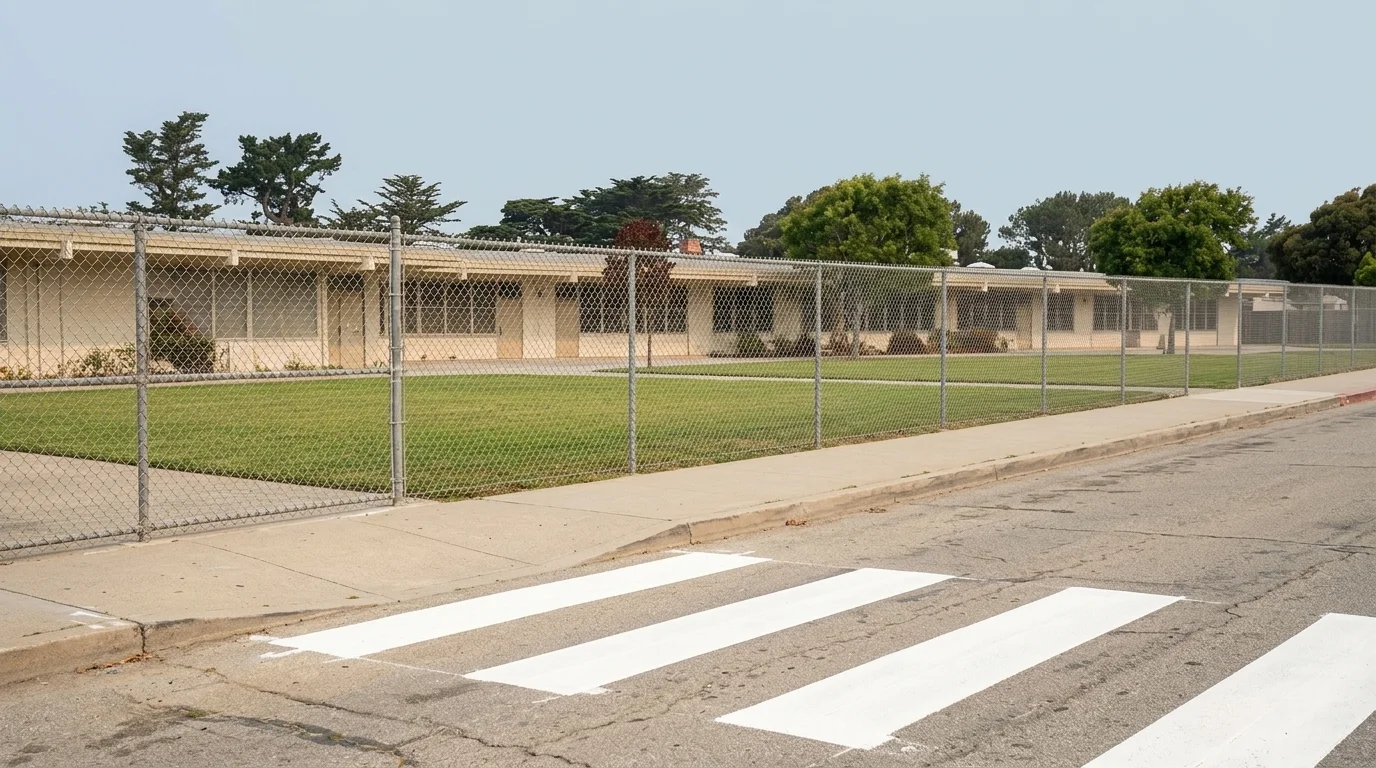
The result is a procurement market split into two distinct archetypes. Stockton Unified School District represents the first: on August 6, the district issued two separate safety fencing RFPs covering Stagg High School and the Chavez High/King Elementary campuses. These are straightforward perimeter hardening bids, the kind of project the DOJ's COPS School Violence Prevention Program (SVPP) was built to fund, the FY2026 SVPP cycle is currently active and offers up to $500,000 per district for exactly this work. Palmdale and Redlands represent the second archetype. Palmdale's August 5 RFQ explicitly names SS4A as its funding source and seeks a school access and circulation safety study. Redlands issued a pedestrian crossing improvement RFP at Redlands High School on July 15. These projects are not about locking campuses down; they are about making the streets around campuses safer for students arriving on foot.
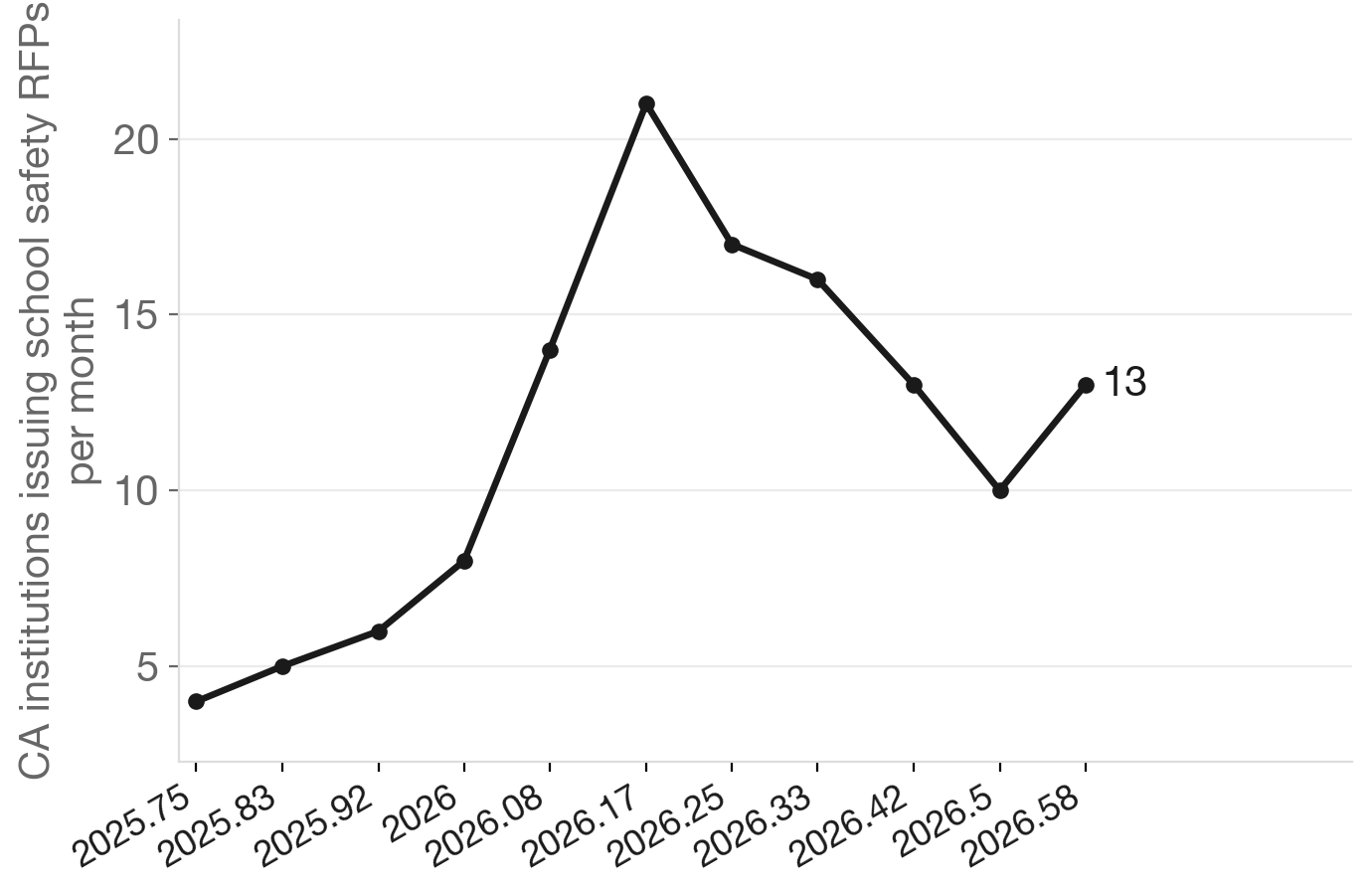
Source: NationGraph.
The geographic concentration of recent activity is worth noting. San Bernardino County, home to both Redlands and the broader Inland Empire corridor, and San Joaquin County, where Stockton sits, are among the regions with the oldest school infrastructure in the state and the highest eligibility for federal disadvantaged-community grant waivers. California runs the largest K-12 system in the nation, with over 1,000 school districts, and even a modest acceleration in safety procurement across that base represents significant aggregate capital spend.
What makes this moment structurally unusual is that both procurement streams are grant-dependent and deadline-bounded. SS4A awards run through 2031, but the planning and study contracts being issued now must be completed before implementation dollars can flow. SVPP grants are awarded competitively by fiscal year cycle. SB 848 compliance is a one-time obligation: once a district adopts its facility safety plan and executes the capital improvements that plan calls for, the legislative pressure eases. The conditions producing this dual-track surge, a fresh state mandate, two active federal grant cycles, and a backlog of deferred school infrastructure investment, are unlikely to coincide again in the same way.
For residents in affected communities, the near-term signal to watch is the bid award calendar. Stockton Unified's fencing RFPs and Palmdale's SS4A study both carry late-August 2026 due dates, meaning contracts could be awarded before the end of the school year's first quarter. Districts that received SB 848 compliance extensions or are still finalizing their facility safety plans will likely enter the procurement queue in the fall, sustaining elevated RFP volume into late 2026. The open question is whether SVPP FY2026 awards, expected later this calendar year, trigger a second smaller surge among districts that held off on fencing projects while waiting to see if federal dollars would offset local costs.