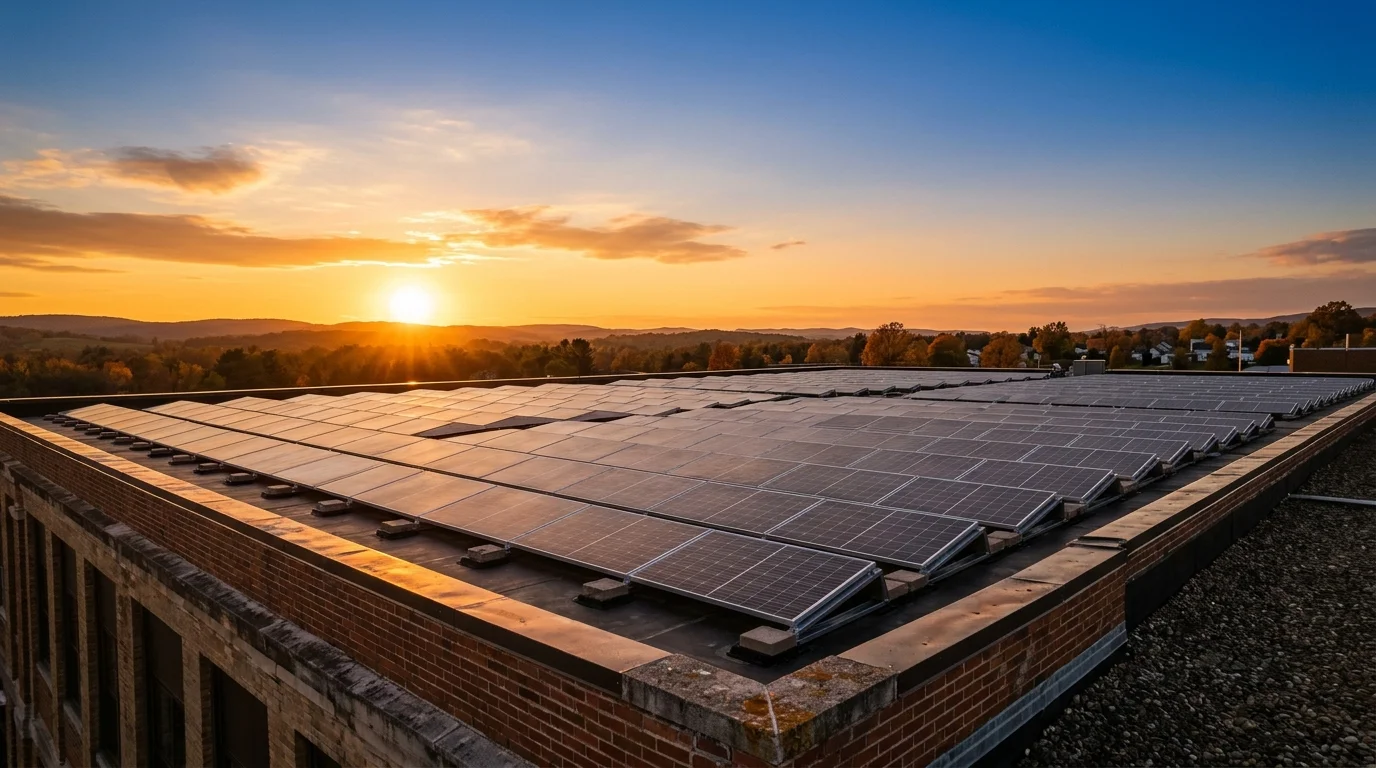
Pennsylvania municipalities and school districts issued 44 solar procurement RFPs in the last 30 days, 4.4 times the state's monthly average of roughly 10, the sharpest relative acceleration among Pennsylvania, New Jersey, New York, Ohio, and Maryland. The surge is not the result of new state solar legislation. Pennsylvania has no solar income tax credit, no sales tax exemption for solar equipment, and historically weak solar renewable energy certificate prices in the $22-to-$40 per megawatt-hour range in 2026. What changed is the federal clock.
The One Big Beautiful Bill Act, enacted in 2025, terminated the residential solar Investment Tax Credit at the end of 2025 and set a July 4, 2026 safe harbor deadline for the commercial and nonprofit Section 48E ITC. Projects that missed the safe harbor must now be fully installed and placed in service by December 31, 2027 to claim the credit, a 30 percent direct reduction in project cost, available as direct pay to local governments and nonprofits. That means a township or school district that has not yet contracted must complete engineering, procurement, and construction inside 15 months. In August 2026, Lisa Schulock of the Philadelphia Energy Authority warned publicly that solar installers across the state are fully booked, and that failure to sign a contract this fall means missing the credit window entirely.
The October 2026 count of 42 RFPs (the trailing 30-day figure captures a few November filings as well) is second only to a July 2025 spike of 55 in an 18-month window, and that earlier spike was partly an artifact of keyword noise, road-salt bids that match a solar search. After filtering out procurement records that use "solar" to describe deicing products, roughly 25 of October's RFPs represent genuine photovoltaic installation projects. Issuers span borough municipal buildings in Conewago, Lancaster, Orangeville, and Hyde Park; school districts including Hanover Area and California Area; Montgomery County's campus facilities; Pennsylvania's Department of Conservation and Natural Resources and Game Commission; and the Westmoreland County Housing Authority. The concentration runs heaviest through south-central Pennsylvania, but no single county dominates, which is itself a signal. This is not a regional infrastructure push coordinated by a state agency. It is dozens of independent local governments reaching the same deadline at the same time.
School districts are arriving at this moment from a second direction. Pennsylvania's Solar for Schools grant program, created by Act 68 of 2024 and administered by the Department of Community and Economic Development, drew $88 million in applications from 88 school districts across 25 counties against $25 million available, a 3-to-1 oversubscription ratio. The state added another $25 million in the fiscal year 2025-26 budget, but the program remains far short of demand. School boards that did not receive grants are now pursuing their own competitive solar RFPs rather than waiting for a future funding round. The Solar for Schools grants and the federal commercial ITC are distinct programs with separate mechanisms and eligibility rules; the grant targets installation cost offsets for schools specifically, while the ITC applies broadly to any commercial, nonprofit, or government entity. But together they have compressed school district procurement into the same narrow fall 2026 window.
The state's newly enacted community solar law, House Bill 1155 signed in April 2025, made Pennsylvania the 23rd state to authorize community solar subscriptions. But the Public Utility Commission's implementation rules were due in April 2026, and first projects are not expected until late 2026 or 2027 at the earliest, meaning community solar is not yet an operational channel for local governments trying to act before the ITC deadline. Municipal rooftop procurement remains the only near-term path.
One federal program is conspicuously absent from the current wave. The EPA's $156 million Solar for All grant to the Pennsylvania Energy Development Authority, funded through the IRA's Greenhouse Gas Reduction Fund, was terminated by the EPA in August 2025. Pennsylvania joined a multi-state lawsuit and the litigation remains unresolved, keeping that money unavailable. The active large-scale federal decarbonization vehicle in the state remains RISE PA, a $396 million federal Climate Pollution Reduction Grant run by the Department of Environmental Protection, but RISE PA targets manufacturers and industrial emitters, not townships or school boards, and it is not a driver of the current municipal procurement surge.
For a Pennsylvania resident, the practical consequence of this wave is that the public buildings most likely to carry solar panels by 2028 are the ones whose governing bodies issued RFPs this fall. Boroughs and school districts that are still evaluating options in early 2027 will face a thinning pool of available installers and no federal tax credit to defray the cost. The PRESS Act, which would have raised Pennsylvania's solar carve-out requirement from 0.5 percent to 5.5 percent and created a durable state-level market signal, was tabled in the legislature in March 2026, leaving federal incentive timing as the only near-term forcing function in the state's solar economics.
The next signal to watch is how many of October's RFPs result in executed contracts before year-end. An RFP is an intent, not a commitment. If installer capacity is as constrained as the Philadelphia Energy Authority warned, some of this procurement wave will stall in the contracting phase, and the December 31, 2027 placed-in-service deadline will determine which projects actually qualify.