Thirteen Florida institutions issued their first hurricane recovery procurement solicitations in over a year during the last 30 days, a number that looks modest until you understand what it represents: the slow-moving tail of a six-storm, eight-year recovery pipeline finally clearing its paperwork backlog just as forecasters offer a rare window of calm.
The context for that number is a $10.94 billion FEMA Public Assistance grant portfolio obligated to Florida in the last 90 days alone, covering damage from Hurricanes Michael, Ian, Idalia, Debby, Helene, and Milton. Of that total, $4.17 billion has already been disbursed, at a pace FEMA described as exceeding $13 million per day through July 2, 2026. The money is moving fast. The question is who is finally able to catch it.
The answer, right now, is the counties that couldn't go first. For most of 2024 and into early 2025, hurricane recovery procurement in Florida was dominated by the larger Gulf Coast jurisdictions: Hillsborough, Lee, Pinellas, and Sarasota led the queue, leveraging bigger administrative offices and pre-existing contractor relationships to move through FEMA's subrecipient requirements quickly. Monthly RFP volume peaked at 113 institutions and 245 separate solicitations in July 2025, then cratered to between 6 and 12 institutions per month through the winter as that first cohort finished its procurements and smaller jurisdictions were still navigating federal compliance paperwork.
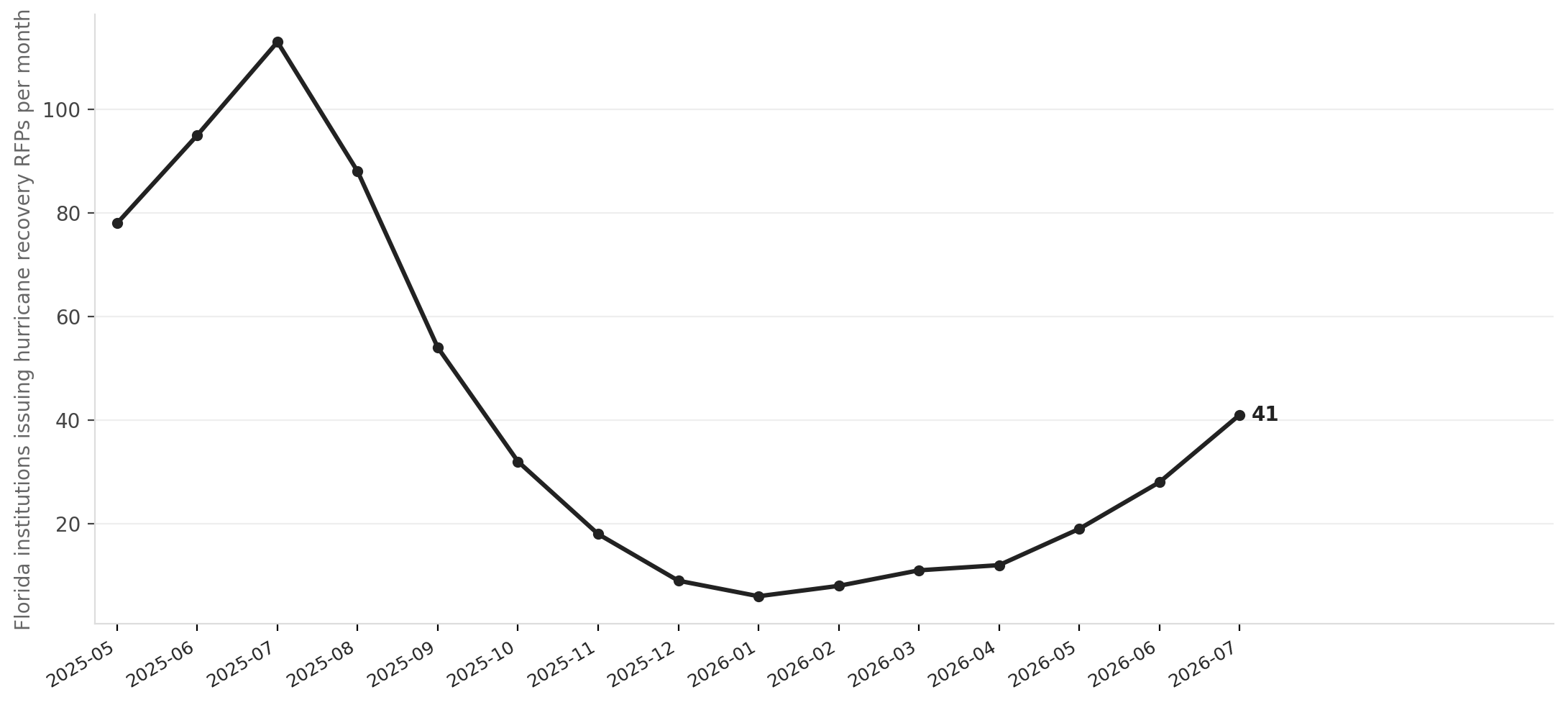
Source: NationGraph.
The 13 institutions re-entering procurement now skew toward exactly the places Sen. Ashley Moody described in June 2026 when she flagged FEMA reimbursements to local Florida governments for more than 500 projects: 'smaller cities and smaller counties that are strapped, in terms of resources,' for whom the paperwork pipeline runs longest. Gadsden County, one of Florida's poorest, is among the re-entrants. So is Bay County in the Panhandle, which is still procuring a fire station relocation tied to FEMA disaster declaration DR-4399, Hurricane Michael, which made landfall in 2018. That single fact captures how uneven this recovery has been: one county is repairing courthouse foundation damage from a 2024 storm while another is still building a fire station from a storm that hit seven years ago.
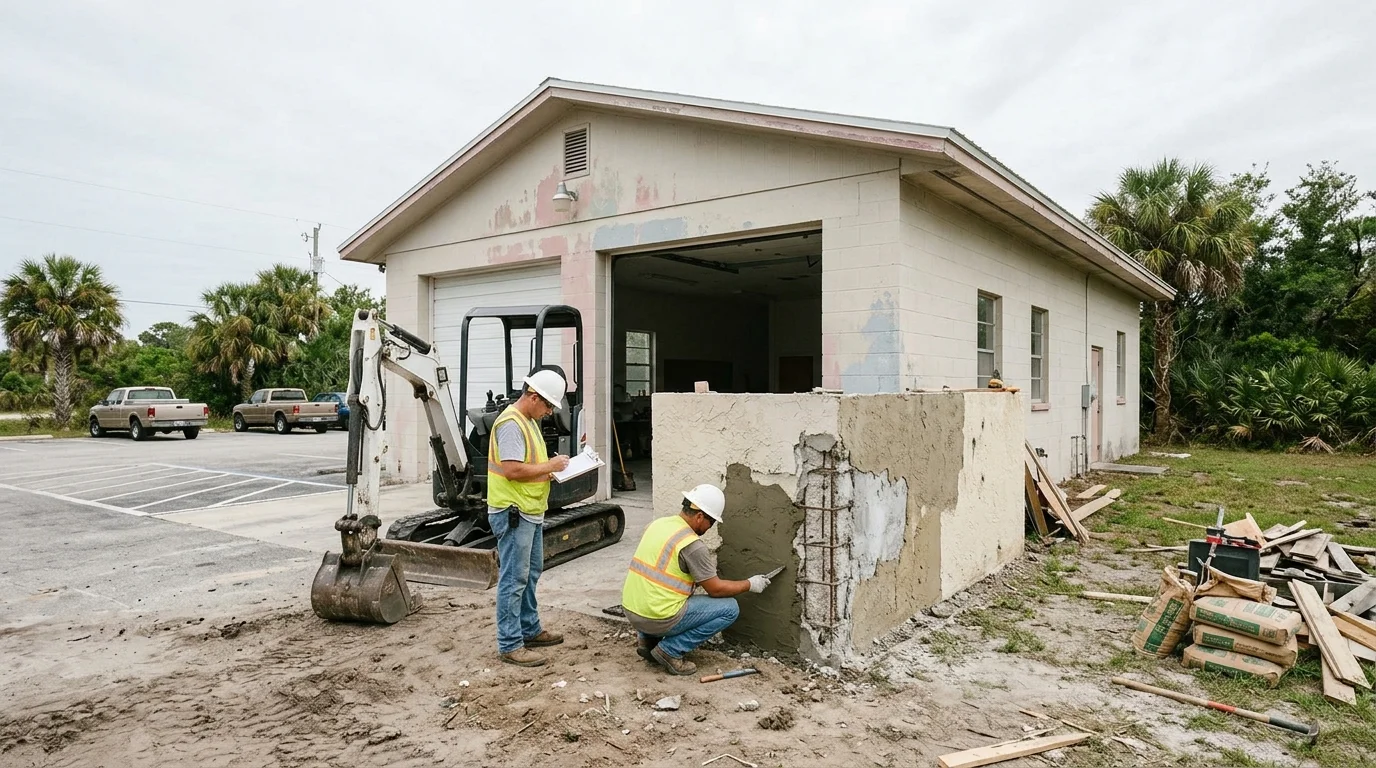
The procurements themselves span that full range. Charlotte County is soliciting repairs to a courthouse foundation damaged by Hurricane Milton. Manatee County is seeking engineering services for Coquina Beach storm damage from Idalia. Sarasota issued an emergency playground repair solicitation. These are not major capital projects; they are the accumulated small-and-mid-scale recovery tasks that only reach procurement once the larger infrastructure work ahead of them in the queue has cleared.
The institutional pressure to move faster is real. FEMA's Procurement Disaster Assistance Team ran a series of virtual federal procurement training sessions for PA subrecipients through July 2026, an active coaching effort that signals FEMA is pushing grantees to obligate remaining funds before grant periods expire. In June alone, FEMA announced $89 million in Public Assistance funding and a separate $90 million in hazard mitigation grants for Florida. The spigot is open; the constraint has been administrative capacity on the receiving end.
The timing is unusually favorable, by hurricane season standards. NOAA's 2026 Atlantic forecast gives a 55% probability of a below-normal season, driven by an emerging El Niño, projecting only 8 to 14 named storms. Colorado State University's July 2026 update reduced its forecast further, projecting total Atlantic cyclone energy at just 40 to 45% of long-term averages. For communities trying to finish construction before the next disruption, a quieter season is not an abstraction; it is the operational window that makes bidding, contracting, and building actually feasible.
But that window is not a guarantee. As NOAA's Ken Graham noted, 'it only takes one storm to make for a very bad season.' Florida has faced six presidentially declared hurricane disasters since 2018, and the counties now entering procurement for the first time in a year are the same ones least equipped to absorb another interruption. The procurement acceleration matters precisely because these jurisdictions have the least margin.
What to watch over the next 60 days: whether the re-acceleration in RFP volume holds as FEMA's procurement training deadlines pass and grant obligation windows narrow. If the pattern from July 2025 repeats, volume could climb back toward triple digits in institutions per month. If smaller counties stall again on contractor capacity or compliance documentation, the money they've waited two years for could sit unspent past the close of the 2026 season. FEMA's grant obligation clock does not pause for storms.