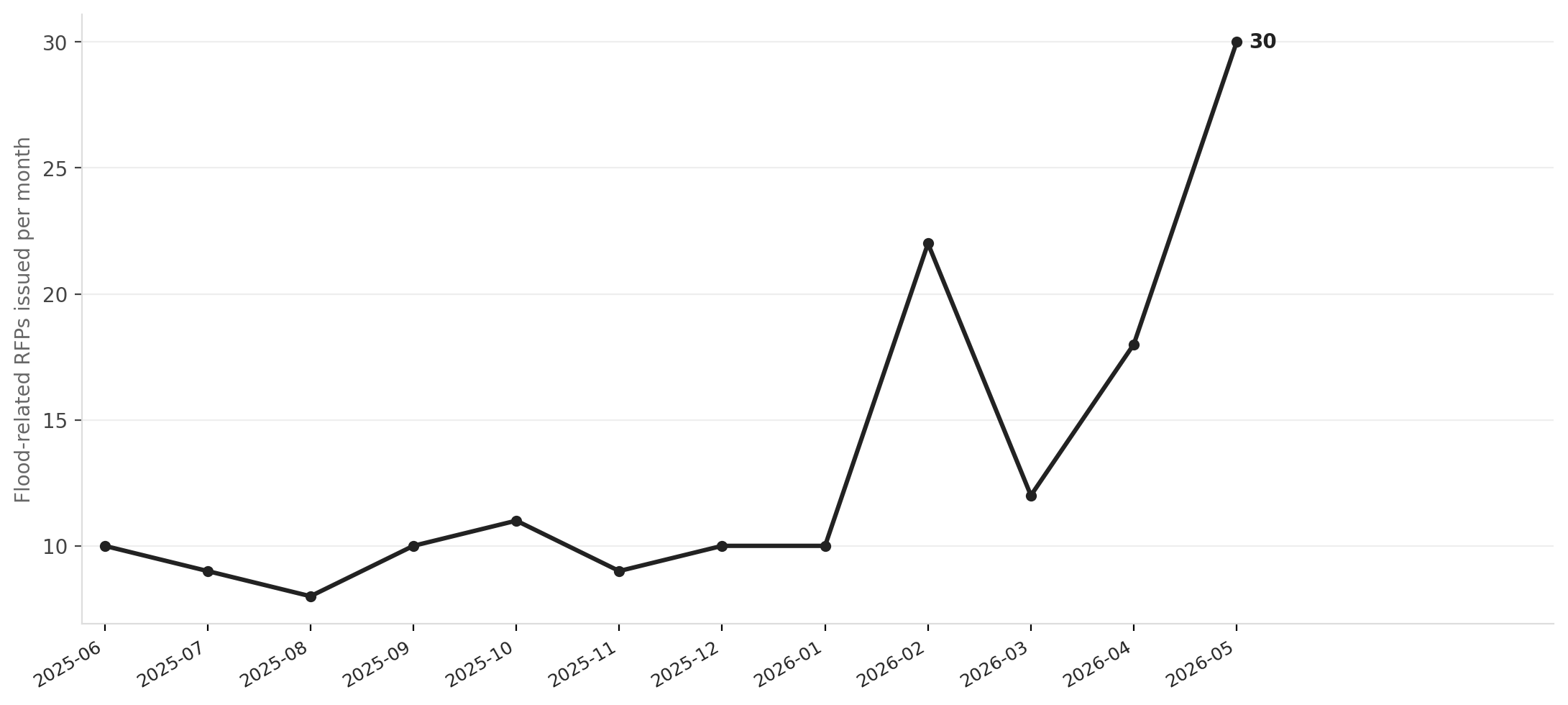
Massachusetts municipalities issued 30 flood-control RFPs in the last 30 days, more than three times the trailing monthly average of 9.6, and the timing is not a coincidence.
On April 15, 2026, the Massachusetts Senate passed S.3050, the Mass Ready Act, a $3.94 billion environmental bond bill that supporters have called the greatest environmental investment in the Commonwealth's history. The bill authorizes $500 million for the Municipal Vulnerability Preparedness program (up from $315 million), $308 million for high-risk dams and inland flood systems, and $200 million for coastal resilience. For cities and towns that have spent years completing vulnerability assessments and drafting project plans, the Senate vote was the signal they had been waiting for: capital is coming, and the queue will be long.
The procurement surge is the tell. Towns are not issuing these RFPs because they have money in hand. They are issuing them so that when a grant award letter lands this summer or fall, they can execute within days rather than months. The MVP program has awarded more than 350 grants to cities and towns since 2018, and in FY2025 it received $108 million in applications against $52.4 million in available awards. That chronic oversubscription has trained municipalities to move fast the moment a larger allocation appears on the horizon.
Source: NationGraph.
The sequencing matters. MVP FY26 Action Grant applications closed April 4, eleven days before the Senate vote. The state's ECO One Stop Coastal Resilience Grant cycle closed March 27, with awards expected in summer 2026. Two major deadlines passed in the same fortnight as the legislation advanced, compressing the pre-award preparation window and producing exactly the kind of procurement burst the data shows. February 2026 also spiked at 22 flood RFPs, suggesting the acceleration began when the bill started moving through the legislature in late 2025.
The single largest recurring procurement in the 30-day window illustrates what execution-mode looks like at scale. The Island End River Flood Resilience Project, a joint undertaking by Everett and Chelsea, is a multi-phase coastal storm surge barrier protecting a 500-acre floodplain, more than 5,000 residents, 800-plus buildings, and roughly 11,000 jobs. Both cities rank among the state's highest environmental-justice-population communities, and the project has been in pre-construction planning long enough to have detailed engineering scopes ready to bid. A Somerville EPA Congressionally Mandated Projects grant of $2.5 million, starting June 2026, is the only new federal flood award to the state in the trailing 90 days, modest on its own, but a marker that federal dollars are still arriving even as state investment dwarfs them.
The geographic spread of identifiable issuers in the 30-day window runs from Nantucket (coastal storm surge) to Attleboro, Shrewsbury, and West Springfield (riverine and inland flooding). The Mass Ready Act addresses both exposures: the bill creates a Connecticut River Valley Resilience Commission and directs $93.5 million specifically to municipal dam repair, recognizing that inland flood risk across the Pioneer Valley and central Massachusetts is as pressing as the coastline. Governor Healey's ResilientCoasts Plan, released in late 2025 and explicitly incorporated into the legislation, identified near-term coastal adaptation priorities; the administration subsequently testified in support of the bill, signaling that the executive branch is aligned with the Senate's timeline.
Advocates including the Mystic River Watershed Association and GreenRoots have framed the state's investment surge as a deliberate hedge against federal funding uncertainty, a backstop for communities that cannot wait on Washington. Senators Markey and Warren secured $30.7 million in FY2026 Congressionally Directed Spending for Massachusetts infrastructure and climate projects in January 2026, but that figure is a fraction of what the Mass Ready Act alone would deploy through the MVP program.
Massachusetts is outpacing every New England neighbor by a significant margin: Vermont posted 9 flood RFPs in the same 30-day window, Connecticut 6. That gap reflects a structural advantage the Commonwealth built over nearly a decade. The MVP program, launched under Executive Order 569 in 2017, has given virtually every municipality a completed vulnerability assessment. Towns are not in planning mode. They are in procurement mode, and they have the paperwork to prove it.
The Mass Ready Act still requires a House version and a conference committee before reaching Governor Healey's desk. That process will determine whether the $500 million MVP authorization survives intact, whether the Resilience Revolving Fund at the Clean Water Trust moves forward, and whether the flood-risk disclosure mandate for homebuyers and renters becomes law. Municipalities watching the RFP calendar will be watching Beacon Hill just as closely.