Twelve California public institutions issued solar procurement solicitations for the first time in over a year during the past 30 days, against a baseline of zero such returning issuers in the same window a year ago. They are not leading a trend. They are chasing one, and the math behind the scramble is unforgiving.
Two federal and state deadlines already closed. A third closes December 31.
The commercial solar Investment Tax Credit (ITC), which had covered up to 40 percent of a qualifying project's cost, ended for new project starts when President Trump signed the 'One Big Beautiful Bill' on July 4, 2026. Any institution that had not commenced construction before that date lost access to a subsidy that, on a multimillion-dollar campus solar installation, can represent seven or eight figures of avoided cost. Separately, the CPUC's NEM 2.0 grandfathering window closed permanently on April 15, 2026. Institutions that missed it now face NEM 3.0's export credit rates of roughly $0.05 to $0.08 per kilowatt-hour, compared with the $0.30 per kilowatt-hour that NEM 2.0 guaranteed for 20 years. That gap, compounded over a two-decade contract, can dwarf the original construction cost difference between acting in 2024 and acting now.
Source: NationGraph.
What remains is the California property tax exclusion for solar installations under SB 710, which sunsets December 31, 2026. For institutions in the IOU service territories of PG&E, SCE, and SDG&E, that exclusion is now the last standing legacy incentive, and losing it closes the final off-ramp for projects that have been sitting in planning queues.
The returning issuers reflect the full range of California's public sector solar market. UC Irvine, which holds an active $822,000 federal DOE Renewable Energy R&D grant, issued a solicitation for medium-voltage solar and battery design services. CSU Bakersfield issued an RFP for an advanced shovel-ready Solar License Power Purchase Agreement, the structure that large UC and CSU campuses use to sidestep direct ownership costs while still locking in long-term electricity prices. Contra Costa Transportation Authority entered with a complete streets project carrying solar elements, working in a county where the Central Contra Costa Transit Authority already holds a $15.95 million federal grant for a Solar Supported Zero Emission Vehicle Fleet project through 2029. Union City followed with a transit facility solar integration solicitation.
That cluster of transit-adjacent solar procurement in Contra Costa County is notable. When a federal grant already funds the storage and fleet side of a zero-emission operation, the solar generation layer becomes the critical dependency, and agencies without it are effectively leaving grant infrastructure underutilized.
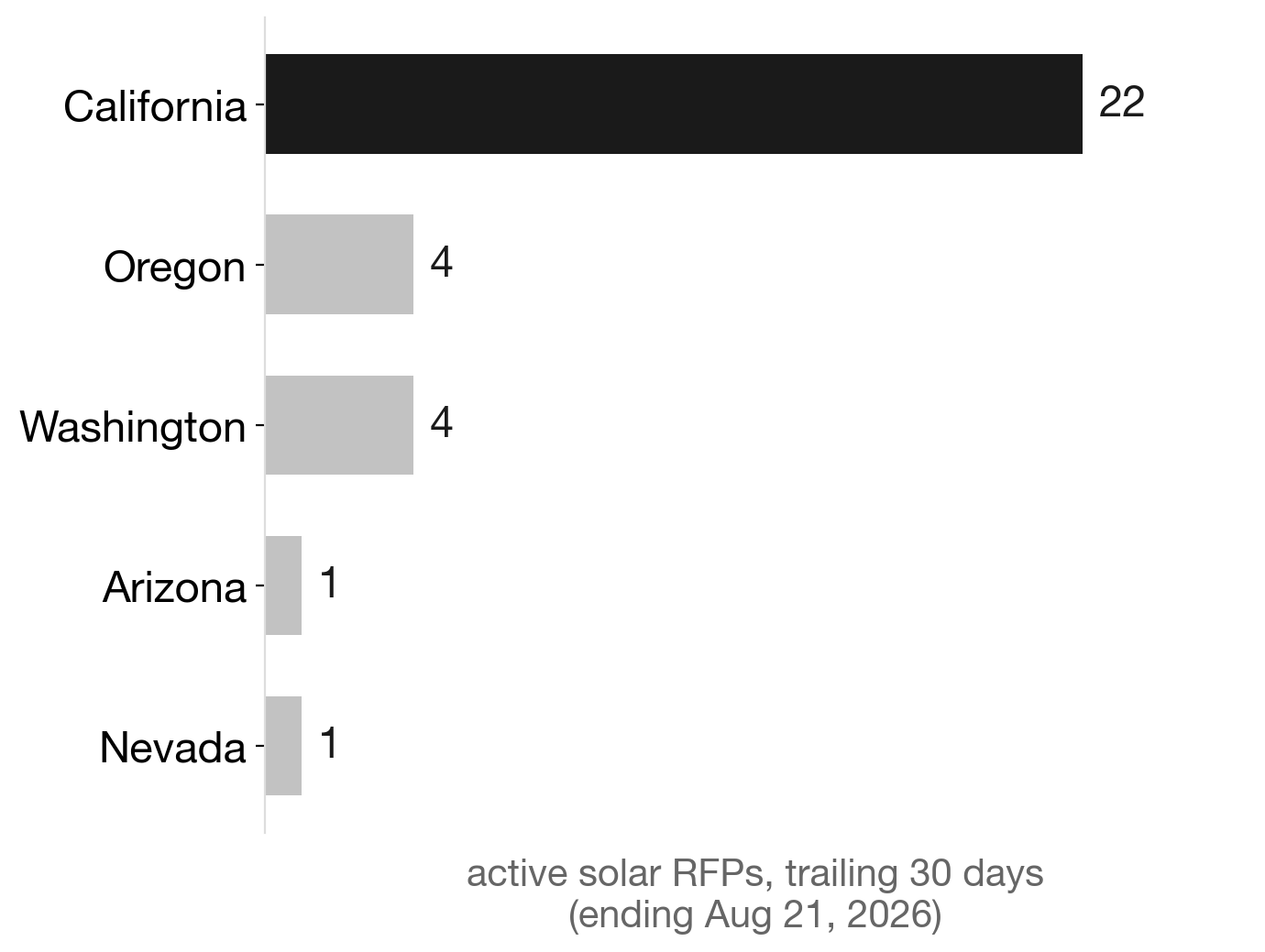
California's 22 active solar RFPs in the past 30 days already outnumber the combined output of Oregon, Washington, Arizona, and Nevada over the same period by more than two to one. Monthly statewide solar RFP volumes have run between 23 and 43 for the past six months, so the 12 returning institutions are not creating market heat. They are arriving late to a market that has been running hot since early 2026, when the dual deadline pressure first became legible to institutional procurement offices.
The pressure is not uniform across the state. Institutions served by municipal utilities, primarily LADWP and SMUD, operate outside the CPUC's NEM framework entirely. Their interconnection economics have not changed, which means their procurement urgency is driven more by the ITC expiration and the property tax sunset than by export rate collapse. IOU-territory institutions, by contrast, are repricing every delayed project under a rate structure that is structurally less favorable than what they could have locked in before April 15. Many are now redesigning those projects around battery storage to reduce grid export dependence, which adds cost and procurement complexity. A PV Magazine analysis from April 2025 flagged exactly this risk for schools and municipalities that waited.
The CSU and UC systems' use of Solar License Power Purchase Agreements insulates them from some of that export rate risk, because the solar developer, not the institution, bears the interconnection and metering exposure. That structural buffer may explain why both CSU Bakersfield and UC Irvine are re-entering now rather than having scrambled before the April 15 NEM deadline. Their calculus was always more about federal tax credit pass-through in the SLPPA structure than about retail rate arbitrage, and the July 4 ITC cutoff changed that math directly.
The December 31 property tax exclusion deadline is now the single most visible remaining trigger. Institutions that close a contract before year-end can still capture that benefit on top of whatever project financing structure they use. Institutions that miss it will be pricing California solar under a tax regime that has not applied to new installations since the exclusion first passed, and that shift will appear directly in their 20-year levelized cost calculations.
The next signal to watch: whether California's monthly RFP volume in September and October holds above 30, which would indicate that the property tax deadline is pulling forward demand in the same way the ITC and NEM deadlines did earlier this year, or whether volume drops as the pipeline of motivated institutions exhausts itself before the final window closes.