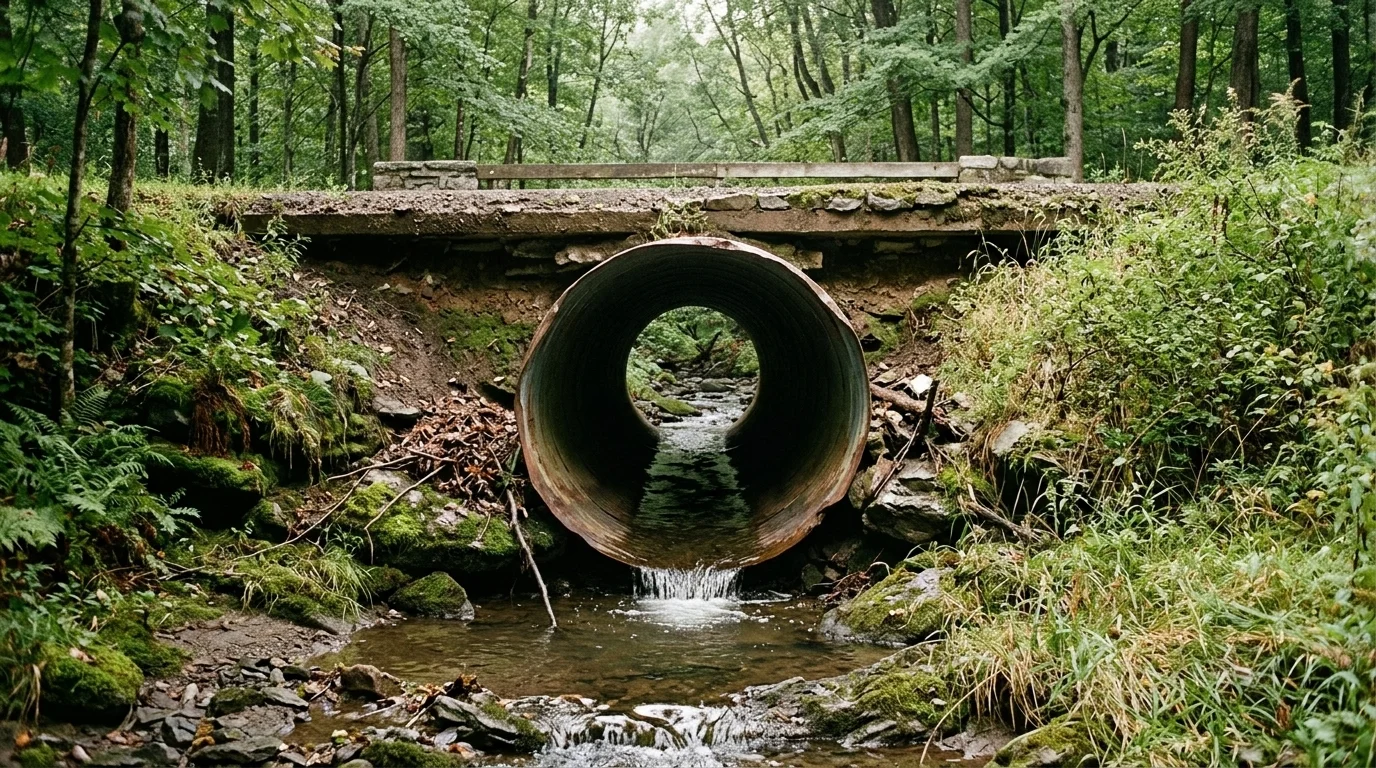
Taghkanic, New York has 1,228 residents, one ZIP code, and as of this month, an active procurement notice for culvert replacement work it could not afford to plan before the state's Environmental Bond Act arrived. It is the smallest of seven New York institutions that issued a flood-related request for proposals in the last 30 days after more than 12 months of collective silence, and it is the clearest proof that the state's multi-billion-dollar flood grant program is finally moving past the agencies and into the towns.
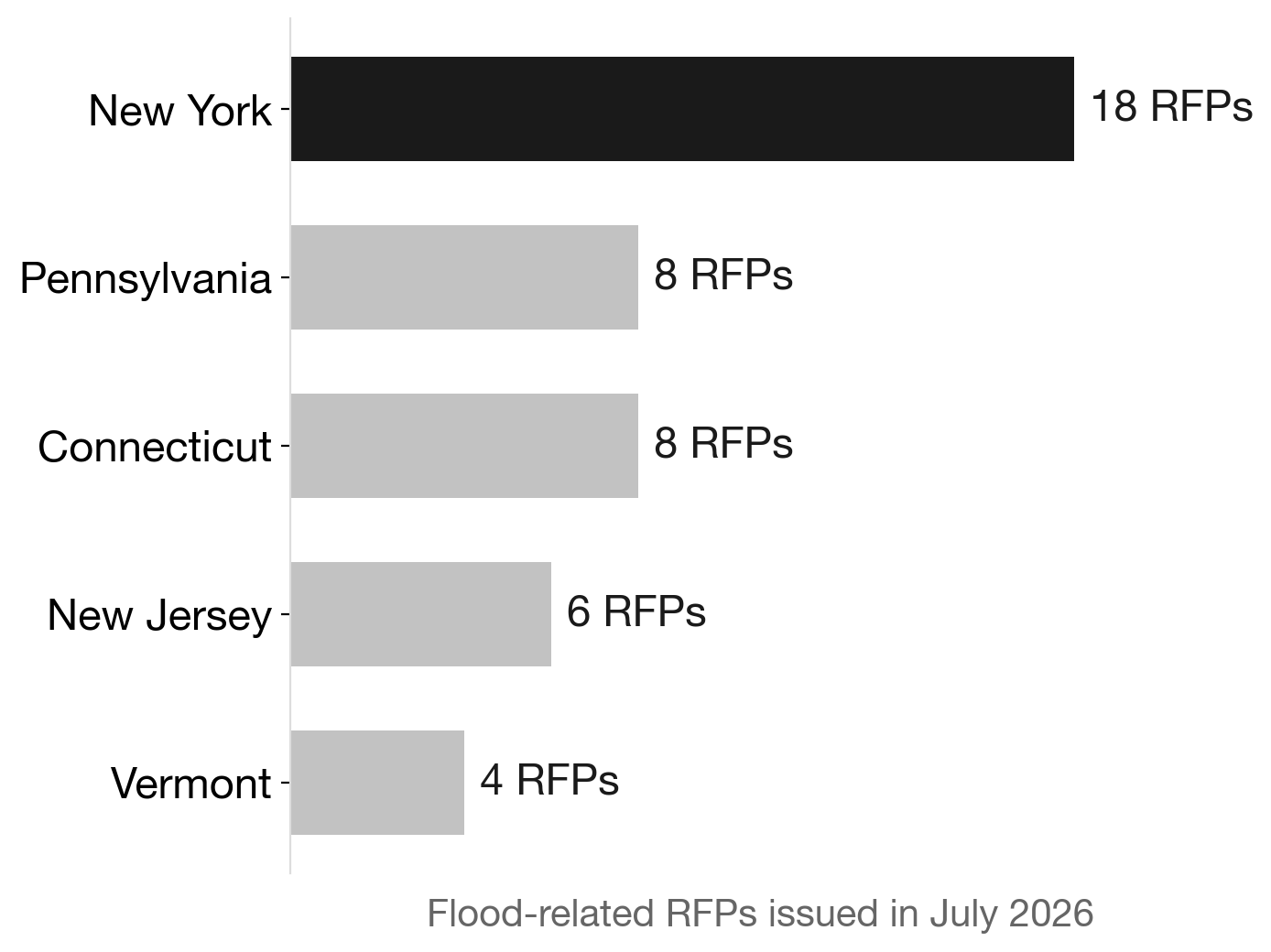
That quiet procurement burst, seven institutions, six counties, zero comparable activity in the prior year, puts New York well ahead of every neighboring state. NY logged 18 flood RFPs from 11 institutions in July 2026 alone, against Pennsylvania's 8, Connecticut's 8, New Jersey's 6, and Vermont's 4. The gap is not explained by New York's size alone. It is explained by a specific policy architecture that other states have not replicated.
The direct driver is the $4.2 billion Clean Water, Clean Air and Green Jobs Environmental Bond Act of 2022, administered jointly by the Department of Environmental Conservation and the Department of State. Governor Hochul announced more than $265 million in water quality and climate resiliency awards in January 2026, including Round 2 of the Resilient Watersheds Grant Program, which put $60 million specifically toward flood mitigation implementation. Applications for that round closed June 26, 2026. The communities now going out to bid are the ones that applied early, secured or anticipated awards, and are now translating state commitments into contractor solicitations.
Source: NationGraph.
A DEC and DOS joint webinar on April 7, 2026 coached municipalities explicitly on how to navigate the application process, almost certainly accelerating the pipeline for smaller communities that lacked dedicated grant-writing staff. That coaching appears to have worked. The seven new entrants span a geography that earlier Bond Act rounds did not reach as visibly: Avon in Livingston County (pop. 6,984), Oxford in Chenango County (pop. 3,527), Urbana in Steuben County (pop. 2,068), and Taghkanic in Columbia County are all rural communities whose flood projects would have stalled without dedicated state subsidy.
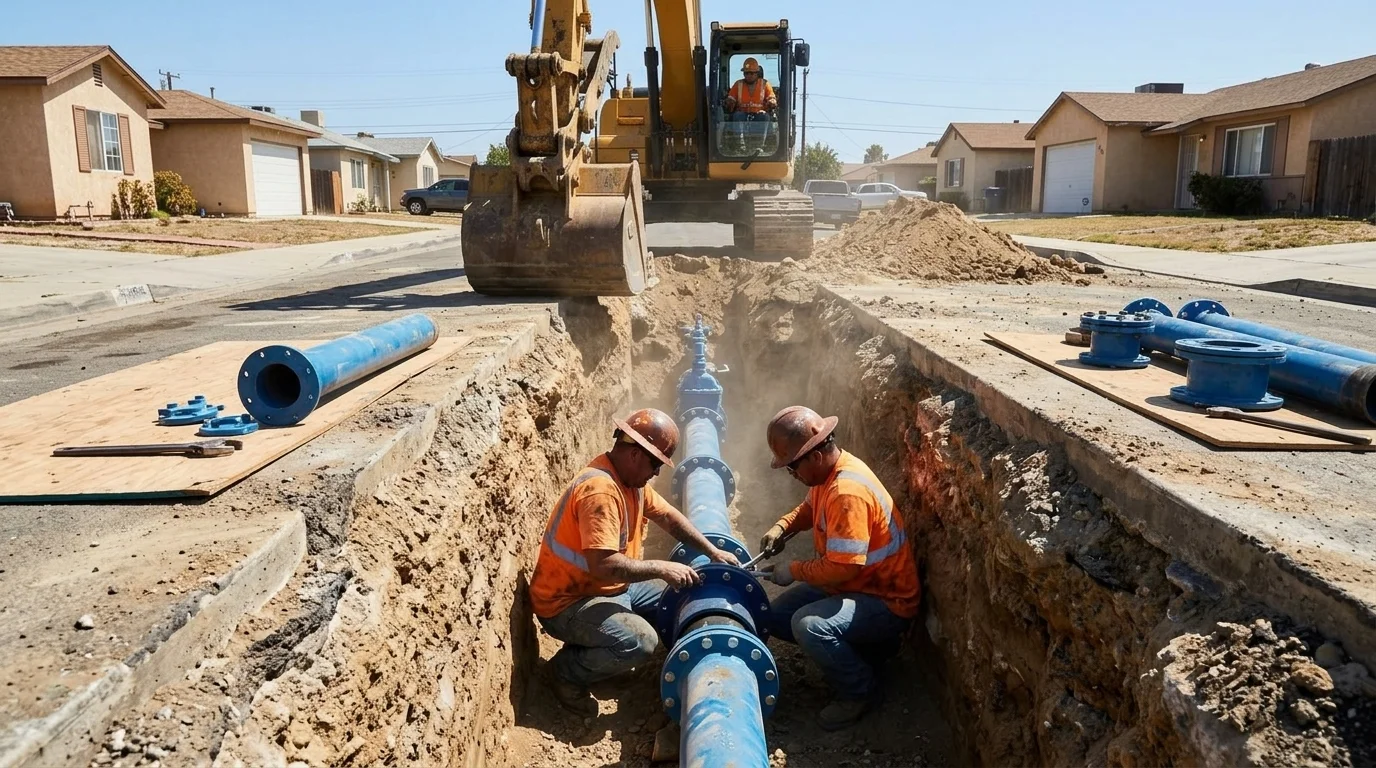
The project types reflect that rural character. Oxford is pursuing bank stabilization. Taghkanic is replacing culverts. These are unglamorous, load-bearing pieces of local water infrastructure that tend to fail quietly until a storm makes them fail catastrophically. Alongside them, CUNY is running a campus-wide flood mitigation procurement covering Brooklyn College, Staten Island, and Medgar Evers. RIOC is conducting a formal flood risk assessment at its Roosevelt Island facilities. The Saint Regis Mohawk Tribe in Franklin County is managing Batch 4 of tribal flood repairs. The breadth, rural culverts to urban campuses to tribal land, is the point.
A separate federal layer is adding momentum. FEMA approved roughly $2 million for four New York flood mitigation projects in April 2026 under its Flood Mitigation Assistance program, including nearly $1 million to assess risk across 27 New York City DOT facilities and $500,000 for drainage modeling in Yonkers. Those awards are modest relative to the Bond Act's scale, but they fill project-specific gaps and signal continued federal engagement alongside the state program.
What makes New York's surge structurally durable, rather than a one-time disbursement, is the Bond Act's design. The Resilient Watersheds Grant Program is explicitly structured for at least five rounds, creating a recurring procurement pulse tied to each application cycle. Communities that miss Round 2 have a credible path into Round 3. That recurrence is rare. Most states administer flood mitigation money through one-time federal pass-throughs or disaster-specific appropriations that arrive irregularly and dry up between storms. New York has built, deliberately, a machine that produces a new cohort of shovel-ready local projects every 12 to 18 months.
For residents of these smaller communities, the immediate change is visible: contractors will be walking streams and measuring culverts this summer. The more consequential shift is in planning capacity. A village of 1,228 people that successfully navigates the Bond Act's application process once is far more likely to do it again. The state's April webinar and the EFC's active outreach are designed to produce exactly that compounding effect.
The next signal to watch is Round 3 of the Resilient Watersheds Grant Program. If the application pool for that round grows beyond the municipalities that appeared in Rounds 1 and 2, it will confirm that the program is genuinely self-propagating, not just clearing a backlog of communities that were already grant-ready. The procurement notices appearing now will tell that story by late 2026.