Twenty-one Florida institutions issued a hurricane recovery procurement request in the last 30 days for the first time in more than a year, a figure more than triple that of Louisiana, the next most active Gulf state, which saw six such new entrants in the same window. That gap is not a measure of Florida's recovery success. It is a measure of how long it takes federal disaster dollars to travel from a Washington allocation to a rural county's contractor search.
The backstory starts in January 2025, when HUD allocated $4 billion in CDBG-DR funds to Florida to cover damages from Hurricanes Idalia, Debby, Helene, and Milton. The largest tranches went to the obvious Gulf Coast heavyweights: Pinellas County received $814 million, Pasco $586 million, and the Florida Department of Commerce $925 million for statewide distribution. Those jurisdictions drove a first procurement wave in July 2025, when 113 Florida institutions issued 245 hurricane-related RFPs in a single month. That wave was concentrated, fast, and dominated by the counties whose names appeared in every storm damage headline.
The 21 institutions now entering the market for the first time represent something different. They include Hardee, Highlands, Levy, Nassau, Hamilton, and Seminole counties, smaller and mid-tier jurisdictions that were either lightly hit or administratively unprepared to move during last summer's initial rush. Under CDBG-DR rules, sub-grantees cannot procure until HUD approves their individual action plans, a sequential process that predictably staggers smaller jurisdictions 12 to 18 months behind major metros. Those approvals are clearing now, exactly as the 2026 Atlantic hurricane season opened on June 1.
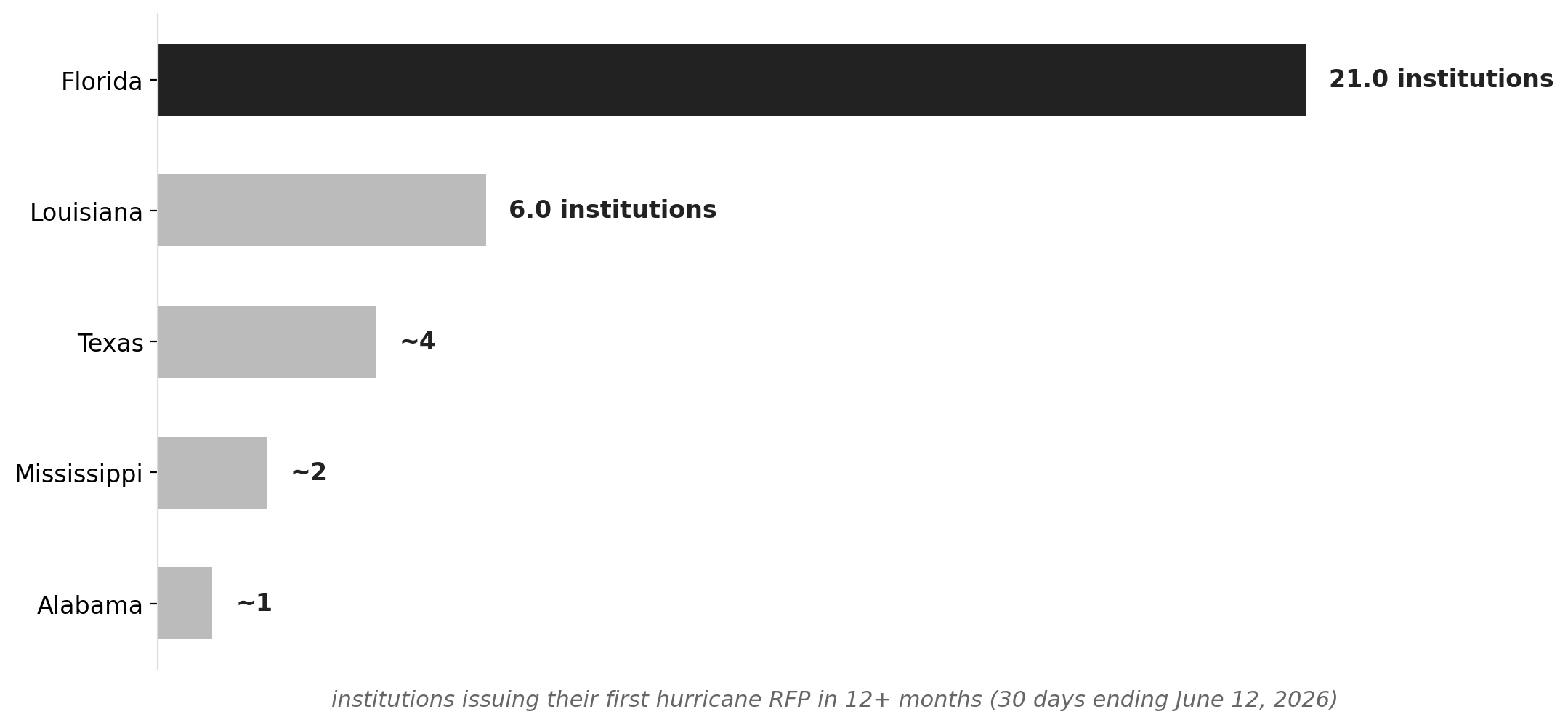
Source: NationGraph.
The project mix in this second cohort is telling. Manatee County is seeking contractors for beach storm damage repair at Coquina Beach. Levy County needs repairs at George T. Lewis Airport. The city of Winter Springs is procuring hurricane-rated safe rooms. Bowling Green is rebuilding water and sewer systems. State-level agencies are issuing debris removal contracts for juvenile justice facilities. That breadth, from coastal tourism infrastructure to inland water systems to state institutions, confirms that the recovery spending has now diffused well past the original storm-track counties into institutional buyers that few observers were tracking.
The Florida Policy Institute's review of CDBG-DR allocations found that jurisdictions with published action plans were meeting just 18 percent of housing unmet needs and only 4 percent of economic recovery needs, while infrastructure captured 55 percent of committed spending. The current procurement cohort mirrors that imbalance: beach repair, airport reconstruction, and utility rebuilds dominate the new RFPs, while housing programs in many of these smaller counties have not yet opened applications.
Disbursement figures underscore the bottleneck. The active CDBG-DR grant portfolio shows $4.87 billion obligated to Florida, but actual outlays remain minimal across most grantees. Hillsborough County approved $95 million in flood-protection projects in April 2026 and noted that many would begin design phases in summer 2026, a timeline that lands squarely in the current new-entrant window. Manatee County's Lasting Manatee program received $252.7 million in CDBG-DR funding, with housing applications opening only in early 2026, roughly 16 months after HUD's initial allocation. That lag is not an anomaly; it is the structural pace of the program.
NOAA's forecast for the 2026 Atlantic season carries a 55 percent probability of below-normal activity, but that probability does not reduce the political pressure on local officials. Florida jurisdictions face HUD oversight reviews tied to spending benchmarks, and any jurisdiction caught mid-procurement when the next storm makes landfall faces both operational disruption and difficult optics. The June 1 season start is functioning as a hard deadline that is accelerating contractor searches regardless of forecast conditions.
For residents in the counties now entering the market, the practical implication is a compressed construction calendar. Contractors who absorbed the first-wave workload from Pinellas, Pasco, and Hillsborough are already carrying large project backlogs. A second cohort of 21-plus institutions arriving simultaneously will compete for the same licensed firms in a state where construction labor has been tight since 2022. Project timelines for the smaller jurisdictions may stretch further than their procurement schedules currently anticipate.
The next signal to watch is whether this second wave sustains through the summer or stalls again. HUD's sub-grant approval queue still holds action plans from additional rural counties and state agencies. If those clear before fall, a third procurement cohort could overlap with active hurricane season response for the first time, testing whether Florida's recovery infrastructure can run a bidding process and an emergency response simultaneously.