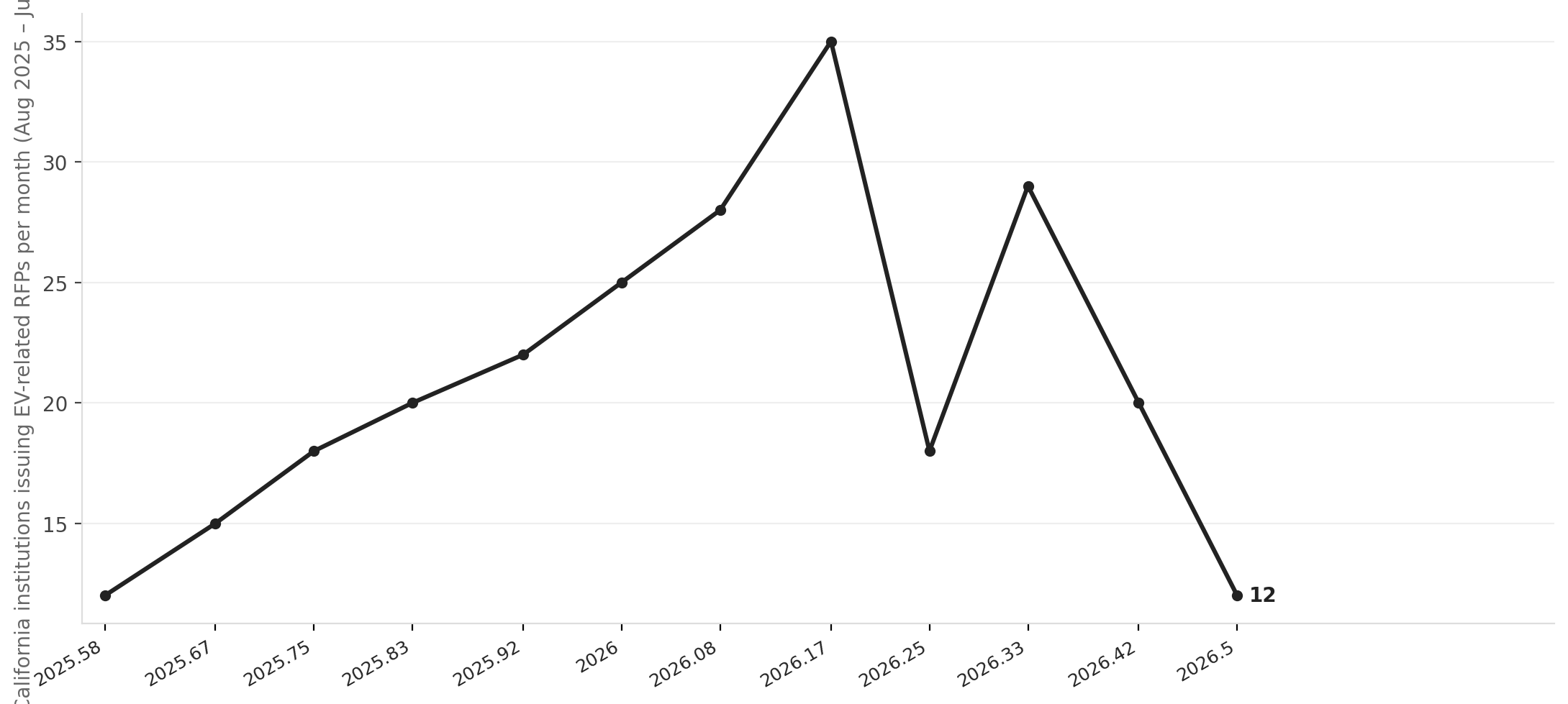
Twelve California government agencies issued their first electric vehicle procurement RFP in over a year during the last 30 days, according to NationGraph contract data covering late June through July 2026. A year earlier, that number was zero. The shift is not a surge of enthusiasm. It is deadline math.
Under CARB's Advanced Clean Fleets regulation, every California state and local government agency must ensure that 100% of new fleet vehicle purchases are zero-emission beginning January 1, 2027. A 50% threshold has been in effect since 2024, which pushed early movers into the market in 2024 and into a broad procurement plateau through the first half of 2026, with monthly first-time RFP volume reaching as high as 35 institutions in March 2026. July's twelve newcomers are the tail of that wave, not the leading edge. For any agency seeking a fleet vehicle delivered before December 31, 2026, a competitive procurement issued now is the last practical on-ramp.
The cohort of July first-timers reveals a specific structural dynamic. Small government fleets of ten or fewer vehicles, and fleets in designated low-population counties, faced no ACF obligations until the 2027 cliff arrives. McFarland, a Kern County city of roughly 14,000 residents whose fleet almost certainly qualified for that small-fleet exemption, issued its first EV vehicle purchase RFP this month. Victor Valley Transit Authority in San Bernardino County posted for Level 2 charger installation. The City of Riverside, serving a metro population of more than 300,000, issued an RFP for EV charging infrastructure design and construction management. Southern California Public Power Authority in Glendora is seeking a charging station network manager. These are not agencies that missed the trend. They are agencies for whom the legal obligation is just now arriving.
Source: NationGraph.
The financial scaffolding is also in place, at least partially. Active federal EV-related grants in California total more than $2.2 billion in obligated funds, led by EPA at $1.46 billion and DOT at $708 million, giving agencies the fiscal cover to move on infrastructure spend. But one cost incentive has quietly closed. The federal Alternative Fuel Vehicle Refueling Property Tax Credit for charger installation expired after July 1, 2026, adding a hard cost-deadline for any agency still finalizing charging infrastructure projects. Agencies that issued infrastructure RFPs this month are racing against two clocks simultaneously.
The political environment surrounding these procurements has sharpened since June 2025, when President Trump signed three Congressional Review Act resolutions rescinding California's EPA Clean Air Act waiver that underpinned consumer EV sales mandates. A Seyfarth analysis of the rescission noted that the ACF's government fleet requirements operate under distinct state authority and are not dependent on the federal waiver. CARB has confirmed that the state and local government fleet portion of the regulation remains intact. The practical effect is that the ACF for government fleets has become the most durable EV enforcement tool California still fully controls, raising its political salience in Sacramento at exactly the moment agencies are trying to decide whether to take the mandate seriously.
The compliance picture is not clean. A June 2025 report from Stanford's Bill Lane Center found that extensive time and effort will be required by local jurisdictions to meet ACF requirements, and flagged utility grid capacity and contractor availability as structural barriers. For agencies issuing first-time RFPs in July 2026 with a December 31, 2026 compliance window, those barriers are no longer abstract planning concerns. They are active procurement risks.
For residents in jurisdictions where these RFPs just landed, the near-term signal is straightforward: the municipal vehicles their agencies buy next are almost certainly electric, and the charging infrastructure to support them is being designed and contracted right now. The longer-term question is whether the agencies that sat out 2024 and 2025 can compress what early movers built over eighteen months into a six-month sprint.
The answer will start to become visible this fall, when awards on July's RFPs are expected. Any agency that has not issued a procurement by August faces a delivery timeline that almost certainly runs past the January 1 deadline.