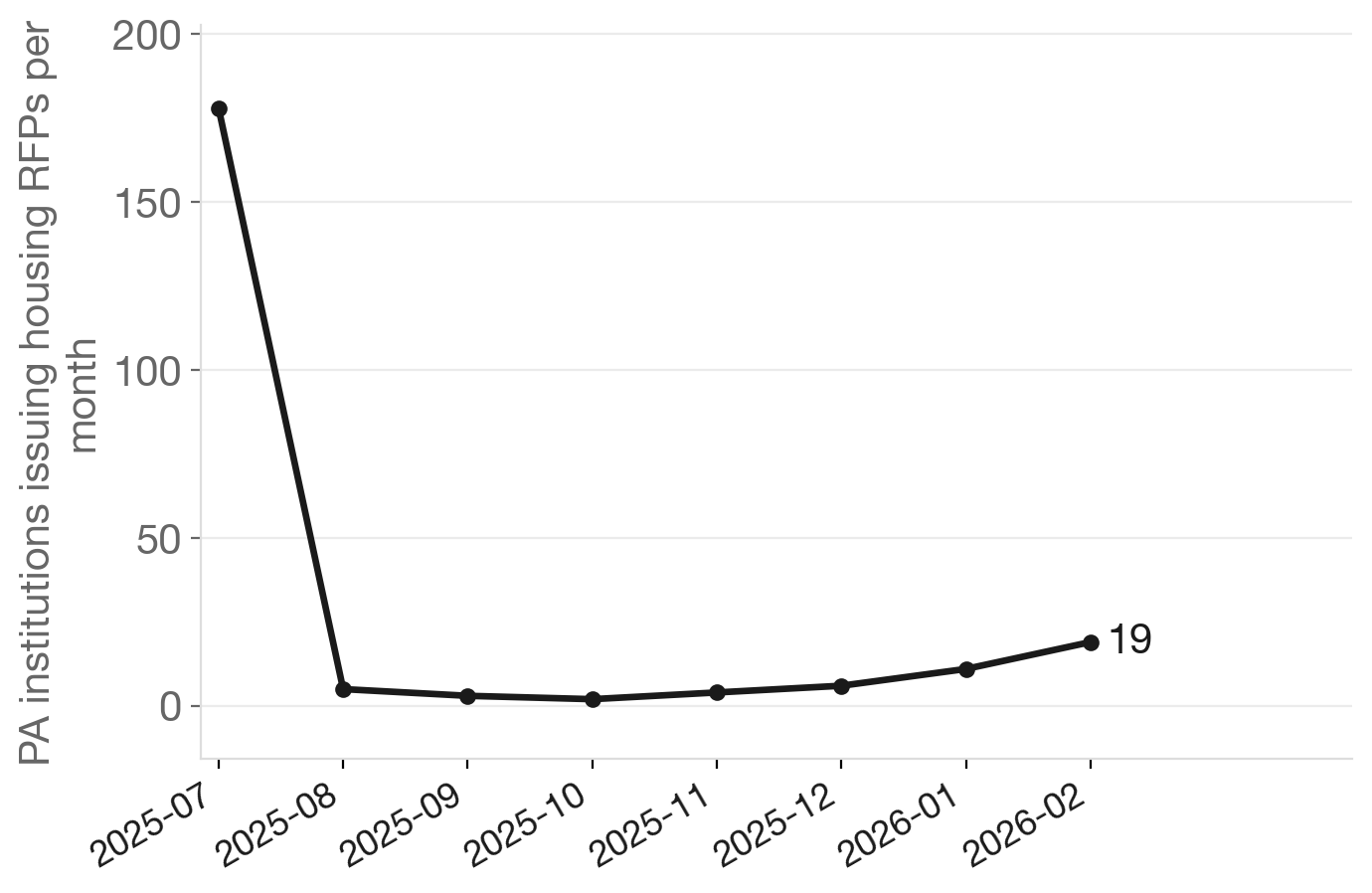
Nineteen Pennsylvania housing authorities, county agencies, and municipal bodies issued a housing-related RFP in the past 30 days after going silent for more than a year, a number that stood at effectively zero in the comparable window a year ago. The institutions behind those solicitations are not the usual large-city procurers. They are county-level redevelopment offices and small housing authorities that had gone dark on contracting since mid-2025, and they are all moving at once.
The money trail runs directly to Harrisburg. On June 11, 2026, the Pennsylvania Housing Finance Agency announced $93.4 million in PHARE funding covering 432 initiatives spanning all 67 counties, the largest single-round distribution in the program's history. Grant awards do not produce construction. They produce procurement. The standard six-to-nine-month lag between a grant announcement and a grantee's first RFP publication places the current surge exactly where it should be: late July and August 2026.
The upstream cause is Governor Josh Shapiro's February 2026 executive order creating Pennsylvania's first-ever Housing Action Plan, paired with a 2026-27 budget proposal calling for a $1 billion Critical Infrastructure Investment Fund and a legislatively secured escalation of the PHARE cap to $100 million per year by 2027, up from $60 million. The plan is explicit that the state cannot close Pennsylvania's projected shortfall of roughly 185,000 homes by 2035 without local governments activating. The June grant round was, in effect, a mandate delivered with a check attached.
Source: NationGraph.
The new entrants illustrate how broadly the activation has spread. Blair County is soliciting partners for an Affordable Housing Trust Fund sustainable housing program targeting households below 80% of area median income. The Lehigh County Housing Authority put out a multi-year architecture and engineering services RFP for aging multifamily renovation. Lawrence County is seeking partners for a Healthy Homes Production Grant aimed at reducing health and safety hazards in low-income rentals and owner-occupied homes. Bucks County's solicitation is tied specifically to CDBG-DR Hurricane Ida recovery funding, federal disaster money that has been moving through the pipeline for years and is only now reaching the local contracting stage. Philadelphia's H.O.M.E. initiative Curbside Appeal Program, targeting roughly 10 blocks per year, adds a neighborhood-scale dimension to what is otherwise a county-level story.
The range matters. These are not adjacent programs running through the same administrative channel. They are architectural services, environmental health interventions, disaster recovery rehabilitation, and neighborhood beautification, different program types, different federal and state funding streams, all converging in the same procurement window because they share the same upstream trigger.
Pennsylvania now leads all neighboring states in 30-day housing RFP volume, with 32 active institutions against 26 for New York, 25 for Ohio, and 22 for New Jersey. That regional comparison is significant because it is not a function of Pennsylvania's population size or its number of housing authorities alone. It reflects the timing and scale of a coordinated state investment round that peer states have not replicated.
The structural reason the surge looks so sharp is Pennsylvania's unusual fragmentation. The state has 2,562 municipalities, many with independent housing authorities, zoning boards, and redevelopment agencies. When a state-level signal arrives, a PHFA grant covering all 67 counties simultaneously, it does not produce a single centralized contract. It produces a distributed wave of local procurement activity, staggered by the administrative capacity of each recipient. Monthly institution-level housing RFP activity had collapsed from a high of 178 institutions in July 2025 to single digits from August through October 2025. The 19 first-time-in-a-year issuers in the current window are institutions coming off a genuine freeze, not incremental additions to an already-active market.
Federal momentum is reinforcing the state push. The 21st Century ROAD to Housing Act, backed by Rep. Brian Fitzpatrick of Pennsylvania's First Congressional District and passed in June 2026, adds HUD competitive grants for local governments to adopt pre-reviewed housing designs and shortens permitting timelines, reducing two of the biggest friction points between a housing grant and a completed unit. HUD had already obligated more than $570 million in housing-related grants to Pennsylvania in Q1 2026 alone, primarily Section 8 vouchers and public housing operating funds, creating a floor of federal dependency that local agencies must contract to administer.
For anyone watching housing supply in Pennsylvania, the next signal to track is not another policy announcement. It is award activity. The RFPs now publishing will close on rolling timelines through the fall, and contract awards, or the absence of them, will reveal whether local agencies have the vendor capacity to absorb the money Harrisburg has committed. A state that has never before issued a Housing Action Plan is now watching 19 first-time procurers learn to execute one.