Florida issued 28 EV-related procurement solicitations in the last 30 days, 4.1 times its 12-month monthly average of roughly 6.8, and nearly all of them landed in October 2026, the month immediately after the federal government forced $144 million in EV infrastructure grants onto FDOT's books in a single day.
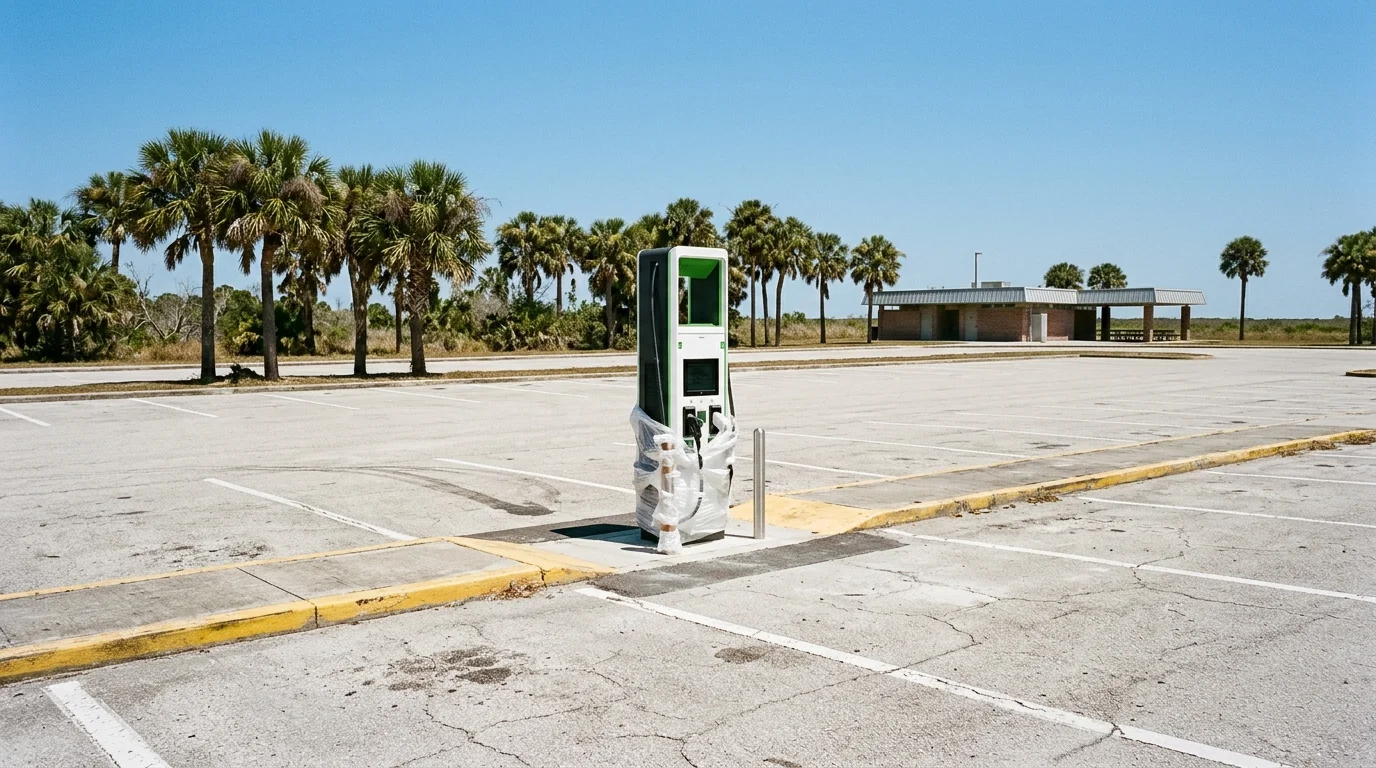
The trigger was September 23, 2026. That is the date FHWA obligated 10 separate NEVI Formula Program grants to FDOT totaling $144 million, one week before the program's five-year statutory authorization under the Infrastructure Investment and Jobs Act expired on September 30. According to FHWA's NEVI funding records, Florida's total five-year NEVI allocation is $219.7 million. As of November 2026, $0 of that allocation has been outlayed to actual projects. The September 23 grants are committed to FDOT but have not yet reached a single charger in the ground.
The downstream effect was immediate. Agencies that had been waiting, or, in some cases, that had been waiting on the state, began issuing their own solicitations. FDOT itself filed 6 RFPs in October. Miami-Dade County filed 4. Hallandale Beach filed 3. The Central Florida RTA and LYNX transit authority filed 2. Tamarac and Islamorada each filed 2. The procurements span DC fast-charging station installation, EV fleet purchases for sedans and pickup trucks, charging management systems for bus depots, microgrid-integrated EVSE, and on-demand electric rideshare contracts. The breadth reflects how many types of agencies had been standing by.
To understand why Florida's local governments are moving this fast now, it helps to understand why the state moved so slowly before. Florida's executive leadership had for years characterized EV charging investment as a form of ideologically driven federal overreach, one official described it publicly as 'woke' spending, and FDOT had not outlayed a dollar of NEVI money while peer states moved ahead. Texas, by comparison, had already outlayed roughly $82 million of its NEVI allocation before the statutory deadline arrived. Florida's 30-day RFP count (28) is now 2.8 times Texas's 10 and more than 9 times Georgia's 3 in the same window. That gap reflects a Florida-specific pressure, not a national wave.
The pressure was compounded by a separate embarrassment. As WUSF reported in July 2026, FDOT had proposed redirecting approximately $153 million of its remaining NEVI funds to a network of 32 eVTOL vertiport air taxi pads rather than ground-based EV chargers. FHWA had not approved Florida's FY2026 state deployment plan as of June 2026, leaving the state listed alongside Iowa and Oregon as non-compliant. The Southern Alliance for Clean Energy publicly called on FHWA to deny the vertiport proposal. The September 23 obligation appears to reflect a pre-expiration push to lock in funds regardless of how the eVTOL controversy resolved, and regardless of whether a deployment plan had been approved.
Congress, meanwhile, had already clawed back $44.6 million of Florida's unobligated FY2022 NEVI funds through a rescission in the Consolidated Appropriations Act of 2026. That reduction left the state with less room to maneuver and more urgency to demonstrate it could actually spend what remained.
Two distinct mechanisms are now accelerating local procurement simultaneously, and they should not be confused for one another. The NEVI Formula Program is a federal grant flowing through FDOT as a state pass-through; it provides the capital. The Florida Sheriffs Association Cooperative Purchasing Program, which renewed its EV charging contract (FSA26-PWR5.0) in August 2026, is a separate state-level pre-qualification vehicle that lets municipalities, counties, school districts, and sheriff's offices buy charging hardware without issuing their own competitive solicitations. As Charge Dev News reported, FSA26-PWR5.0 runs through June 30, 2028. NEVI provides the capital pressure; FSA lowers the transaction cost. The 28 RFPs in the seed metric represent agencies that chose to run their own solicitations rather than use FSA, which is why both procurement channels are visible at the same time.
The infrastructure case is real, whatever the politics surrounding it. Florida holds the second-largest EV fleet in the country but ranks below the national average on public chargers per vehicle. The state completed its highway Alternative Fuel Corridor network ahead of most states, which is, notably, the statutory condition that FDOT cited to justify pivoting NEVI funds toward vertiports. A corridor network without sufficient off-corridor charging leaves a large and growing EV population underserved.
The next signal to watch is whether FHWA formally approves or rejects FDOT's eVTOL deployment plan. If FHWA denies it, the $144 million obligated on September 23 will need to flow into conventional EV infrastructure, and the local procurement wave now underway may become the primary channel through which Florida finally spends what it has owed its EV drivers for four years. If FHWA approves, the legal and advocacy challenges from groups like SACE are likely to follow quickly, and the agencies that filed October RFPs may find themselves in a funding queue with no certain resolution date.