Pickleball procurement has hit a new ceiling: 418 public institutions across 34 states issued court construction or resurfacing RFPs in the last 60 days, roughly 4.2 times the prior bimonthly average of 99. The hype driving that number belongs not to professional leagues or indoor entertainment complexes but to something considerably less glamorous: fiscal-year budget calendars and grant application deadlines that have been stacking up in local parks departments since 2024.
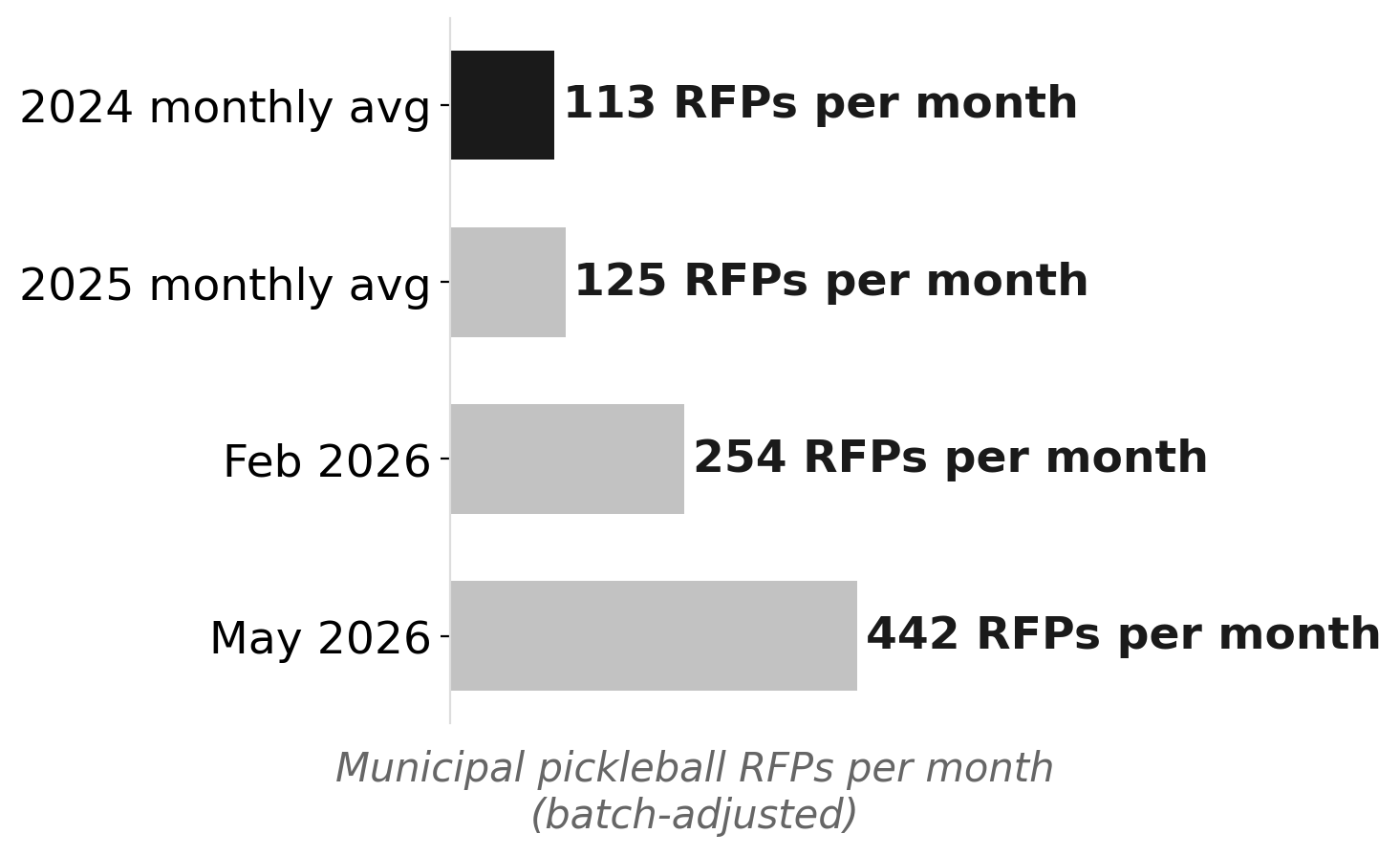
The timing inversion is worth pausing on. Court growth across the 100 most populous U.S. cities slowed to just 4% in 2026, down from 13% in 2025. The big-city build-out is maturing. What is accelerating is the smaller-municipality catch-up: townships, boroughs, and county parks departments that spent 2022 and 2023 documenting surging court demand and are now, in their first full FY2026 capital planning cycle, actually spending the money. Batch-adjusted monthly RFP counts reached 254 in February 2026 and 442 in May, both roughly two to three times the prior-year monthly baseline of 100 to 133. The spring peak reflects when most municipal capital improvement plans move from approved budget to active procurement.
No single program is driving this. What several independent funding streams share is a timing coincidence: their FY2026 disbursement windows land simultaneously on local procurement calendars. In New Jersey, which leads all states with 40 procuring institutions in the trailing period, two separate state programs are at work. The Local Recreation Improvement Grant, administered by the Department of Community Affairs, has been delivering five- and six-figure awards to townships for court construction and resurfacing. The Green Acres Program, a competitive grant run by the Department of Environmental Protection with awards up to $1 million, targets open-space acquisition and development on a separate application cycle. Both trigger RFPs, but through distinct processes with different deadlines and administrators. South Brunswick received a $500,000 legislative district grant for tennis and pickleball courts at Woodlot Park in September 2026. Burlington County separately distributed $5 million across 40 municipalities through its open-space preservation tax levy. These are not coordinated; they are parallel.
Source: NationGraph.
Georgia tells the same story through a different mechanism. Walton County approved 12 SPLOST-funded pickleball courts at Meridian Park in early 2026, with the city of Loganville contributing up to $200,000 from its own budget. SPLOST is a locally voted special-purpose sales tax with no administrative connection to New Jersey's programs. The federal Land and Water Conservation Fund, distributed through state agencies as matching grants for outdoor recreation development, adds another layer in states including New Jersey and California. The Naperville Park District in Illinois budgeted $14 million in total FY2026 capital spending; Melrose, Massachusetts allocated $125,000 from a local override for court renovation. Each of these is its own decision, made by its own elected body, on its own timeline.
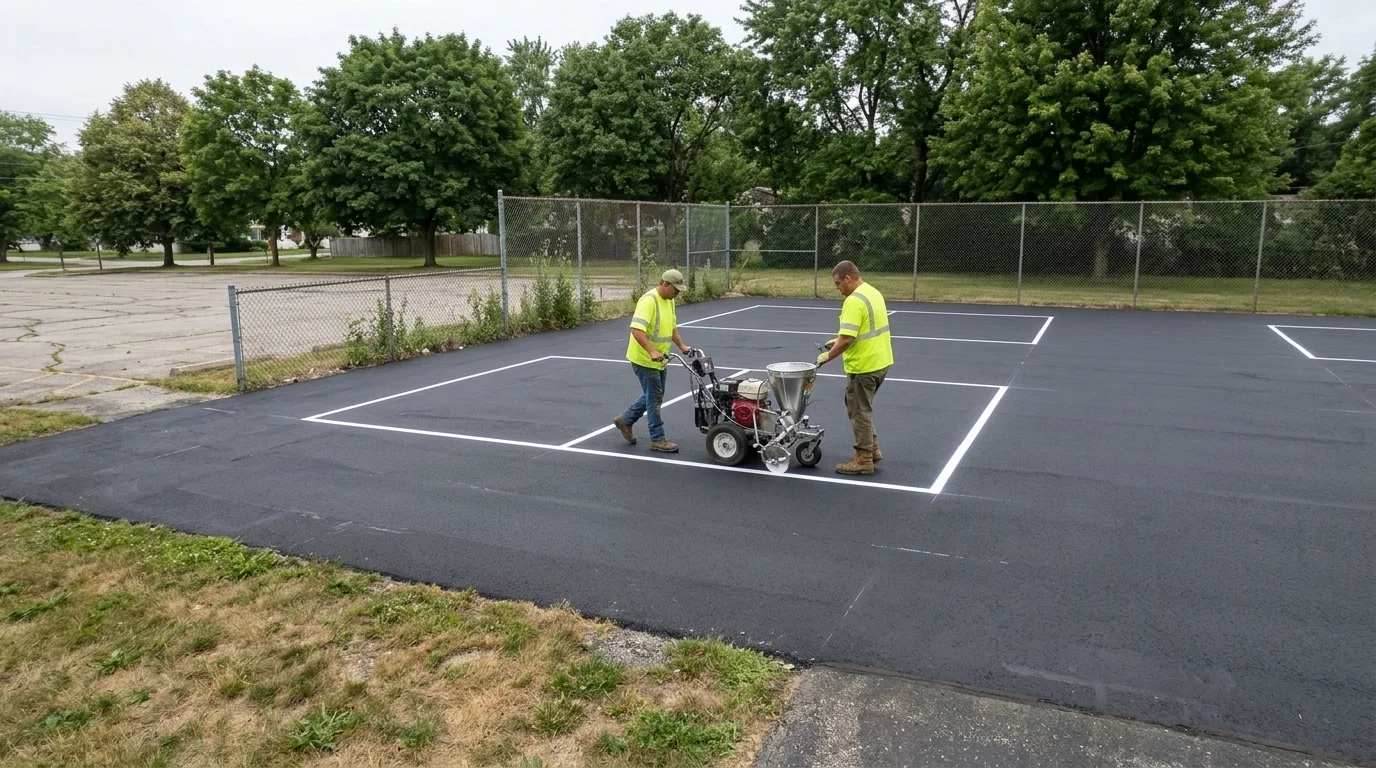
The 157 municipal and county governments that account for the bulk of the organic RFP count are overwhelmingly commissioning outdoor, publicly accessible courts: resurfacing aging asphalt, converting underused tennis courts, adding dedicated pickleball lines to multi-use facilities. This is a different market than the indoor commercial facility boom, which has seen more than 1,200 new venues open nationally over two years, pushing that private market past $3 billion. Industry analysts are already flagging overbuilding risk in that segment. The public-sector wave faces a different constraint: it is bounded by grant cycles and CIP allocations, not investor appetite. When the FY2026 money is spent, municipalities will need to document demand again before FY2027 budgets unlock the next round.
That cycle sets up a clear signal to watch. The spring 2026 RFP peak, 442 procurements in May, likely represents the high-water mark of the current cycle. The rolling average had settled back toward 117 to 127 by late summer and fall. If FY2027 capital budgets and state grant rounds, particularly New Jersey's LRIG and Green Acres programs with their February application deadlines, produce a comparable spring cluster, it will confirm that this is a durable two-to-three-times-elevated baseline rather than a one-cycle flush. USA Pickleball counts more than 82,600 known court locations nationally as of its 2025 Annual Growth Report; whether that number grows meaningfully in 2027 will depend less on whether Americans are still enthusiastic about the sport than on whether parks directors can get matching funds approved before the fiscal year closes.