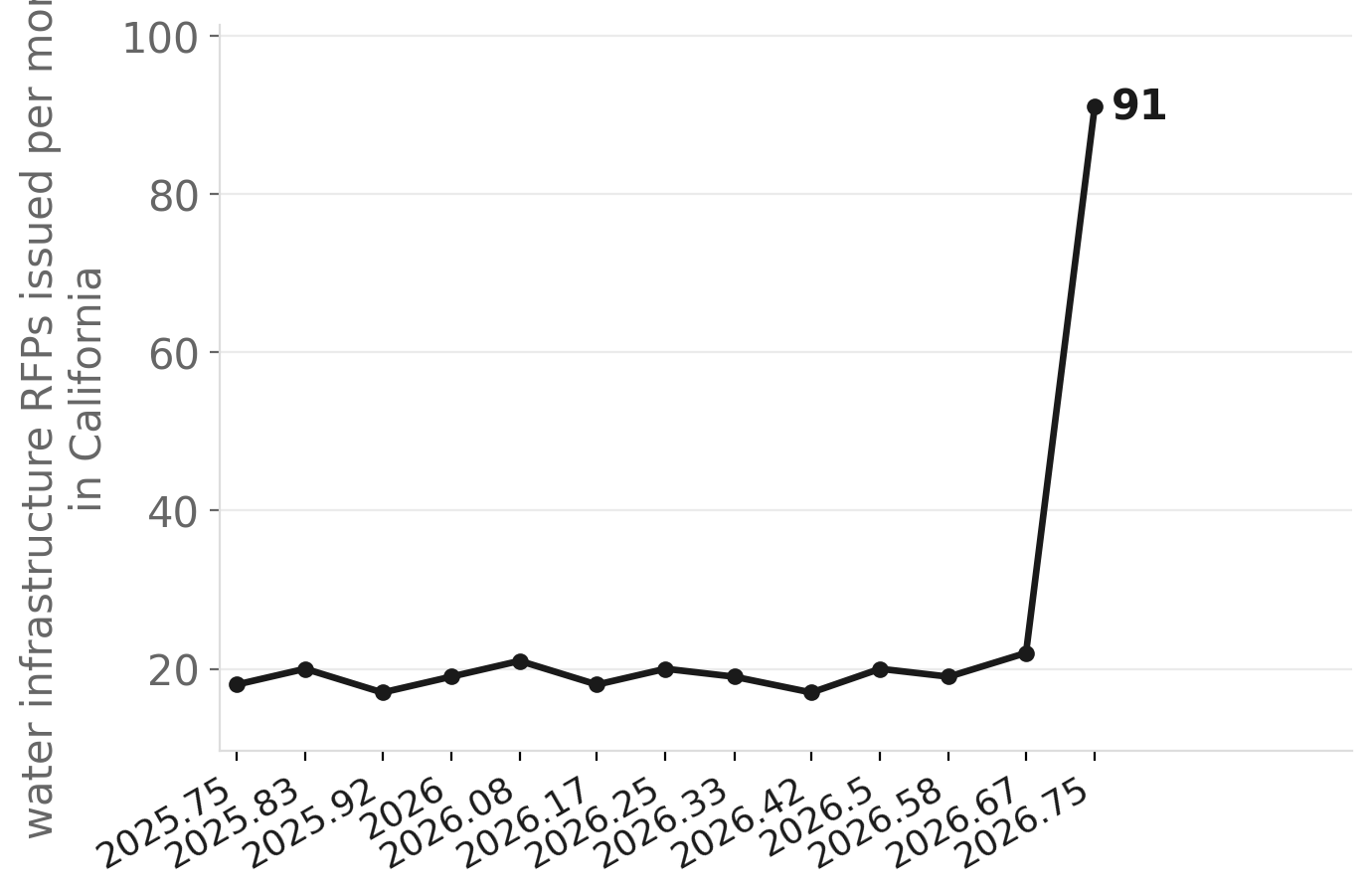
California water agencies have issued 94 requests for proposals in the past 30 days, against a trailing 13-month average of roughly 19 per month, a nearly fivefold spike that has no close parallel in Florida (63), Texas (54), Washington (44), or New York (38). The surge is not concentrated in one region: Sacramento leads with 7 RFPs, but Orange County cities, San Diego, Sonoma, and the Bay Area are all active. Three separate federal funding signals, firing in rapid succession, appear to be driving it.
The first signal arrived on March 17, 2026, when the Department of the Interior announced $889 million for Western water infrastructure through the One Big Beautiful Bill Act, with $540 million earmarked for California. The money is already appropriated and flowing to named Bureau of Reclamation projects: $235 million for the Delta-Mendota Canal, $200 million for the Friant-Kern Canal, $50 million for the San Luis Canal, and $15 million for a Tehama-Colusa Canal pumping plant upgrade. For Central Valley agriculture and the communities that depend on it, this is enacted federal spending, not a promise.
The second signal is still in motion, which is precisely why it's moving procurement desks. The Water Resources Development Act of 2026 (H.R. 9497) passed the full House 415-9 on September 16, after clearing both the House Transportation and Infrastructure Committee (66-0) and the Senate Environment and Public Works Committee unanimously in July. WRDA 2026 contains named earmarks for dozens of California cities, Encinitas ($44.25M), La Cañada Flintridge ($29M), Atascadero, Burbank, and Irvine ($20M each) among them, and authorizes $14 billion for the Clean Water State Revolving Fund and $16.5 billion for the Drinking Water SRF nationally. A critical distinction: WRDA is an authorization bill, not an appropriations bill. The city-level earmarks give Congress and local sponsors legal authority to pursue Army Corps projects, but actual dollars don't flow until a separate appropriations act is passed. The Senate floor vote is still pending. Local agencies understand this, and they are procuring anyway, because projects without procurement documents in hand cannot absorb appropriations when they arrive.
Source: NationGraph.
The October RFP explosion tracks almost directly to the September 16 House vote. The lesson agencies took from prior WRDA cycles is that the window between authorization and appropriation is narrow, competitive, and penalizes late movers. California's 52-seat congressional delegation secured more city-level earmarks than any other state, which means the competition to be shovel-ready is playing out on an unusually wide front.
The third mechanism is quieter but creates its own deadline pressure. California holds $1.96 billion in active, EPA-obligated water infrastructure grants across 124 projects, yet only $132 million of that has been outlayed so far. According to a Smart Cities Dive analysis of local water projects, this gap between obligation and outlay reflects a procurement backlog, not a shortage of money. Agencies sitting on committed but unspent EPA grants face their own internal timelines: grant periods expire, and money that isn't drawn down on schedule can be recaptured. The RFP surge is, in part, agencies working through that backlog simultaneously.
Overlaying all three signals is California's structural position as a water-stressed state. The Sacramento River basin supplies roughly 30 million people, the Central Valley's canal system is aging, and prolonged drought cycles have kept federal water money politically viable across party lines in Sacramento and Washington alike. The Sacramento River Basin also received a separate $155 million USACE authorization on July 1, covering nine Central Valley counties, adding another procurement trigger for agencies in that corridor.
For residents and ratepayers, the practical consequence is a construction pipeline that is about to get very crowded. When multiple agencies in overlapping labor markets procure simultaneously, contractor capacity tightens and bid prices rise. Agencies that file RFPs now, while the contractor market is still absorbing the new volume, have a structural advantage over those that wait for Senate passage to begin.
What to watch next: the Senate floor vote on WRDA 2026. If the bill clears the Senate and moves to conference without significant changes to the California earmarks, the appropriations ask becomes the next fight, and agencies with completed procurement and ready contractor relationships will be positioned to spend first. If the Senate restructures the earmark list or delays past the end of the legislative calendar, some of this October procurement activity will have gotten ahead of funding that doesn't materialize on the expected schedule. The RFP count will tell that story before any press release does.