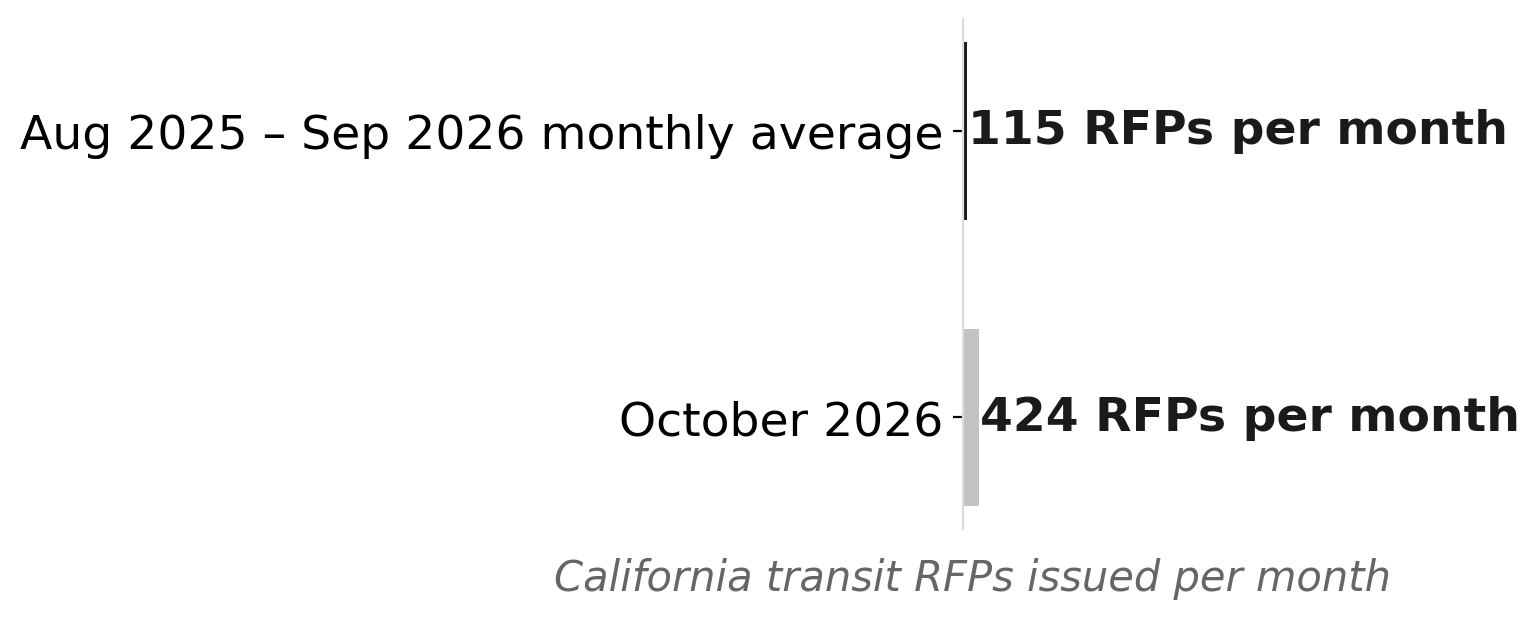
California transit agencies issued 424 requests for proposals in October 2026, the highest single-month total in at least 15 months and 3.7 times the trailing average of roughly 115 per month. The agencies doing the buying stretch from Monterey to Bakersfield to Norwalk, and they are not acting in concert. They are responding to two separate clocks that happen to be running out at the same time.
One clock is in the Bay Area. The other is in Los Angeles. Together they have produced a procurement surge unlike anything in recent California transit history.
The Bay Area pressure traces directly to SB 63, the Connect Bay Area Act, signed by Governor Newsom on October 13, 2025. The law authorizes a 14-year local sales tax measure across Alameda, Contra Costa, San Francisco, San Mateo, and Santa Clara counties, projected to raise roughly $1 billion per year. But the measure has to pass at the ballot box in November 2026, and voters will be deciding whether to tax themselves to fund agencies many of them consider unreliable. Transit operators read the politics clearly: the surest way to lose that vote is to appear unprepared. Contracts for planning studies, scheduling software, CAD/AVL systems, and facility upgrades are not just operational needs right now. They are campaign materials.
Source: NationGraph.
The financial stakes behind that political calculation are severe. BART, Muni, Caltrain, and AC Transit collectively face an annual deficit exceeding $700 million once pandemic-era federal relief expires at the close of fiscal year 2026. Newsom signed a $590 million state emergency loan in February 2026 to bridge those agencies through the ballot cycle, but the loan is exactly that: a bridge. If the November 2026 measure fails, there is no obvious backstop. Agencies are procuring now partly because the loan gives them the cash to do so, and partly because a procurement backlog that stretches past Election Day would be politically toxic.
The Southern California pressure runs on a different mechanism and a different timeline. LA Metro's board documents identify October 2026 as the required start of what they call an "aggressive procurement" phase for Olympics-related services, with a firm target of executing ferry and transit operator contracts by July 2027. The LA28 organizing committee is separately soliciting bids for a 2,000- to 3,000-bus Games transportation network. That is not a soft deadline. Operators that miss the July 2027 contract window will not be running buses during the Games.
The funding picture for the Olympic side is considerably thinner than for the Bay Area. California's congressional delegation, led by Rep. Sydney Kamlager-Dove, sent a letter to Transportation Secretary Sean Duffy in March 2026 requesting $2 billion in federal FY2027 transit funding for LA28 mobilization, calling it the "final opportunity" for timely federal investment. State lawmakers, for their part, approved roughly 5% of the requested LA28 transportation funding as of September 2026. That gap between the ask and the appropriation is part of what is driving local agencies to move on procurement without waiting for state or federal authorization: they cannot afford to wait for money that may not arrive.
These are four distinct levers pulling simultaneously. SB 63 is a local sales tax ballot authorization, not an appropriation of any kind. The $590 million emergency loan is a state appropriation specifically bridging Bay Area agencies to that vote. The $7.7 billion active federal DOT transit grant portfolio spread across 446 California grants is a separate federal stream funding capital projects statewide, not contingent on SB 63's outcome. And the Olympic procurement pressure is a deadline-driven operational need without a dedicated funding source attached to it. They share a calendar coincidence, not a coordinating authority.
The geographic spread of October's RFP issuers makes clear this is not a Bay Area phenomenon or an LA phenomenon. Monterey-Salinas Transit, Golden Empire Transit District in Bakersfield, Foothill Transit in the San Gabriel Valley, and agencies in Torrance and Santa Monica all appear in the top issuer counts. Project types range from short-range transit plans and electric vehicle charging infrastructure to next-generation maintenance facilities and regional fixed-route service contracts. The simultaneity reflects how California's fractured transit funding model, dozens of independent operators each managing their own fiscal cliffs, responds when multiple external deadlines arrive in the same quarter.
The next visible signal to watch is November 2026 itself. If Bay Area voters approve the SB 63 measure, the agencies that have spent the past several months procuring system upgrades and planning studies will have the long-term revenue to pay for what they ordered. If the measure fails, the $590 million state loan will have partially funded a procurement wave with no follow-on funding source. On the Olympic side, the July 2027 contract execution deadline is fixed. Agencies that have not locked in agreements by then will be watching the Games from the sideline.