Federal mental health grants newly awarded to Ohio have reached $60.7 million in the last 90 days, up 86% from $32.7 million in the same window a year ago. The state is outpacing every neighbor by at least two to one: Pennsylvania received $27.6 million in the same period, Michigan $25.9 million, Indiana $21.1 million. The surge is real, it is large, and it is arriving at precisely the moment Washington is proposing to dismantle the programs producing it.
Two forces are driving the spike. The first is a structural one: SAMHSA awarded Ohio a $100.2 million State Opioid and Stimulant Response (SOS) 4.0 grant to the Ohio Department of Behavioral Health on September 30, 2024, the latest in a chain that stretches back through $97 million in FFY2023 and $100 million in FFY2024. Sub-grants under SOS 4.0 are now flowing to ADAMH boards statewide through active 2026 RFAs, including Project AMP and the WISE Initiative. That pipeline accounts for a sustained floor of HHS commitments visible in the 90-day window. The second force is sharper: a single HUD Continuum of Care renewal to Cincinnati-area nonprofit Strategies to End Homelessness jumped from $2.09 million in FY2025 to $31.2 million in the FY2026 cycle beginning July 1, a 14.9-fold increase in one year. That single award accounts for roughly half the year-over-year headline increase and reflects a broader federal push to reclassify homeless-services funding as behavioral health integration spending.
Strip out the HUD outlier and the remaining HHS-only new commitments still approach $29.5 million for the quarter. Ohio State University received $7.8 million across several programs, including dedicated Mental Health Research Grants. Case Western Reserve collected $7.4 million across drug addiction and aging-related research. The Cleveland Clinic and Case Western together added another $1.6 million. The full active federal mental health portfolio in Ohio now stands at 211 grants, $472.7 million obligated, and $202 million already disbursed.
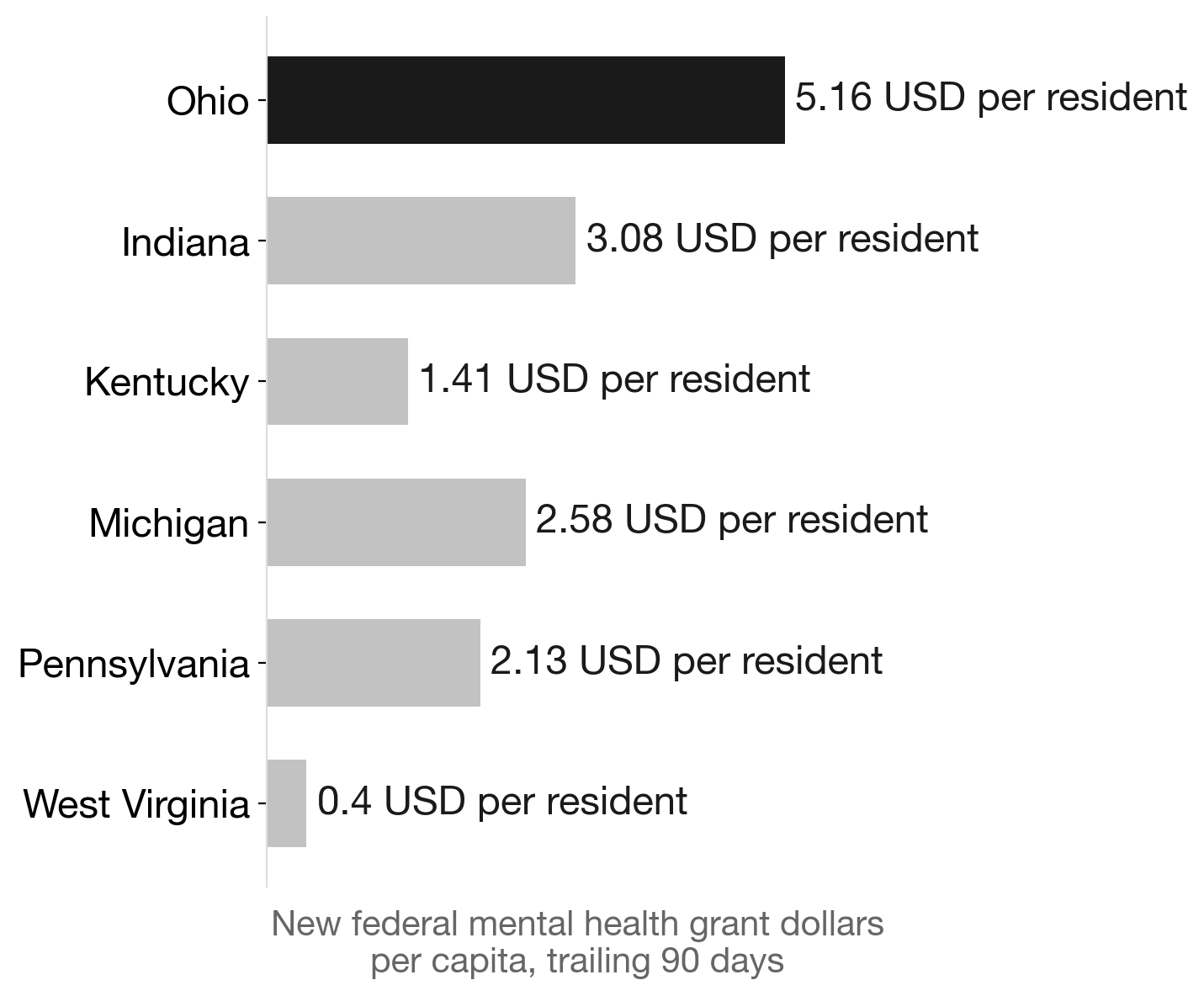
Source: NationGraph.
The state's behavioral health system has been built, deliberately, to absorb this kind of federal investment. Ohio's network of ADAMH boards is structurally dependent on federal pass-through dollars, and the state's H.B. 96 budget for the newly rebranded Ohio Department of Behavioral Health (formerly OhioMHAS, renamed October 2025) appropriated $1.23 billion for FY2026, with federal funds comprising 29% of the total and a $170 million annual State Opioid Response federal line item baked in. As the Community Solutions analysis of behavioral health funding in Ohio makes clear, that dependency is not incidental. It is structural.
The paradox is this: Ohio is cashing checks at a record pace from a federal government that is simultaneously proposing more than $1.1 billion in additional SAMHSA cuts and the elimination of 42 programs, including the Certified Community Behavioral Health Clinic grants that support local providers directly. DOGE-directed cuts have already halted $1 billion in Education Department mental health spending for children nationwide. And Ohio has already felt a preview of what disruption looks like: in February 2026, SAMHSA funding was abruptly frozen before being reinstated, throwing mental health and suicide prevention organizations into brief turmoil. The Ohio Suicide Prevention Foundation's CEO stated publicly at the time that the state loses five people a day to suicide. The state's opioid death toll gives that number its full weight: from 2013 to 2019, the need for behavioral health treatment in Ohio grew 353%.
For Ohioans, the immediate picture is one of a system receiving more federal support than at any comparable recent window. Sub-grant RFAs are open, providers are applying, and ADAMH boards are distributing dollars. But the architecture underneath that activity, the SAMHSA formula grants, the CCBHC program, the State Opioid Response line, is exactly what the proposed federal FY2026 budget targets. Ohio's $1.23 billion DBH budget assumes those lines hold.
The next signal to watch is the federal appropriations process. If the proposed SAMHSA cuts advance through reconciliation, Ohio's ADAMH boards will face a gap between the commitments they are making today, under active SOS 4.0 sub-grant awards, and the federal revenue they can count on in FY2027 and beyond. The current 90-day surge is genuine. Whether it represents a new baseline or a final draw-down before a structural retrenchment is a question the state budget office will be answering within the year.