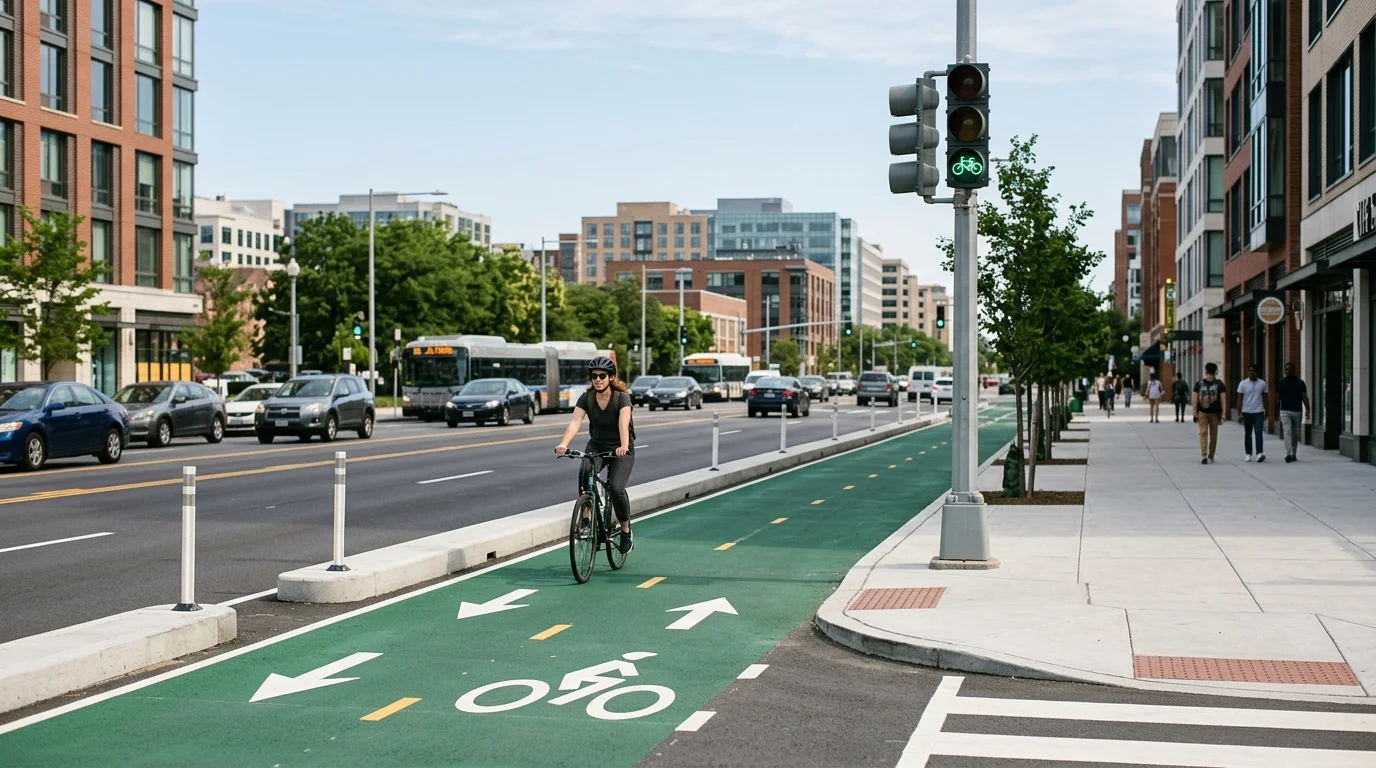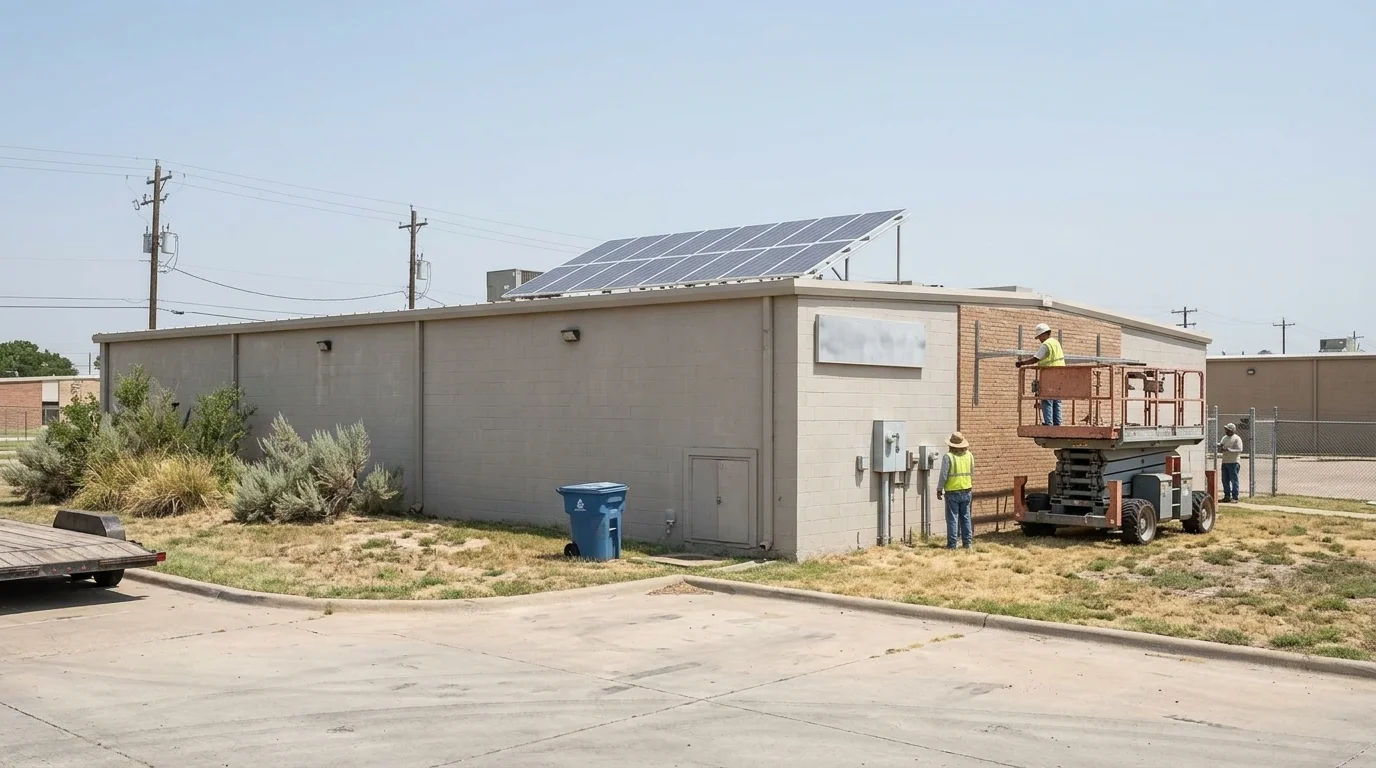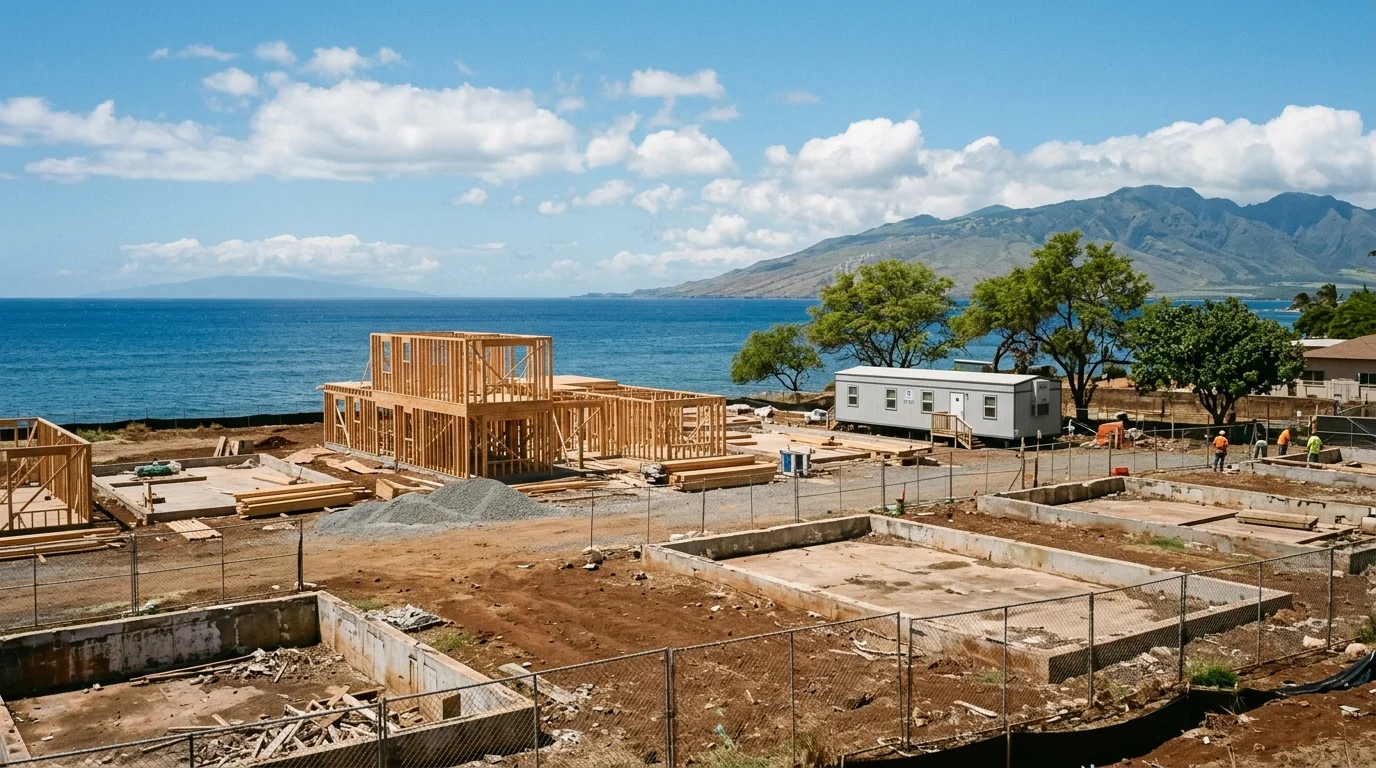
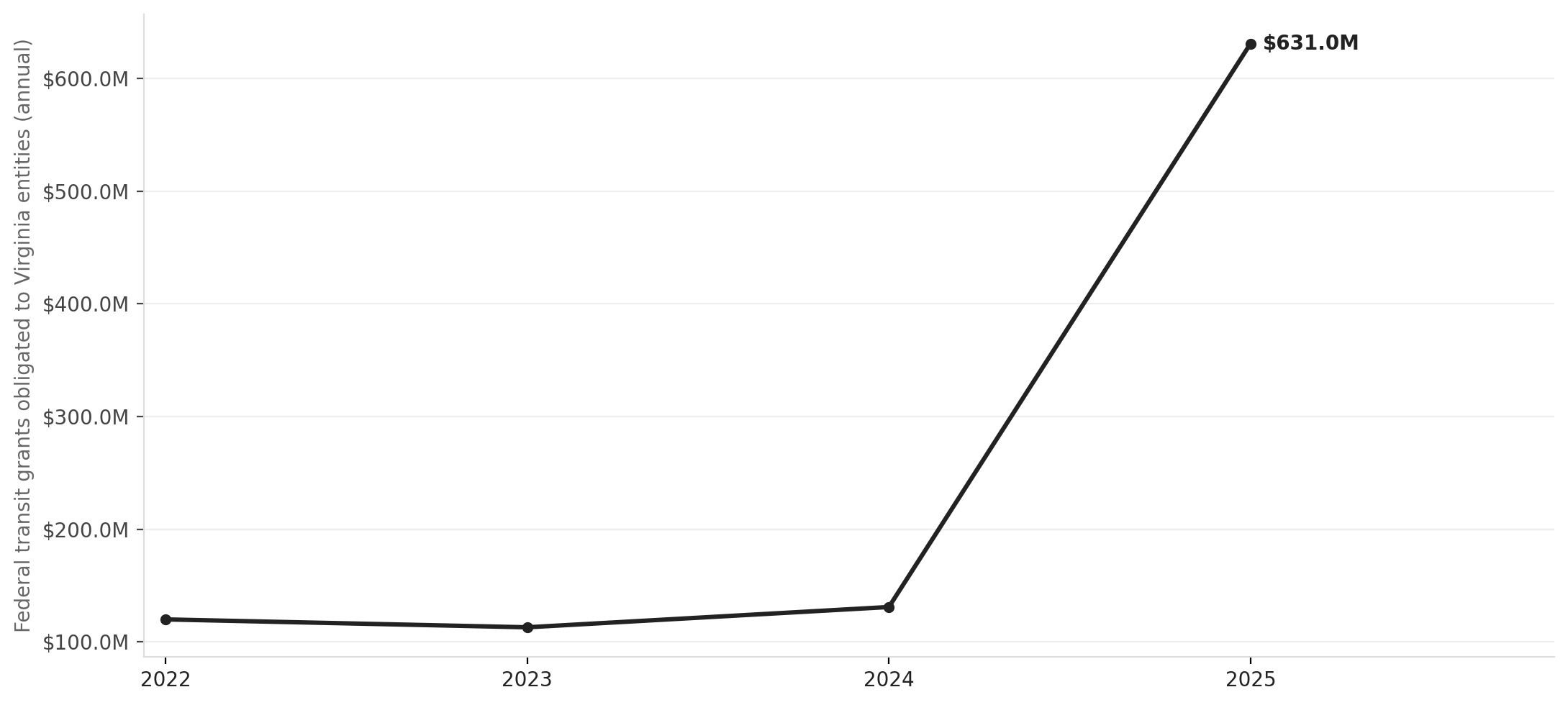
Virginia's transit agencies pulled in $631 million in newly obligated federal grants starting in 2025, nearly five times the $131 million they received in 2024 and the $113 million in 2023. The money is real, the projects are real, and the construction timelines are running. What Virginia does not have is a state plan to pay the operating costs once the work is done.
The core of the federal windfall came from two programs seeded by the Bipartisan Infrastructure Law. A $313 million EPA Clean Ports award went to the Commonwealth directly. Fairfax County landed a $50.6 million Low or No Emission bus grant. Hampton Roads Transit received $25 million for bus facilities and another $19.8 million in state-of-good-repair funds. Hampton Roads Transit and the Potomac and Rappahannock Transportation Commission together now carry more than $155 million in active FTA formula and facilities grants running through 2028 and 2030. Virginia's own six-year improvement plan commits $5.3 billion to transit between FY2026 and FY2031, with $1.249 billion targeted in FY2026 alone.
That capital picture looks nothing like the operating picture. The 2026 Virginia General Assembly session ended March 14 without passing HB 1179 (Del. Kathy Tran) or SB 730 (Sen. Scott Surovell), the two bills that would have created new regional revenue sources to close the roughly $400 million annual funding gap for WMATA, VRE, and Northern Virginia bus systems. The proposed mechanisms were a sales tax surcharge, a transportation network company fee, and a retail delivery tax. All three died in a session that also ended, remarkably, without a new two-year state budget. A special session was still running as of June 2026.
Source: NationGraph.
As Virginia Mercury reported in November 2025, the bills had cleared key committee hurdles with unusual bipartisan momentum, backed by the DMVMoves task force and regional county boards across Northern Virginia. The Arlington County Board formally joined the push in December. None of that translated into enacted law.
The structural problem runs deeper than one failed bill. Virginia caps its annual operating assistance growth to WMATA at 3 percent, a legislative artifact that has slowly decoupled state funding from Metro's actual cost trajectory. DRPT director Tiffany Robinson has noted that Virginia taxpayers already send nearly $800 million to WMATA annually in FY2026 before any proposed increases. The combined $460 million annual capital commitment from Virginia, Maryland, and the District has also lost purchasing power to inflation, a point the DMVMoves task force acknowledged when it approved a new capital package in October 2025 that still requires enabling legislation in all three jurisdictions. WMATA's 1970s-era rail signaling system, one of the largest single items in Metro's capital backlog, remains in the queue.
BikeWalkRVA director Brantley Tyndall put the federal uncertainty plainly, calling it "probably the biggest change to transportation development for 2026" in terms of how agencies are planning. That uncertainty compounds the state-level gap: agencies are now managing a federal capital pipeline that is larger than at any point in the last decade while the state's own governance structure has not resolved how to fund the systems those projects will serve.
The paradox runs through every corner of the state's transit map. Fairfax County has $50 million in new federal bus money to deploy. Hampton Roads Transit is executing a facilities modernization with FTA funds. The Charlottesville and Williamsburg systems are processing years of deferred procurement records as they get their administrative houses in order. Meanwhile, WMATA's 2.1 million weekly riders in Northern Virginia depend on a system whose next operating budget is being negotiated without the dedicated funding stream the legislature was supposed to create.
The immediate signal to watch is the special budget session. If the General Assembly adopts a two-year budget that includes even a partial transit funding mechanism, it would change the operating calculus for every agency now sitting on a federal capital award. If the session closes without one, agencies face the prospect of completing federally funded capital projects while the state operating assistance formula remains frozen at its 3 percent growth cap.
A second signal is whether the transit funding bills return in the 2027 session with enough structural modification to move through a legislature that, under Democratic majorities and a Democratic governor, still could not get them across the line in 2026.