Oregon public agencies have issued 13 solar procurement requests in the last 30 days, three times the trailing monthly average of 4.2, the highest single-month volume in at least three years, and the window driving that urgency closes on July 4, 2026.
That deadline is not a metaphor. Under H.R. 1, the federal budget reconciliation bill that curtailed the Investment Tax Credit and Production Tax Credit, any solar project that does not break ground by July 4 loses access to incentives worth up to 30 percent of project cost. For a $5 million municipal solar-plus-storage system, that gap is $1.5 million the issuing agency cannot recover. Projects missing the construction-start deadline have a secondary exit, they can still qualify if they are fully in service by December 31, 2027, but that window is narrower and the financing math changes substantially.
The RFP surge did not build gradually. Ten of the 13 requests were issued in May alone, a near-vertical spike after a flat winter in which Oregon averaged two to three solar solicitations per month. The timing aligns precisely with two overlapping policy triggers that arrived within weeks of each other.
Source: NationGraph.
The first is federal: the July 4 construction-start deadline created by H.R. 1, which accelerated the expiration of clean-energy tax incentives by nearly a decade. The second is state: Governor Tina Kotek signed HB 4031 on March 17, 2026, with the law taking effect June 5. HB 4031 allows large solar and wind developers to bypass Oregon's Energy Facility Siting Council, a review process that can take up to three years, and seek county-level land-use approvals instead, provided the project qualifies for a federal tax credit. Angela Crowley Koch, executive director of the Oregon Solar and Storage Industries Association, had warned publicly that EFSC timelines were already preventing some projects from meeting federal deadlines. HB 4031 was written specifically to close that gap.
Kotek had also issued Executive Order 25-25 in October 2025 directing state agencies to accelerate renewable permitting, followed by EO 25-29 in November broadening that mandate. By the time HB 4031 took effect in early June, three separate policy levers, two executive orders, a new state law, and a federal cliff edge, had all activated within eight months of each other.
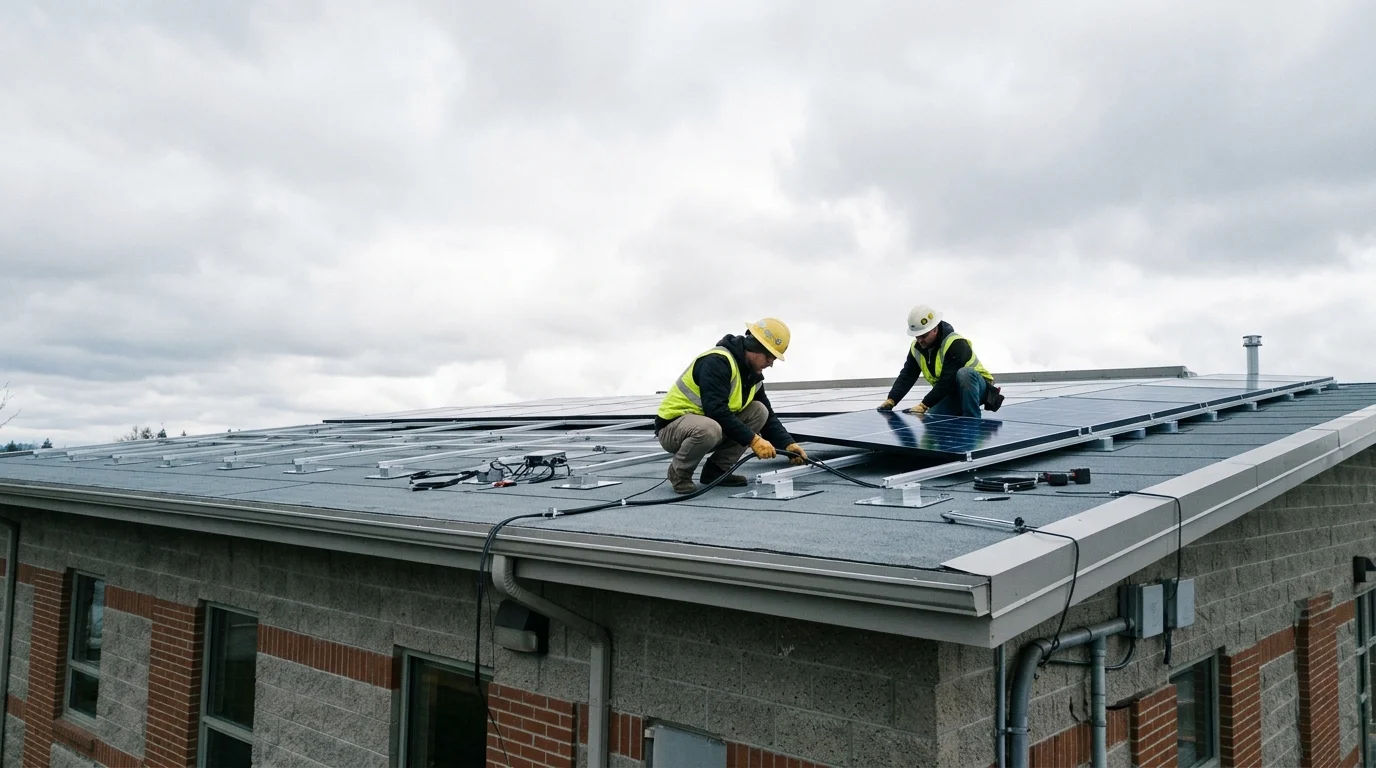
The issuers reflect that pressure across the full institutional spectrum. Jackson County Fire District is procuring a solar-plus-battery-storage design-build. Portland State University issued a solicitation for a residential housing solar system. Silver Falls Library District put out a photovoltaic and energy-storage project. Klamath County, the City of Forest Grove, and Oregon DOT all have active solicitations. The City of Eugene's community renewable energy solar-plus-storage RFP has been issued three times in 90 days, a reissuance cadence that signals active repricing as project costs shift under deadline pressure. The geographic spread, Marion, Washington, Lane, Jackson, Josephine, and Klamath counties, eliminates any single local explanation and points directly to the statewide policy environment.
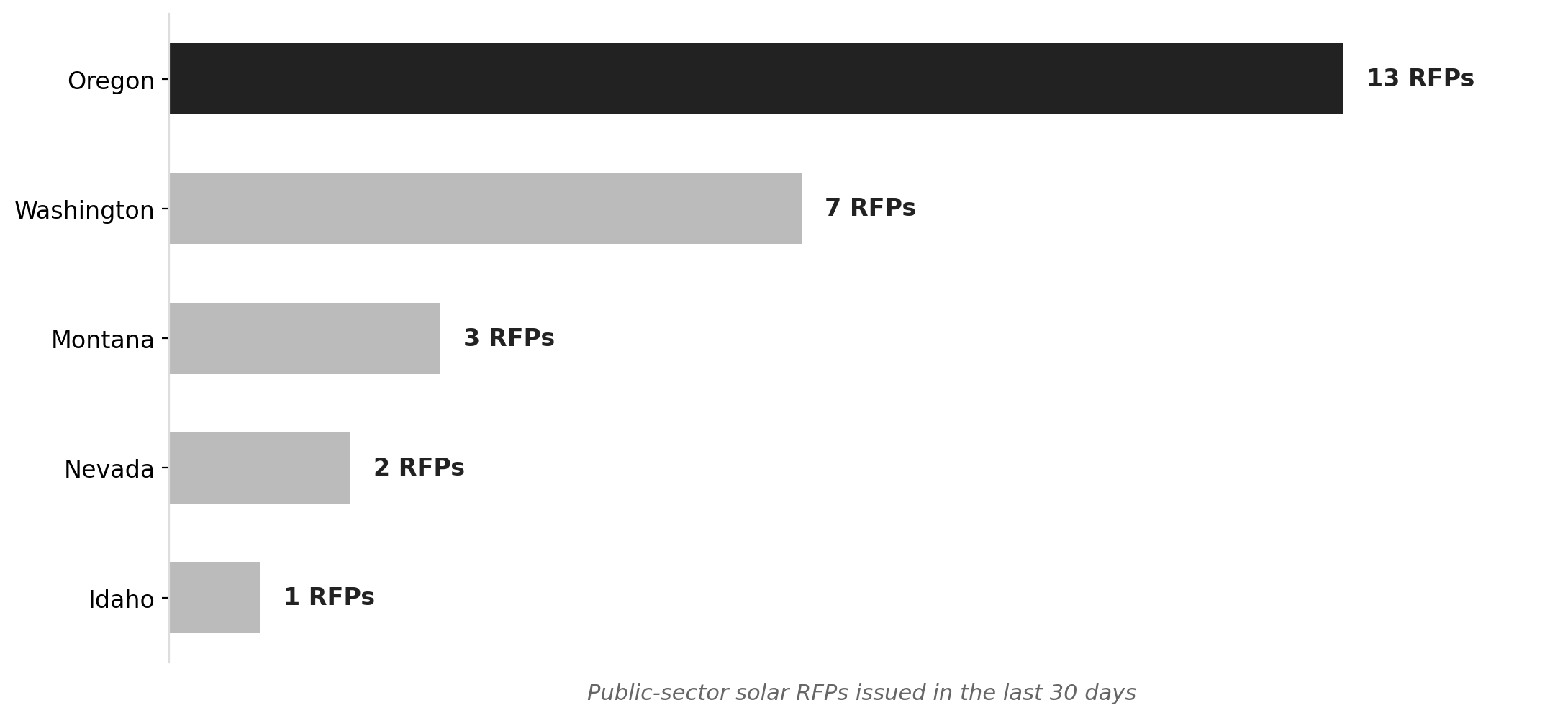
Oregon also leads neighboring states by a significant margin. Washington issued seven solar RFPs in the same 30-day window; Montana issued three; Nevada two; Idaho one. California leads the region at 122, but California's procurement base is an order of magnitude larger. Among Pacific Northwest states, Oregon's current pace is an outlier.
The Oregon Department of Energy's Solar and Storage Rebate Program, which offers up to $5,000 for solar installations and $2,500 for storage, issued final rules in April 2026 and is reopening reservation windows, adding a secondary procurement incentive for municipalities that may not meet the federal threshold but still want to capture state dollars. A parallel consumer protection law, HB 4029, which took effect June 5 alongside HB 4031, imposes new contractor disclosure and licensing standards, adding compliance preparation costs that make early procurement more attractive than waiting.
One chokepoint remains unaddressed by any of these measures. The Bonneville Power Administration controls roughly three-quarters of the Pacific Northwest transmission grid, and BPA's interconnection queue already has hundreds of projects waiting years for approval. HB 4031 streamlines land-use permitting at the county level; it does not touch BPA timelines. An agency that breaks ground by July 4 to preserve its federal tax credit could still wait years before its project delivers power to the grid. That gap between procurement urgency and grid readiness is the next policy problem Oregon will have to solve, and the RFP data suggests the gap will be measured in megawatts.
For agencies still considering a solicitation, the practical deadline is now. Construction must begin, not complete, but begin, by July 4. That leaves weeks, not months, to award a contract, mobilize a contractor, and move a shovel. The agencies already in the market understood that arithmetic before most observers did. Whether the projects that follow can actually connect to the grid is a question for the fall.